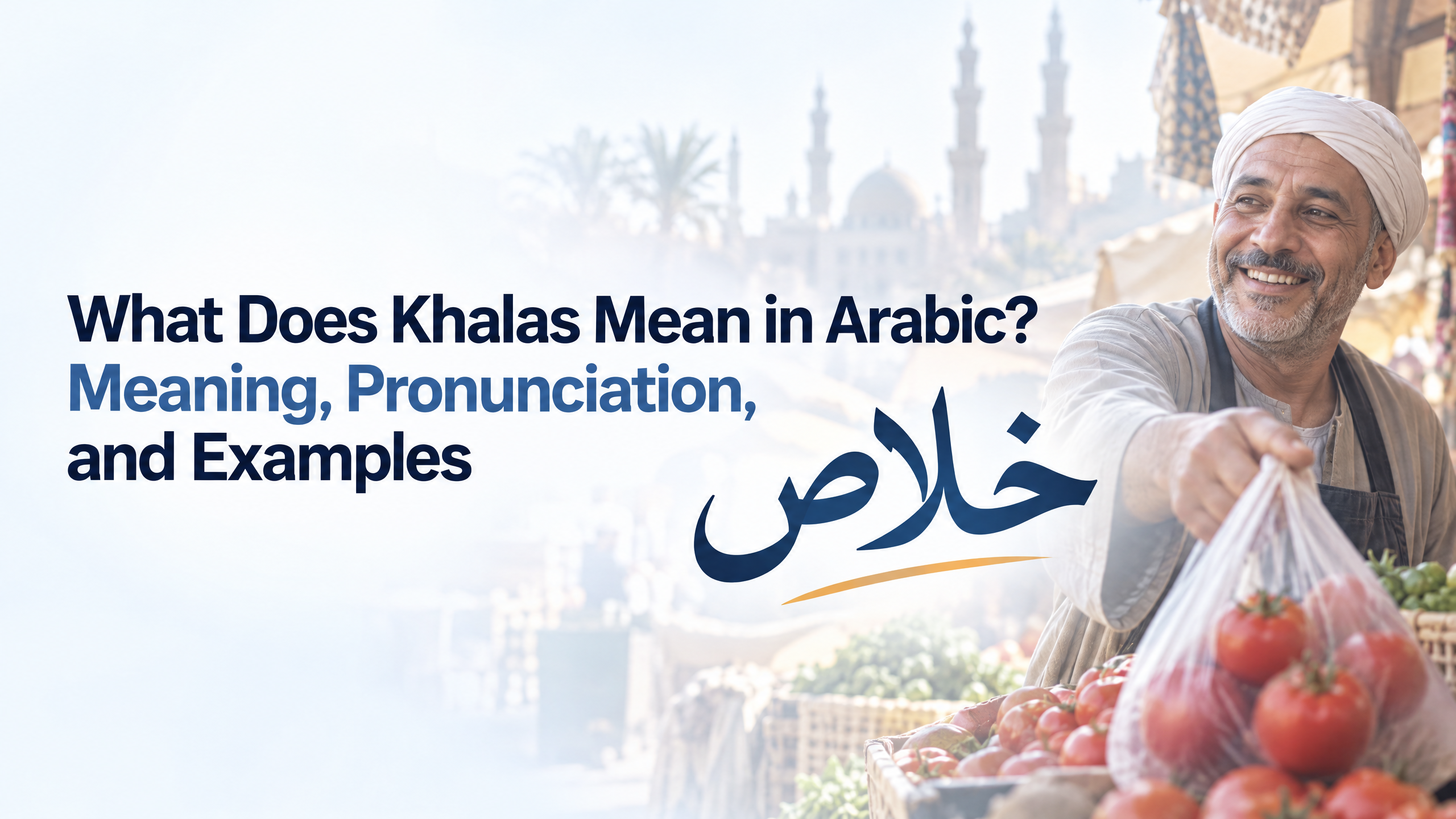
Picture a busy market in Cairo. You ask for some tomatoes, and the seller keeps piling them into your bag. You lift your hand and say “khalas.” He laughs, ties the bag, and hands it to you. That’s all it took.
So what does khalas mean in Arabic? Most of the time, khalas (خلاص) means “enough,” “stop,” or “done.” Arabs say it many times a day, at home, at work, and on the street, whenever something has come to an end.
There’s more to this little word than a quick translation, though. Where it comes from, how you say it, and even your tone of voice can change what it means. And if you’ve ever mixed it up with bas or kifaya, you’re not alone. We’ll clear that up too.
What You’ll Learn in This Article
- The everyday meanings of khalas, with real examples.
- The old Arabic root behind the word.
- How to say the two hard sounds in khalas.
- How to spell it in Arabic letters, English letters, and chat.
- When to use khalas, bas, or kifaya.
What Does Khalas mean in Arabic?
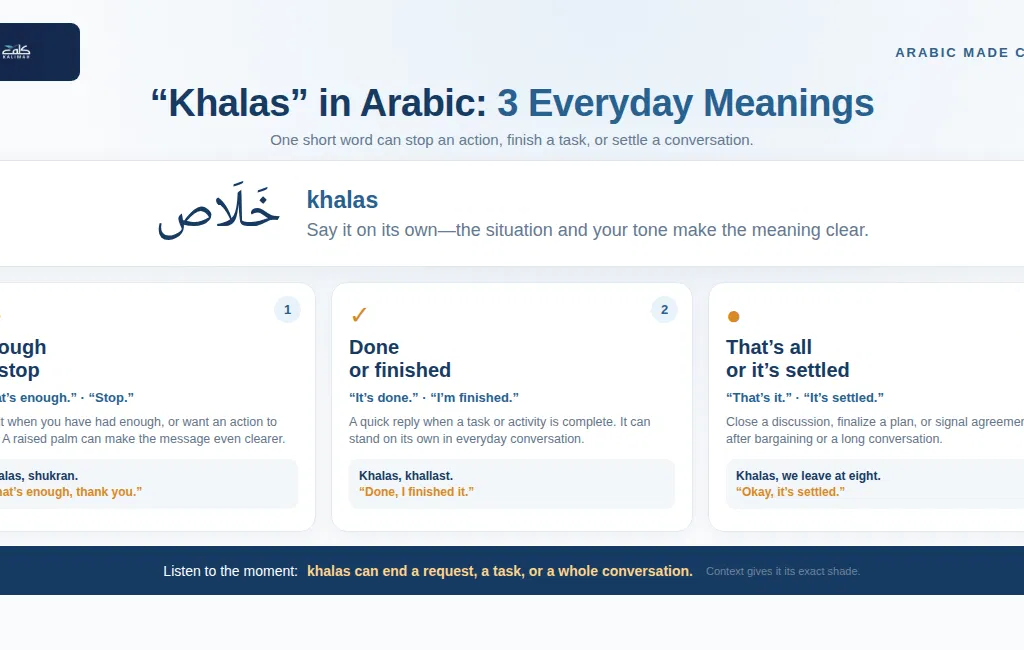
Khalas is a spoken Arabic word that tells people something is over. What ends can change from moment to moment. It might be an action, a job, an amount of food, or an argument. The three groups below cover the ways you will hear it most.
Khalas Means “Enough” or “Stop”
The most common use of khalas is asking someone to stop. A mother says it to two kids fighting over a toy. A friend says it when a joke has gone on too long. You can say it all by itself, and people will understand you right away.
It also works for amounts. When someone pours you more tea or piles more rice on your plate, you say khalas once you have enough. A polite guest often says “khalas, shukran,” which means “that’s enough, thank you.”
Shoppers use it all the time. As wikiHow explains, a customer might say it to a shopkeeper to mean “that’s all I need.” If you plan to shop in Egypt, this Egyptian Arabic vocabulary guide gives you more words for the market.
One more tip: khalas is short and strong, so you don’t need extra words to make it clear. A raised palm while you say it makes the meaning even plainer.
Khalas Means “Done” or “Finished”
Khalas also tells people a task is complete. A mechanic hands you your keys and says “khalas.” That means your car is ready. A student shuts a notebook and says “khalas,” and everyone knows the homework is finished.
You will often hear it next to the verb for “finish.” “Khalas, khallast” means “Done, I finished it.” Some people say the word twice, “khalas, khalas,” to mean “Okay, okay, it’s done, you can stop asking.”
This use is great for beginners because it works as a full reply. When someone asks “Are you ready?” or “Did you finish?”, a calm “khalas” answers the question.
Kids pick up this word very fast because they hear it at home every day. If you want your child to go beyond home words and really read and speak Arabic, Kalimah Center’s Arabic course for kids teaches children with patient native teachers.
Khalas Means “That’s All” or “It’s Settled”
The third use closes a talk or makes a choice final. “Khalas, we leave at eight” means the plan is set and there is nothing more to discuss. After a long debate, one friend may sigh and say “khalas,” which means “fine, I agree.”
You will hear this a lot when people bargain. The buyer and seller go back and forth on the price. When one of them says “khalas,” the deal is done.
Parents use this meaning too. A child begs, “Please, please, please,” and the parent finally says “khalas.” That’s the end of it, and the answer won’t change. It shows how much one short word can do in Arabic: it can close a whole conversation in just two syllables.
Khalas in Formal Arabic: Salvation and Other Old Meanings
Before khalas meant “enough,” it meant being saved. In formal Arabic dictionaries like Almaany, its main meaning is escaping danger safely. In the past, people would congratulate a man on his khalās from death. In Christian Arabic, al-khalās means the salvation of the soul.
The old books list a few surprising meanings too. Khalās al-ajīr means a worker’s pay. The word can also mean something equal to another thing. An early judge named Shurayh once ruled that a man who broke a bow had to pay its khalās, meaning a bow just like it. In traditional medicine, the word refers to the placenta and cord that leave the body after birth.
Change one vowel, and you get a different word. Khilās (خِلاص), with an “i” sound, means gold or silver cleaned by fire, butter taken from ghee, or date syrup, as Arabdict shows.
Arabic writers often leave short vowels out. So readers have to work out the right word from the rest of the sentence.
Read also: What Does Yalla Mean in Arabic?
Where Does the Word Khalas Come From?
Khalas did not start out as slang. It is an old Arabic word with deep roots, and its first meaning was about being saved from danger.
The Arabic Root خ-ل-ص Behind Khalas
Most Arabic words grow from a root of three letters. Khalas comes from the root خ-ل-ص (kh-l-ṣ). This root carries the idea of being free, clean, or pure.
The verb from this root is خَلَصَ (khalaṣa). It means to escape safely, to become pure, or to reach the end of something. Khalās is the noun form of this verb, so its basic meaning is “getting free.”
That idea explains how people use the word today. When you finish a job, you are free of it. When an argument ends, everyone is free to move on.
Many other common words share this root. Ikhlās (إخلاص) means sincerity, and it gives its name to Surat al-Ikhlās. Khulāsa (خلاصة) means a summary, and khālis (خالص) means pure. Once you know the root, these words become much easier to remember.
Experience Kalimah Center Classes
Watch real excerpts from our live sessions at Kalimah Center and see how we bring learning to life. These clips highlight our interactive, student-centered teaching approach across all our courses—designed to keep learners engaged, motivated, and actively involved every step of the way.
Master Arabic with Kalimah Center
Join our expert-led online classes and start your journey toward Arabic fluency today.
Book Your Free TrialHow Do You Pronounce Khalas?
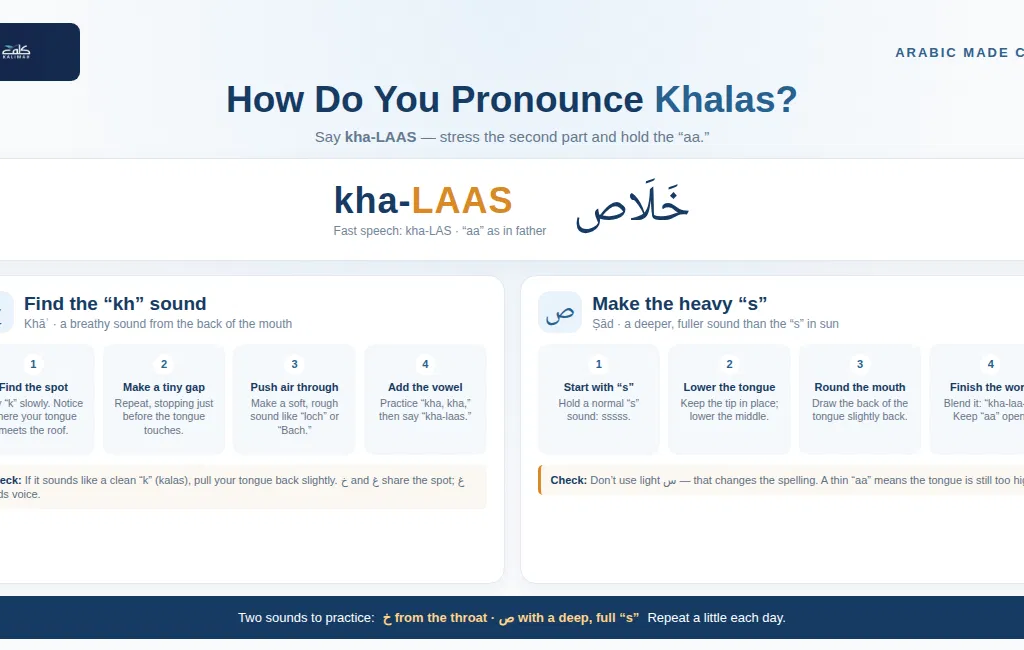
You say khalas as kha-LAAS, with the stress on the second part. When people talk fast, the long “aa” gets shorter, so you’ll often hear kha-LAS. Two of its sounds don’t exist in English, but with the steps below, you can get both right in a few days.
How to Say the “Kh” Sound (خ) in 4 Steps
The first letter, خ (khā’), is made at the back of your mouth. It sounds like the “ch” in the Scottish word loch or the German name Bach. Here’s how to find it:
- Say the letter “k” slowly, and notice where the back of your tongue touches the roof of your mouth.
- Say it again, but stop just before your tongue touches. Leave a tiny gap.
- Push air through that gap. You should hear a soft, rough sound, a bit like a cat’s hiss from deep in your throat.
- Add the vowel: “kh-a, kh-a, kha.” Then try the whole word: “kha-laas.”
The most common mistake is saying a plain “k.” That turns the word into “kalas,” and many Arabic speakers won’t recognize it. If you hear a clean “k,” your tongue is touching. Back off a little and try again.
It also helps to practice خ next to its partner letter, غ (ghain). Both are made in the same spot, but your voice buzzes on غ. This guide to the Arabic letter ghain walks you through it. Do about a minute of practice each day for a week, and the sound will start to feel normal.
How to Say the Heavy “S” Sound (ص) in 4 Steps
The last letter, ص (ṣād), is a heavy “s.” It’s deeper and fuller than the “s” in “sun.” Follow these steps:
- Say a normal “s” and hold it: “sssss.”
- Keep the tip of your tongue where it is, but drop the middle of your tongue down low.
- Pull the back of your tongue back a little, so your mouth feels round and full. The hiss should sound darker.
- Put it at the end of the word: “kha-laa-ṣ.”
This heavy letter changes the vowel in front of it too. The “aa” in khalas sounds like the “a” in “father,” not the “a” in “cat.” If your “aa” sounds bright and thin, your tongue is still too high.
Watch out for the light “s” (س). Using it gives you خلاس, which isn’t a real word. People will probably still understand you from the situation, but your accent will stand out.
These two letters are where most adult learners get stuck. At Kalimah Center, the Online Arabic Course starts with letters and sounds, and a native teacher corrects your mouth position live in class. That way, the mistake gets fixed before it turns into a habit.
Read also: What Does Wallah Mean in Arabic?
How Do You Write Khalas in Arabic and English?
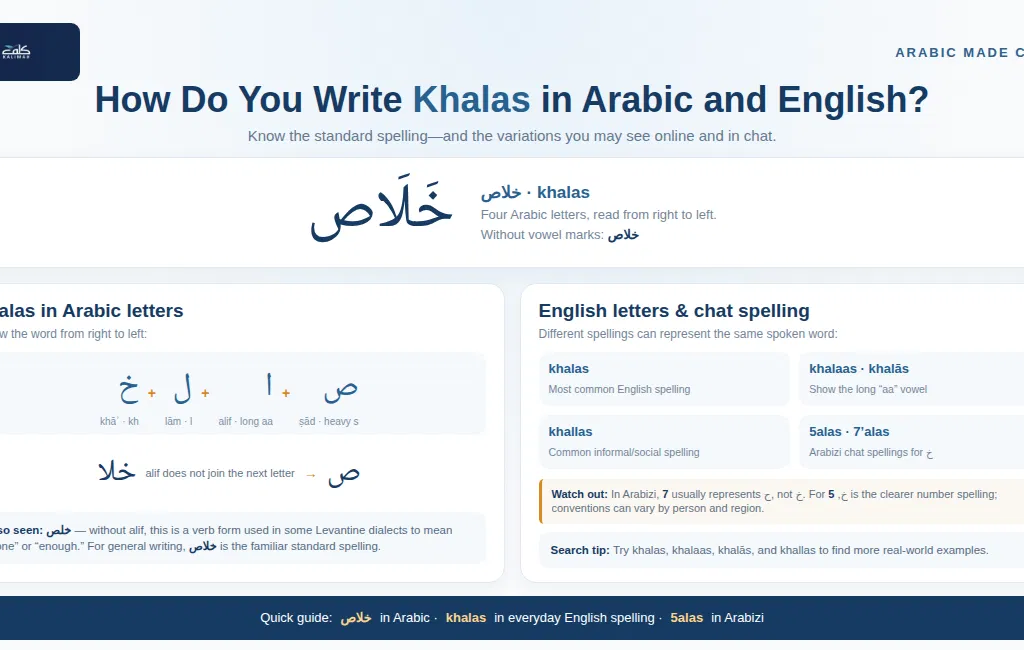
The standard spelling is خلاص. Online, though, you will see the word written in many other ways. Knowing them helps you read texts, posts, and chats with confidence.
Khalas in Arabic Letters
Khalas is written خلاص, from right to left. It has four letters: خ (kh), ل (l), ا (the long “aa”), and ص (the heavy “s”). With all its vowel marks, it looks like this: خَلَاص.
Look closely and you will see a small gap before the last letter. The ا (alif) never joins the letter that comes after it. So the word looks like “خلا” followed by “ص.”
You may also see خلص, which has no alif. This is the verb form, not a spelling mistake. In Syria, Lebanon, Jordan, and Palestine, people often say خلص on its own to mean “done” or “enough.”
Both forms carry the same idea. Still, it is better to use خلاص in your own writing, since every Arabic reader knows it.
Khalas in English Letters and Chat Spelling
In English, the most common spelling is “khalas.” You may also see “khalaas” or “khalās,” which show the long vowel. “Khallas” turns up a lot on social media.
In chat, many Arabs use Arabizi, which mixes English letters with numbers. The letter خ is written as 5 or 7′, so khalas becomes “5alas” or “7’alas.“
Be careful with “7alas.” In Arabizi, the number 7 stands for ح, a different “h” sound. An Arabic reader would see a different word. If you search for this word online, try all of these spellings. You will find many more videos, songs, and real examples of how people use it.
How Does Tone Change the Meaning of Khalas?
The same word can sound calm, angry, sad, or friendly. Listen to the voice behind it, and you will know what the speaker really means.
Five Ways to Say Khalas
There are three many several ways to say khalas:
- A neutral khalas is flat and calm. It simply means “it’s done.” A mechanic or a waiter uses this tone.
- A firm khalas is short and sharp, and the voice drops at the end. It means “stop now.” You will hear this from parents and from people who are fed up.
- A resigned khalas is soft and slow, often with a sigh. It means “it is what it is.” People say it after bad news, sometimes followed by naṣīb, which means “it was meant to be.”
- An accepting khalas sounds warm and easy. It means “fine, okay,” and it often comes with māshi (okay) or ittafa’na (we agreed).
- A questioning khalas goes up at the end. “Khalas?” means “Are we done?” or “Is that it?”
How to Say Khalas Without Sounding Rude
Khalas isn’t a rude word. Said sharply and on its own, though, it can sound cold, almost like slamming a door. This matters most with older people, teachers, and anyone you’ve just met. A few small changes keep it friendly:
- Add a “thank you.” “Khalas, shukran” means “That’s enough, thank you.” It works almost anywhere, from a dinner table to a shop counter.
- Start with bas. “Bas, khalas” sounds softer than khalas alone. The extra word slows you down and takes the edge off.
- Lower your voice. A calm, quiet khalas sounds polite. A loud, fast one sounds like you’re annoyed.
- Use your hand. In many Arab homes, a guest places a right hand on the chest while saying “khalas, shukran.” It tells the host kindly that you’ve eaten enough, without seeming to turn down their food.
You’ll need that last tip more than you might think. Arab hosts often keep filling your plate to show they care. Saying “no” over and over can feel awkward. A hand on the chest and a warm “khalas, shukran” solves the problem nicely.
For more polite words you can pair with khalas, take a look at these Arabic phrases and sentences for beginners. A few of them will make you sound warm instead of blunt.
Khalas vs. Bas vs. Kifaya: What’s the Difference?
All three words can mean “enough” in English, but each one stresses a different idea. Khalas says something is over. Bas says to stop at this point. Kifaya says the amount is enough.
| Word | Arabic | Main idea | Other uses | Example |
| Khalas | خلاص | It’s over | Done, settled, fine | “Khalas, I finished.” |
| Bas | بس | Stop right here | Also means “only” and “but” | “Bas, shukran.” (That’s it, thanks.) |
| Kifaya | كفاية | That’s enough | Used to complain | “Kifaya talking!” (Enough talking!) |
When to Use Khalas, Bas, or Kifaya
Use khalas when a job is done or a choice is final. “Khalas, I sent the email” fits well here. Bas or kifaya would sound odd in this sentence.
Use bas to stop something at a certain point. When someone is pouring juice into your glass, “bas” tells them where to stop. Remember that bas has other jobs too. “Bas wahid” means “only one,” and “bas” in the middle of a sentence means “but.”
Use kifaya when the amount is enough or you have had enough of something. “Kifaya” can sound annoyed, like “Enough already!” In the Levant, people often say “bikaffi” instead.
A quick test can help you choose. Ask yourself if something has ended, needs to stop here, or is now enough.
Formal Arabic Words for Enough, Stop, and Finish
Khalas, bas, and kifaya are all spoken Arabic. You won’t find them in news reports, school essays, or work emails. Formal Arabic, called Fusha or Modern Standard Arabic, uses other words.
For “enough,” use كفى (kafā). For “stop,” use توقّف (tawaqqaf). For “it finished,” use انتهى (intahā). For “I finished,” use أنهيتُ (anhaytu). A news anchor would say “intahat al-mubārāh,” meaning “the match ended.” A fan at home would just shout “khalas!” when the final whistle blows.
Knowing both sets of words lets you speak like a local and write like a pro. Most learners need both, so it is worth practicing them side by side.
Inside Kalimah Center: Moments from Our Courses
Get a glimpse into the vibrant learning experience at Kalimah Center. These snapshots capture real moments from our live classes—where students engage deeply, connect with passionate instructors, and grow in a welcoming, supportive environment.
Master Arabic with Kalimah Center
Join our expert-led online classes and start your journey toward Arabic fluency today.
Book Your Free TrialBook Your Free Arabic Class at Kalimah Center Today
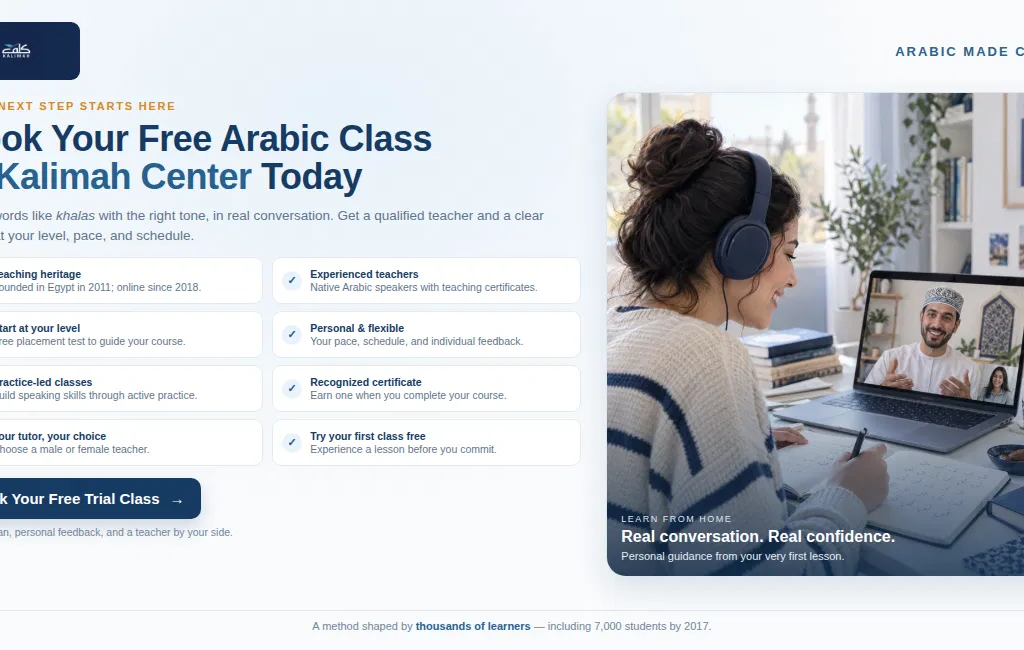
Learning words like khalas from a list is a good start. Using them with the right tone, in a real chat, takes a real teacher. Kalimah Center gives you that teacher, plus a clear plan to follow.
Here is what you get when you learn with Kalimah Center:
- Real experience: Kalimah opened in 2011 as an institute in Egypt teaching Modern Standard Arabic to students from around the world. By 2017, 7,000 students had studied there, and in 2018 it moved this method online.
- Native, qualified teachers: The teachers are native Arabic speakers with strong certificates in teaching Arabic and Quran.
- A course that fits your level: You start with a free placement test, so the course matches what you already know.
- Flexible and personal: Lessons follow your own pace and schedule, and you get personal feedback.
- Practice, not lectures: Classes focus on practice more than theory.
- A certificate you can show: You earn a recognized certificate when you finish your course.
- Male and female teachers: You can choose a male or a female tutor.
Your first class is free, so you have nothing to lose. Book it today, and say your next “khalas” like a native speaker.
Explore Our Courses:
Browse our courses and start learning today.
- Online Arabic Course: Tailored to your level, our comprehensive Arabic program includes 16 teaching levels and 400+ hours of personalized sessions.
- Online Quran With Tajweed Course: Perfect for non-Arabic speakers, our course spans 13 levels and equips you with Tajweed mastery from beginner to advanced.
- Online Arabic Course For Kids: Nurture your child’s love for Arabic with our engaging and structured program, available in 24 levels for primary, intermediate, and secondary stages.
Conclusion
Now you know what khalas means in Arabic. It marks an end point, whether that is a meal, a task, a fight, or a deal. That one idea ties together every way people use it, from a mother calming her kids to a buyer closing a sale.
The word also shows how Arabic works. A single root, خ-ل-ص, gave life to words for being saved, being pure, being sincere, and being done. When you learn one root, you often unlock five or six new words for free.
Khalas also shows that tone matters as much as words in spoken Arabic. The same two syllables can be kind, cold, sad, or final. Paying attention to how people say a word, not just what they say, is one of the fastest ways to understand native speakers.
Here is a simple plan for this week. Use khalas in three real moments: once to stop, once to say you’re done, and once with “shukran” to turn down more food. Then try bas and kifaya in the same way. Small daily practice like this will make these words feel natural much faster than reading about them.
FAQs
Learners often have more questions once they start hearing khalas in real life. Below are short answers to the ones we hear most.
What Is the Difference Between Khalas and Yalla?
Khalas ends something, while yalla starts something. Yalla means “let’s go” or “come on.” People often say both together: “Khalas, yalla!” means “We’re done, let’s go.”
What Does “Khalas Ba’a” Mean in Egyptian Arabic?
“Khalas ba’a” (خلاص بقى) means “enough already!” in Egyptian Arabic. The word ba’a adds a feeling of being tired or annoyed, so it sounds stronger than khalas alone.
Do All Arab Countries Say Khalas the Same Way?
Most Arab countries say and understand khalas, from Morocco to the Gulf. In the Levant, people also use the shorter form خلص, which sounds like “khalas” or “khlos.”
How Should I Reply When Someone Says Khalas?
A simple “ḥāḍir” (okay, sure) or “tamām” (fine) is a polite reply. If someone is asking you to stop, stopping and smiling is the best answer of all.
Is Khalas Also a Type of Date?
Yes, Khalas is also the name of a well-known date fruit grown in Saudi Arabia and the Gulf. Its name has the same spelling as the word, but it has nothing to do with “enough.”
Is the Word Khalas in the Quran?
The exact word khalās does not appear in the Quran, but words from its root do. Examples are khalaṣū in Surah Yusuf 12:80 and khāliṣan, “pure,” in Surah An-Nahl 16:66.
Is Khalas Used in Hebrew?
Yes, Israeli Hebrew slang borrowed khalas from Arabic. It keeps the same meaning, “enough” or “that’s it.”