Arabic is a language rich with special letters that give it its distinctive sound and appearance. Among these letters is “غ” (Ghain), a letter with a deep, guttural sound and a distinctive shape. It is an important letter in Arabic words, giving them a different sound and meaning.
In this, we shall observe the structure of the Arabic letter “غ”, its phonetic pronunciation, written representations, and some usual examples where it appears.
Shape Of The Arabic Letter “غ” (Ghain)
The Arabic letter “غ” is the nineteenth in the Arabic alphabet. It’s curved in structure and often confused with “ع” (Ain) due to the shared structure.

However, “غ” is distinctive with the placement of a diacritical point over it.
In pronunciation, “غ” has a distinct guttural sound that does not exist in English. It resembles the French “r” in words like “rogue” and is produced by vibrating the throat while exhaling air.
Recognizing “غ” In Arabic Writing
The first step in becoming proficient with the letter “غ” is an awareness of what it looks like and how it is written in different contexts:
- General Shape: “غ” is a circular curve with a dot at the top, thus making it unique from other Arabic letters.
- Alphabetical Position: It comes after “ع” and before “ف” in the alphabet.
- Letter Forms: The form of Arabic letters differs with their position within a word. “غ” differs depending on whether it appears at the beginning, middle, or end of a word.
Pronunciation Of “غ” (Ghain)
To correctly pronounce “غ,” place the back of your tongue near the top of your throat and roll out a raspy sound.

This is crucial in word differentiation, as “غ” will alter the meaning of words when substituted with other letters.
Sound Similarity: The closest European approximation is the French “r” sound in “Paris” or the Dutch “g” sound in “goed.”
Articulation Tip: Drill by repeating words like “غابة” (forest) and “مغربي” (Moroccan) to get used to the sound.
Master Arabic with Kalimah Center
Join our expert-led online classes and start your journey toward Arabic fluency today.
Book Your Free TrialVariations Of Ghayn Arabic Letter “غ”
Like other letters of Arabic, “غ” varies in shape depending on its position in a word:

Isolated Form: “غ” remains as is when alone on a page.
Initial Form: When at the start of a word, “غـ” is added to the next letter, as in “غريب” (strange).
Medial Form: Within a word, “ـغـ” appears between both ends, such as “مغسلة” (laundry).
Final Form: At the end of the word, “ـغ” appears after the previous letter, such as “بليغ” (eloquent).
Read also: Letter kh in Arabic
Common Words And Phrases Containing “غ”
The letter “غ” appears in many essential Arabic words. Here are some examples:
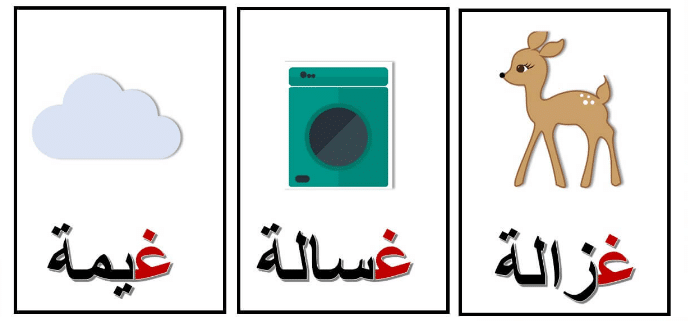
Initial Position:
- “غداء” (lunch)
- “غروب” (sunset)
- “غزال” (gazelle)
Medial Position:
- “مغامرة” (adventure)
- “مغفرة” (forgiveness)
- “اغتسال” (bathing)
Final Position:
- “بليغ” (eloquent)
- “تفريغ” (emptying)
- “مراوغ” (elusive)
Phrases Featuring “غ”
To understand “غ” in context, consider these sentences:
- “الغابة مليئة بالأشجار” (The forest is full of trees)
- “الغراب طائر ذكى” (The crow is a smart bird)
- “أمارس اللغة العربية في وقت الفراغ” (I practice Arabic in my free time)
Tips For Mastering The Letter “غ”
Practice the following to master the letter “غ”:

- Listen to Native Speakers: Arabic native speakers naturally use “غ” when speaking. Listening to how they say it helps in mimicking the sound.
- Practice Writing: Practice writing the letter in its different forms on a regular basis to get used to how it appears in words.
- Use Tongue Exercises: As “غ” is a guttural letter, exercises that assist in strengthening throat articulation can help with pronunciation.
Common Mistakes With “غ”
Arabic learners of English usually have trouble with the letter “غ” because:

1. Mispronunciation: Students mistake “غ” for the English “g” in “go” instead of its throat sound.
2. Confusing it with “ع”: The letter “غ” is visually similar to “ع” but differs in sound and meaning. The dot on “غ” is a key identifier.
Master Arabic with Kalimah Center
Join our expert-led online classes and start your journey toward Arabic fluency today.
Book Your Free TrialInside Kalimah Center: Moments from Our Courses
Get a glimpse into the vibrant learning experience at Kalimah Center. These snapshots capture real moments from our live classes—where students engage deeply, connect with passionate instructors, and grow in a welcoming, supportive environment.
Here Are The Reviews On Our Courses:
Our students frequently commend the excellence of our courses and the commitment shown by our instructors. You can read their complete reviews on Trustpilot.

Unlock Your Potential in Arabic and Quran with Kalimah Center!
Ready to deepen your connection with the Quran and enhance your understanding of Arabic? Join Kalimah Center today and embark on a transformative journey of learning and growth! Our professional, handpicked Online Arabic and Quran Tutors are dedicated to helping you master these essential skills with ease and expertise.
📚 Explore Our Courses:
Online Arabic Course: Tailored to your level, our comprehensive Arabic program includes 16 teaching levels and 400+ hours of personalized sessions.
Online Quran With Tajweed Course: Perfect for non-Arabic speakers, our course spans 13 levels and equips you with Tajweed mastery from beginner to advanced.
Online Arabic Course For Kids: Nurture your child’s love for Arabic with our engaging and structured program, available in 24 levels for primary, intermediate, and secondary stages.
🚀 Start Your Free Trial Today! 🚀
Don’t miss out on this life-changing opportunity to deepen your faith and knowledge. Sign up now for your free trial and take the first step towards becoming a better practicing Muslim with Kalimah Center!
Conclusion
The “غ” letter is the basic pillar of the Arabic language and has an important function in spoken and written Arabic. By practicing its pronunciation, recognizing its differences, and using it in words, students will feel assured in their Arabic ability. Practice regularly, and one day “غ” will become as natural a part of your Arabic life.
FAQs about The Arabic Letter “غ” (Ghain)
What is the Arabic letter Ghain (غ) and its position in the alphabet?
The letter Ghain (غ) is the 19th letter of the Arabic alphabet. It is written as a curved stroke with a single diacritical dot placed directly above it. Ghain follows the letter Ain (ع) and precedes the letter Fa (ف) in the standard alphabetical order.
How do you correctly pronounce the Arabic letter Ghain (غ)?
To pronounce Ghain (غ), place the back of the tongue near the soft palate at the top of the throat to produce a voiced velar fricative sound. It sounds like a rolling, raspy vibration, closely resembling the standard French “r” in “Paris” or the Dutch “g” in “goed.”
What are the four written forms of the Arabic letter Ghain (غ)?
The shape of Ghain changes based on its position in a word. It has an isolated form (غ) when standing alone, an initial form (غـ) at the start of a word, a medial form (ـغـ) connected on both sides in the middle, and a final form (ـغ) at the end.
What are some common examples of Arabic words containing the letter Ghain?
Common examples of words starting with Ghain include “غابة” (forest) and “غزال” (gazelle). In the medial position, it appears in “مغربي” (Moroccan) and “مغسلة” (laundry), while final-position examples include “بليغ” (eloquent) and “تفريغ” (emptying).
What is the difference between the Arabic letters Ain (ع) and Ghain (غ)?
While Ain (ع) and Ghain (غ) share the exact same primary curved body stroke, they differ visually by a single diacritical dot. Ghain features a dot above the letter, whereas Ain has no dot. Phonetically, Ain is a pharyngeal sound, while Ghain is a guttural throat sound.