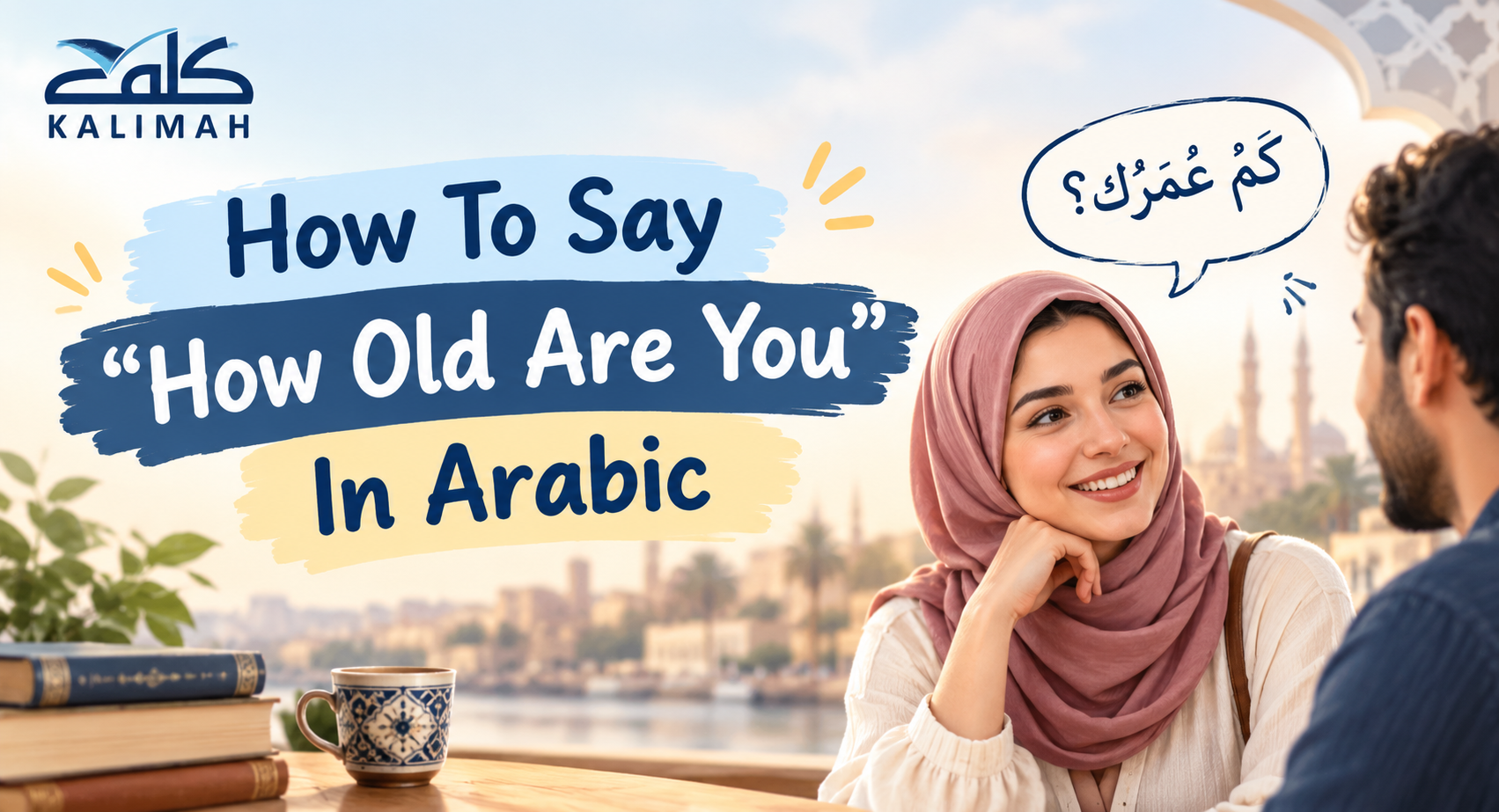
Do you want to know how to say “how old are you” in Arabic? In standard Arabic, you ask a man كَمْ عُمْرُكَ؟ (kam ʿumruka?). You ask a woman كَمْ عُمْرُكِ؟ (kam ʿumruki?). These two short phrases work in every Arab country.
Age is one of the first things people ask when they meet. Kids ask it at school. Neighbors ask about your children. A new teacher may ask it on the first day of class.
But Arabic has more than one way to ask. The words change for a man, a woman, or a group. They change again in Egypt, Syria, the Gulf, Iraq, and Morocco.
Many guides give you one phrase and stop there. That can leave you stuck when someone asks you back. So this guide also shows you how to reply, which word for “years” to use, and how to ask in a kind way.
You don’t need to know any grammar to follow along. Each step adds one small skill. Go through the eight steps in order. By the end, you can ask, answer, and chat about age in Arabic.
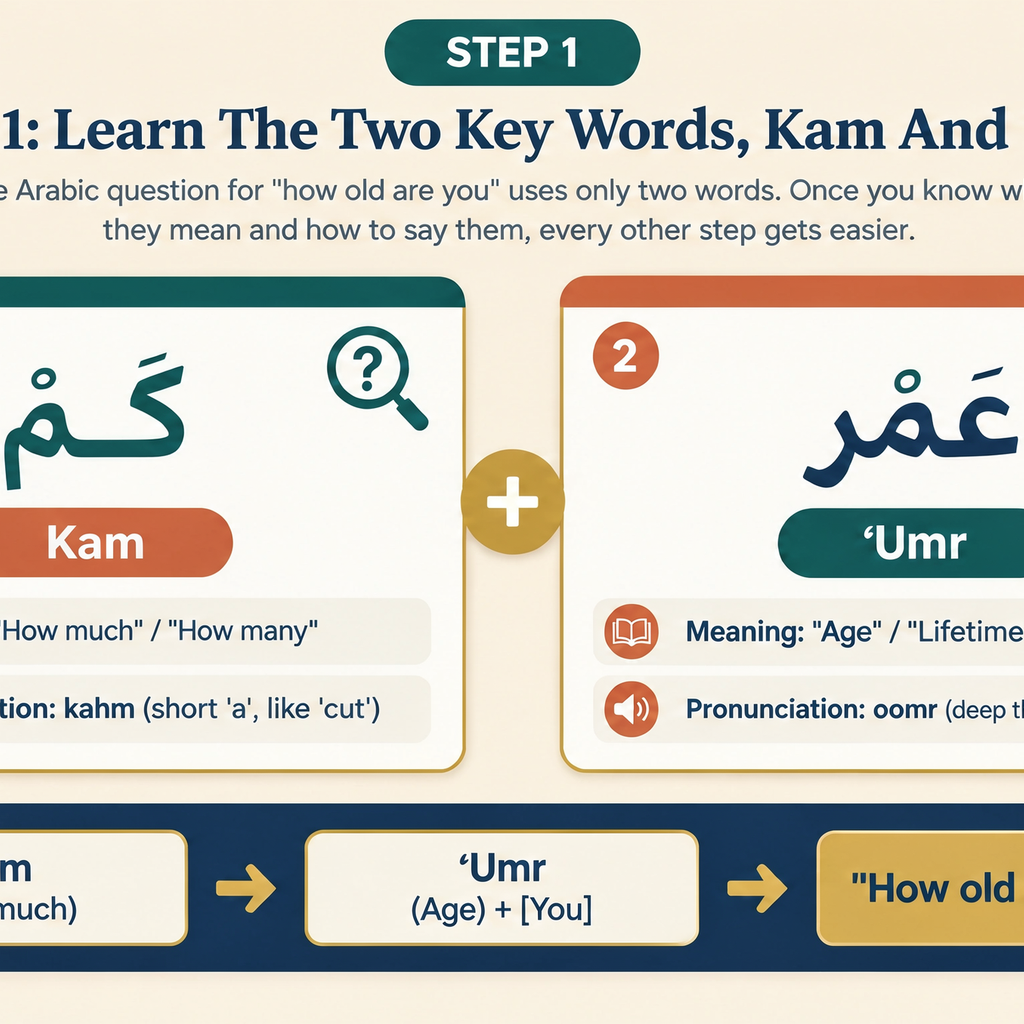
Step 1: Learn The Two Key Words, Kam And ʿUmr
The Arabic question for “how old are you” uses only two words. Once you know what they mean and how to say them, every other step gets easier.
What Kam And ʿUmr Mean In Arabic
The first word is كَمْ (kam). It means “how much” or “how many.” You will use it a lot. Arabs use it to ask about prices, numbers, and time too.
The second word is عُمْر (ʿumr). It means “age” or “life.” The dictionary meaning of ʿumr is the length of a life, from birth to death. Its plural is أعمار (aʿmār). That means “ages.”
Put the two words together. Now the question means “how much is your life?” That may sound odd in English. In Arabic, it is the normal way to ask.
Here is something many learners miss. Arabic does not use the word “old” in this question at all. Some people try to copy English word by word. They say “kam sana anta qadīm?” That means “how many years are you old?” No Arab talks like this.
So keep it simple. Ask about the person’s ʿumr. Then you will sound right from the very first day.
Saying Kam ʿUmruk The Right Way
The word kam is easy. It sounds like the English word “come,” only shorter. The word ʿumr is a bit harder. It starts with the letter ع. This letter is called ʿayn. English has no sound like it. In this guide, we write it as ʿ.
To make the ʿayn, say “ah.” Then gently squeeze the back of your throat as you say it. It should feel tight, like a small push from deep inside.
You will see a few other marks in this guide. Here is what they mean:
- ā, ī, and ū are long vowels. Hold them twice as long as a normal vowel.
- ḥ is a strong, breathy “h.” It sounds like fogging up a mirror.
- kh sounds like the “ch” in the Scottish word “loch.”
- sh sounds like “shoe.” And ch sounds like “church.”
If the ʿayn feels too hard, don’t worry. People will still get it if you say “umruk.” Keep trying a little each day. This one sound will make you sound much more like a native speaker.
Step 2: Change The Ending For A Man, A Woman, Or A Group
In Arabic, the word “your” is a small ending on the end of a word. That ending changes based on who you talk to. The table below shows every standard form, from one man to a group of women.
| Talking To | Arabic | How To Say It |
| A man or boy | كَمْ عُمْرُكَ؟ | kam ʿumruka? |
| A woman or girl | كَمْ عُمْرُكِ؟ | kam ʿumruki? |
| Two people | كَمْ عُمْرُكُمَا؟ | kam ʿumrukumā? |
| A group of men, or a mixed group | كَمْ أَعْمَارُكُمْ؟ or كَمْ عُمْرُكُمْ؟ | kam aʿmārukum? or kam ʿumrukum? |
| A group of women | كَمْ أَعْمَارُكُنَّ؟ | kam aʿmārukunna? |
Look at the first two rows. The only change is the last sound. It is -a for a man and -i for a woman. When Arabic is written without vowel marks, both look the same: كم عمرك. So the ending is something you hear, not something you see.
How To Ask About Someone Else’s Age
Sometimes you want to know another person’s age. It might be a friend’s child, a new baby, or someone’s parent. For this, you swap “your” for “his” or “her.”
- كَمْ عُمْرُهُ؟ (kam ʿumruhu?) means “How old is he?”
- كَمْ عُمْرُهَا؟ (kam ʿumruhā?) means “How old is she?”
- كَمْ عُمْرُ أَبِيكَ؟ (kam ʿumru abīka?) means “How old is your father?”
- كَمْ عُمْرُ أُمِّكَ؟ (kam ʿumru ummika?) means “How old is your mother?”
You will hear the first two all the time when you visit a family. People love to ask about kids. Here is a short example:
A: ما شاء الله! كَمْ عُمْرُهُ؟
mā shāʾ Allāh! kam ʿumruhu?
Mashallah! How old is he?
B: عُمْرُهُ خَمْسُ سَنَوَاتٍ.
ʿumruhu khamsu sanawāt.
He is five years old.
Look at the reply. It starts with ʿumruhu. That means “his age.” Then comes the number. You will learn how to say the number part in Step 6.8
You’re right. The heading promises both styles, but the section only covers the formal one. Here is the corrected Step 3 with an everyday H3 added. I also moved the “don’t mix styles” tip to the end, since it now covers both styles.
Master Arabic with Kalimah Center
Join our expert-led online classes and start your journey toward Arabic fluency today.
Book Your Free TrialStep 3: Choose Formal Or Everyday Arabic
Arabic has two main styles. Standard Arabic is used in books, news, and school. Spoken dialects are used at home and on the street. Choose your style first, and the right words will follow.
The Formal Question For Interviews And Older People
Some places call for extra respect. Think of a job interview, a doctor’s office, or a talk with your friend’s grandfather. For these times, Arabic has a more formal question:
كَمْ تَبْلُغُ مِنَ العُمْرِ؟ (kam tablughu mina l-ʿumr?)
Word by word, it means “how much have you reached of age?” It sounds careful and polite.
For a woman, the verb changes a little:
كَمْ تَبْلُغِينَ مِنَ العُمْرِ؟ (kam tablughīna mina l-ʿumr?)
You may also see مَا عُمْرُكَ؟ (mā ʿumruka?). It means “what is your age?” It is simple and polite. It sits in the middle, between formal and everyday speech.
Use these forms when you want to sound respectful. They are good for official forms, first meetings, and anyone much older than you. A soft voice and a smile make them sound even kinder.
The Everyday Question For Friends And Classmates
With friends, classmates, and people your own age, you don’t need the formal question. Most people just say كم عمرك؟ and keep it short.
When Arabs speak fast, they often drop the last short vowel. So kam ʿumruka becomes kam ʿumrak. And kam ʿumruki becomes kam ʿumrik. It is the same question, just quicker and more relaxed.
Here is how it sounds in a quick chat:
A: أهلًا! أنا سامي. كم عمرك؟
ahlan! ana Sāmī. kam ʿumrak?
Hi! I’m Sami. How old are you?
B: عشرون.
ʿishrūn.
Twenty.
See how short the reply is? In everyday talk, people often say just the number. They skip “ʿumrī” and “sana” because the meaning is clear.
One last tip: try not to mix styles in one short chat. If you start formal, stay formal. If you start casual, stay casual. Native speakers will still understand a mix. But in school, tests, or meetings, it can sound careless.
The spoken dialects, like Egyptian Arabic, have their own words for this question. You will learn those in Steps 4 and 5.
Step 4: Ask “How Old Are You” In Egyptian Arabic
Egyptian Arabic is the dialect most Arabs know. Many people hear it in Egyptian movies, songs, and TV shows. That makes it a smart second choice after standard Arabic.
The Main Egyptian Question: ʿAndak Kām Sana?
Egyptians don’t often ask about your “age.” They ask how many years you “have.” The most common question is عندك كام سنة؟
Here is how to say it:
- To a man: ʿandak kām sana?
- To a woman: ʿandik kām sana?
- To a group: ʿanduku kām sana? (عندكو كام سنة؟)
Now let’s look at each word:
- عند (ʿand) means “with you.” Here, it works like “you have.”
- كام (kām) is the Egyptian way to say kam, or “how many.”
- سنة (sana) means “year.”
So the full question means “how many years do you have? You will hear it in shops, schools, and homes all over Cairo. It is short and friendly. It is also easy to remember.
Other Egyptian Ways To Ask About Age
Egyptians have two more ways to ask. Both are short and casual.
- The first one is عمرك كام؟ (ʿumrak kām?). To a woman, say ʿumrik kām? It uses the same word ʿumr you learned in Step 1.
- The second one is سنّك كام؟ (sinnak kām?). Sinn is another word for age. To a woman, say sinnik kām?
Did you see where the question word goes? In standard Arabic, kam comes first. In Egyptian Arabic, kām often moves to the end. You will see this again and again in the dialect. For example, Egyptians say “da b-kām?” to ask “how much is this?”
All three Egyptian questions mean the same thing. Pick the one that feels easiest to say. If you are not sure, use ʿandak kām sana? Everyone uses it, so you can’t go wrong.
Experience Kalimah Center Classes
Watch real excerpts from our live sessions at Kalimah Center and see how we bring learning to life. These clips highlight our interactive, student-centered teaching approach across all our courses—designed to keep learners engaged, motivated, and actively involved every step of the way.
Step 5: Learn The Question In Other Arabic Dialects
Arabic is spoken in more than 20 countries. Each region has its own style. You don’t need to use every form below, but knowing them helps you when you travel or watch shows.
The table shows how people ask “how old are you” in four more regions. The last column tells you where you might hear each one.
| Dialect | To A Man | To A Woman | Where You Hear It |
| Levantine | قدّيش عمرك؟ (addēsh ʿumrak?) | قدّيش عمرك؟ (addēsh ʿumrik?) | Syria, Lebanon, Jordan, Palestine |
| Gulf | كم عمرك؟ (kam ʿumrak?) | كم عمرك؟ (kam ʿumrich?) | Saudi Arabia, UAE, Kuwait, Qatar |
| Iraqi | شكد عمرك؟ (shgad ʿumrak?) | شكد عمرك؟ (shgad ʿumrich?) | Iraq |
| Moroccan | شحال فعمرك؟ (shḥāl f-ʿumrek?) | شحال فعمرك؟ (shḥāl f-ʿumrek?) | Morocco |
In some Gulf areas, the “k” sound turns into “ch.” So kam becomes cham ʿumrak? The same thing happens in other words. For example, kalb (dog) can sound like chalb. In Moroccan Arabic, one form works for both men and women.
Which Arabic Dialect Should You Learn First?
With so many choices, you may not know where to start. Here is a simple plan.
- Begin with standard Arabic: kam ʿumruka? and kam ʿumruki? These work in every Arab country. They may sound a little formal at a café. Still, people always understand them.
- Next, learn the Egyptian form, ʿandak kām sana? It is the one you will hear most in movies, music, and online videos.
- After that, choose a dialect based on your plans. Moving to Dubai? Learn the Gulf form. Have friends from Lebanon? Learn the Levantine form. Going to Marrakesh? Learn the Moroccan form.
The best way to get these sounds right is to hear them from real people. In the Kalimah Center online Arabic course, you learn with native Arabic tutors. You hear every phrase the way Arabs really say it, from your very first class. That is much easier than copying a voice from a recording.
Step 6: Answer With Your Age
Asking is only half of the chat. Soon, someone will ask you back. Your answer has three parts: “my age is,” the number, and the word for “year.”
The Words You Need To Say Your Age
Before you build an answer, learn these key words:
- عُمْرِي (ʿumrī) means “my age.”
- عِنْدِي (ʿandi) means “I have.” Egyptians and many others use it.
- سَنَة (sana) means “year.”
- سَنَوَات (sanawāt) means “years” in standard Arabic.
- سِنِين (sinīn) means “years” in Egyptian and Levantine Arabic.
- عَام (ʿām) is one more word for “year.” It is used in formal Arabic and in Morocco.
Now put them together. In standard Arabic, you say:
عُمْرِي عِشْرُونَ سَنَةً (ʿumrī ʿishrūna sanatan). This means “I am 20 years old.”
In Egyptian Arabic, you say:
عندي ٣٠ سنة (ʿandi talatīn sana). This means “I am 30.”
For the formal question from Step 3, answer like this:
أَبْلُغُ مِنَ العُمْرِ ثَلَاثِينَ عَامًا (ablughu mina l-ʿumri thalāthīna ʿāman). This means “I am 30 years of age.”
In Levantine Arabic, people say ʿumri ʿishrīn sene. In Moroccan Arabic, they say ʿandi ʿishrīn ʿām. Need help with the numbers? Our guide to Arabic numbers from 1 to 100 shows how to say each one.
When To Use Sana Or Sanawāt
This is the part most learners get wrong. In Arabic, the number decides the form of the word “year.” The table below shows the pattern in standard Arabic and in Egyptian Arabic.
| Age | Standard Arabic | Egyptian Arabic |
| 1 | سنة واحدة (sana wāḥida) | سنة (sana) |
| 2 | سنتان (sanatān) | سنتين (sanatēn) |
| 3 to 10 | ثلاثُ سنواتٍ to عشرُ سنواتٍ (sanawāt) | تلات سنين to عشر سنين (sinīn) |
| 11 to 99 | إحدى عشرةَ سنةً، عشرون سنةً (sanatan) | حداشر سنة، عشرين سنة (sana) |
| 100 and up | مئةُ سنةٍ (sanatin) | مية سنة (sana) |
Here is the easy rule. From 3 to 10, use the plural. From 11 and up, go back to the singular. So a 7-year-old is “sabʿ sanawāt.” But a 27-year-old is “sabʿun wa-ʿishrūna sanatan.” It is never “sanawāt” after 10.
Standard Arabic has one more small rule. The word sana is a female word. Because of this, the numbers 3 to 10 drop their female ending. That’s why we say ثلاثُ سنوات (thalāthu sanawāt), not ثلاثةُ سنوات. It feels backward at first. But you will get used to it with practice.
Read also: How to Say Friend in Arabic
Step 7: Practice With Short Dialogues
Phrases are easier to remember when you see them in a real chat. Read each dialogue out loud, and play both parts. Want to start the chat with a greeting? See our guide on how to say hi in Arabic.
Formal And Casual Dialogues In Standard Arabic
The first dialogue fits an interview, an office, or a first meeting with an older person:
A: مِنْ فَضْلِكَ، كَمْ تَبْلُغُ مِنَ العُمْرِ؟
min faḍlika, kam tablughu mina l-ʿumr?
Excuse me, how old are you?
B: أَبْلُغُ مِنَ العُمْرِ اثْنَيْنِ وَأَرْبَعِينَ عَامًا.
ablughu mina l-ʿumri ithnayni wa-arbaʿīna ʿāman.
I am 42 years old.
The second dialogue fits a classroom. It also fits two new friends who speak standard Arabic:
A: كَمْ عُمْرُكِ يَا سَارَة؟
kam ʿumruki yā Sāra?
How old are you, Sara?
B: عُمْرِي تِسْعَ عَشْرَةَ سَنَةً. وَأَنْتَ؟
ʿumrī tisʿa ʿashrata sanatan. wa-anta?
I am 19. And you?
A: عُمْرِي عِشْرُونَ سَنَةً.
ʿumrī ʿishrūna sanatan.
I am 20.
See the little phrase wa-anta? It means “and you?” Say wa-anti? to a woman. It is the easiest way to keep a chat going.
A Friendly Dialogue In Egyptian Arabic
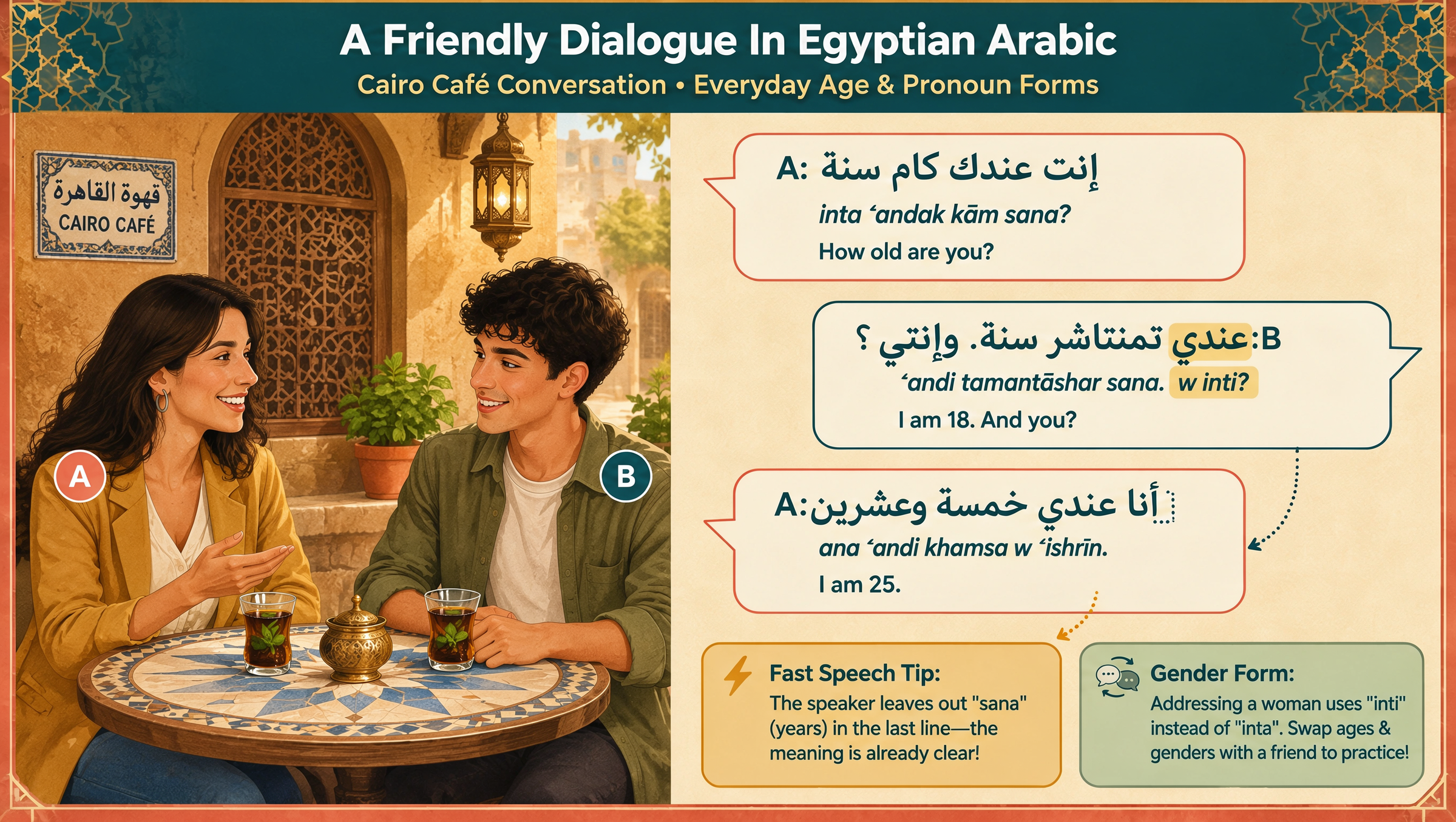
This is the kind of chat you might hear at a café in Cairo. You might also hear it between new neighbors:
A: إنت عندك كام سنة؟
inta ʿandak kām sana?
How old are you?
B: عندي تمنتاشر سنة. وإنتي؟
ʿandi tamantāshar sana. w inti?
I am 18. And you?
A: أنا عندي خمسة وعشرين.
ana ʿandi khamsa w ʿishrīn.
I am 25.
Look at the last line. The speaker leaves out the word “sana.” Egyptians often do this when they talk fast. The meaning is already clear.
Also look at “w inti?” The speaker is talking to a woman, so she uses inti, not inta.
Try reading this dialogue with a friend. Then change the ages and the genders. Each time you swap them, you practice a new form. And you don’t have to learn any new words.
Step 8: Ask About Age In A Kind And Polite Way
Knowing the words is not the whole story. You also need to know when and how to use them. Good manners help you make friends faster in any Arab country.
When It Is Okay To Ask Someone’s Age
In Arab homes, asking a child’s age is very normal. Adults do it all the time. It is a warm way to show you care about a family. With adults, it is a little different. Asking someone you just met can feel too personal. This is even more true with older people. It is also true with women in formal places.
So start gently. Before your question, say ممكن أسألك؟ (mumkin asʾalak?). It means “may I ask you?” To a woman, say mumkin asʾalik? In standard Arabic, you can say هَلْ تَسْمَحُ لِي أَنْ أَسْأَلَكَ؟ (hal tasmaḥu lī an asʾalaka?). It means “would you let me ask you?”
These small openers show respect. They also give the other person an easy way to say no. With friends your own age, you can skip them and just ask.
What To Say If You Don’t Want To Share Your Age
Sometimes you may not want to tell your age. That is fine. Arabic has a friendly way out. Smile and say عُمْرِي سِرّ (ʿumrī sirr). It means “my age is a secret.” People often say it as a light joke. That way, no one feels upset.
You can also make it a game. Say خَمِّنْ! (khammin!) to a man, or خَمِّني! (khammini!) to a woman. It means “Guess!” When the other person guesses, you can reply with one of these words:
- قَرِيب (qarīb) means “close.”
- أَصْغَر (aṣghar) means “younger.”
- أَكْبَر (akbar) means “older.”
Little jokes like these make you sound relaxed and natural. They are hard to learn from books, because they come from real talk. At Kalimah Center, you can pick a plan that fits your budget. Then you can practice chats like this with a live tutor every week.
Read also: How Are You in Arabic & Response
Everyday Arabic Phrases That Use The Word ʿUmr
Once you know the word ʿumr, you will start to see it everywhere. It shows up in songs, sayings, and even the Quran. Learning these phrases helps you understand native speakers much better.
Common Phrases With ʿUmr In Daily Life
Here are some phrases you will hear often:
- صديق العمر (ṣadīq al-ʿumr) means “lifelong friend.” It is for a friend you have known since you were small.
- رفيقة العمر (rafīqat al-ʿumr) means “life partner.” People often use it for a wife.
- مقتبل العمر (muqtabal al-ʿumr) means “early youth.” It is the start of adult life.
- جنى العمر (jany al-ʿumr) means “life savings.” It is all the money a person has saved over many years.
- أزمة منتصف العمر (azmat muntaṣaf al-ʿumr) means “midlife crisis.”
Here is one in a sentence: هذا صديق عمري (hādhā ṣadīq ʿumrī). It means “This is my lifelong friend.” Old Arabic also used ʿumr in a promise. People said لَعَمْرُكَ (laʿamruka). It means “by your life.” You may find it in old poems. These phrases make the word ʿumr feel alive. It stops being a word on a list. It becomes part of real speech.
The Word ʿUmr In The Quran And The Stages Of Life
The word ʿumr also appears in the Quran. In Surah An-Nahl, verse 70 (16:70), Allah speaks of people who reach أَرْذَلِ الْعُمُرِ (ardhal al-ʿumur). This means the weakest part of old age. It is a time when a person forgets what they once knew.
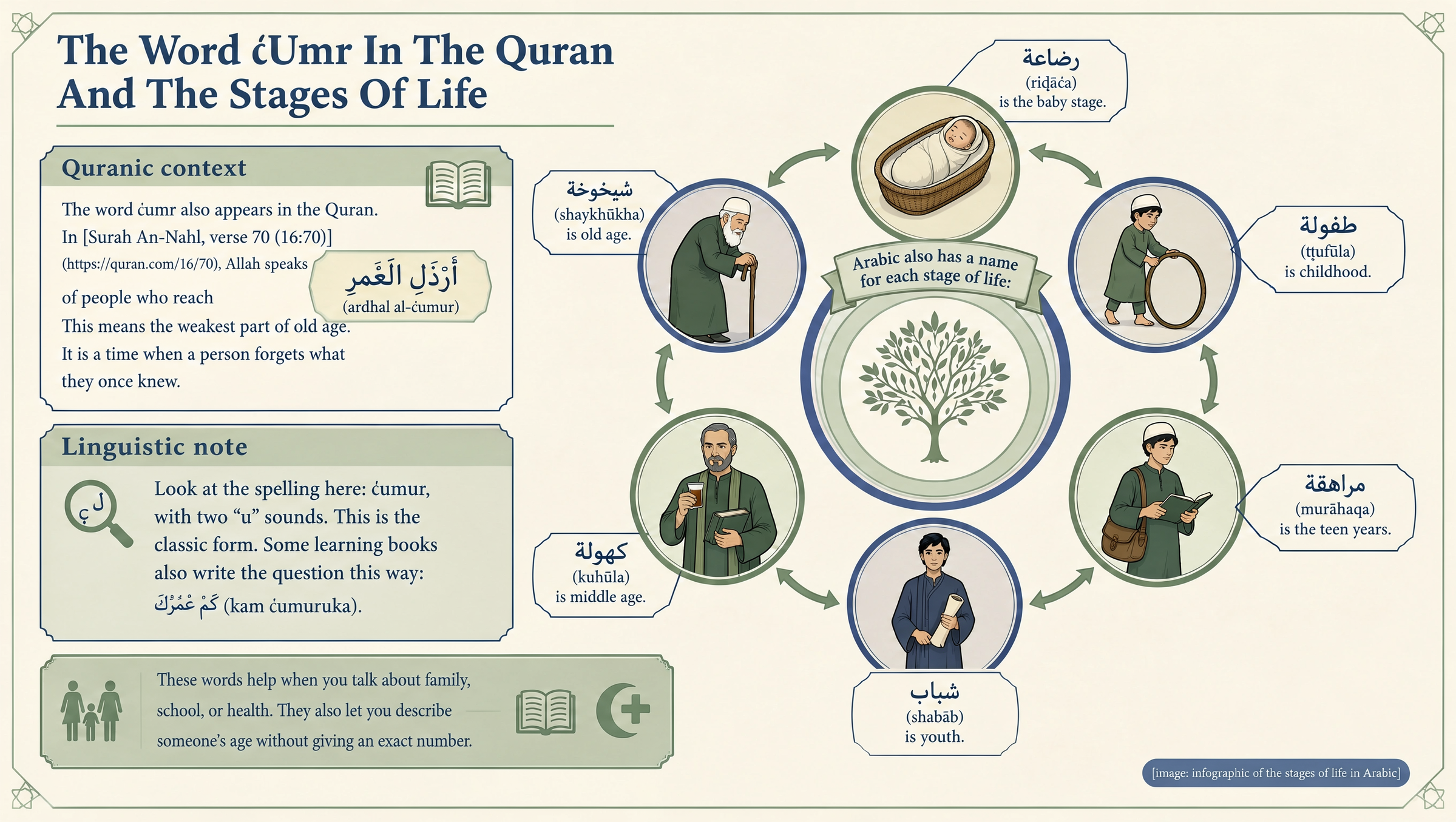
Look at the spelling here: ʿumur, with two “u” sounds. This is the classic form. Some learning books also write the question this way: كَمْ عُمُرُكَ (kam ʿumuruka). Arabic also has a name for each stage of life:
- رضاعة (riḍāʿa) is the baby stage.
- طفولة (ṭufūla) is childhood.
- مراهقة (murāhaqa) is the teen years.
- شباب (shabāb) is youth.
- كهولة (kuhūla) is middle age.
- شيخوخة (shaykhūkha) is old age.
These words help when you talk about family, school, or health. They also let you describe someone’s age without giving an exact number.
Inside Kalimah Center: Moments from Our Courses
Get a glimpse into the vibrant learning experience at Kalimah Center. These snapshots capture real moments from our live classes—where students engage deeply, connect with passionate instructors, and grow in a welcoming, supportive environment.
Master Arabic with Kalimah Center
Join our expert-led online classes and start your journey toward Arabic fluency today.
Book Your Free TrialStart Speaking Arabic With A Native Tutor At Kalimah Center
Reading phrases is a good start. Speaking them with a real person is what makes them stay in your head. Kalimah Center has taught Arabic since 2011. It began in Cairo and now teaches students online around the world.
Here is what you get when you learn with Kalimah Center:
- Native Arabic tutors, many with Al-Azhar training, who fix your mistakes while you speak.
- Male and female teachers, so you can learn with the one you feel most at ease with.
- One-on-one or group classes, booked at times that suit your day.
- A clear path of 16 levels and more than 400 hours of lessons, from your first words to fluent talk.
- Kalimah’s own lessons and books, made from more than 14 years of teaching.
- Your class materials open 24/7, so you can review any time.
- A certificate for each level you pass, so you can see how far you have come.
Not sure yet? Your first lesson is free. Meet your tutor, ask “kam ʿumruka?” for real, and see how it feels.
Explore Our Courses:
- Online Arabic Course: Tailored to your level, our comprehensive Arabic program includes 16 teaching levels and 400+ hours of personalized sessions.
- Online Quran With Tajweed Course: Perfect for non-Arabic speakers, our course spans 13 levels and equips you with Tajweed mastery from beginner to advanced.
- Online Arabic Course For Kids: Nurture your child’s love for Arabic with our engaging and structured program, available in 24 levels for primary, intermediate, and secondary stages.
Conclusion
Now you know how to say “how old are you” in Arabic in many ways. You can ask a man or a woman. You can ask a group, or ask about someone else. You can switch to Egyptian Arabic, or spot the forms used from Syria to Morocco. And you can give your own age with the right word for “years.”
Before you speak, try a quick habit. We call it the 3-Switch Check. First, pick your style: standard Arabic or a dialect. Second, pick the ending for a man or a woman. Third, check if you are talking to one person or a group. Three fast choices, and you will land on the right phrase.
The 3-Switch Check works for many other phrases too. You can use it for “what is your name?” or “where are you from?” To keep building your basics, read our list of useful Arabic phrases and sentences for beginners.
Want a simple way to practice this week? Try this plan. On day one, say the two main questions ten times each. On day two, say your own age out loud. On day three, ask about a friend’s family members. On day four, read the dialogues with a partner.
Keep going for the rest of the week. On day five, try the Egyptian forms. On day six, pick one more dialect you like. On day seven, ask a real person. It can be a friend, a neighbor, or a tutor.
Small, daily practice is what makes new words stick. Soon, asking someone’s age in Arabic will feel easy. And the next time someone asks you, you will know just what to say.
FAQs
Learners often have a few more questions after their first lesson on this topic. Here are short, clear answers to the ones we hear most.
How Do You Say “How Old Are You” In Arabic?
In standard Arabic, you say كَمْ عُمْرُكَ؟ (kam ʿumruka?) to a man and كَمْ عُمْرُكِ؟ (kam ʿumruki?) to a woman. In Egyptian Arabic, people say عندك كام سنة؟ (ʿandak kām sana?).
How Do You Write “How Old Are You” In Arabic Letters?
You write it as كم عمرك؟ in everyday text. This same spelling is used for both a man and a woman, because most Arabic text leaves out the small vowel marks.
How Do You Ask A Child How Old They Are In Arabic?
To ask a child how old they are, adults often add a sweet word. They say كم عمرك يا حبيبي؟ (kam ʿumrak yā ḥabībī?) to a boy, and yā ḥabībtī to a girl.
How Do You Say A Baby’s Age In Months In Arabic?
To say a baby’s age in months, use the word شهر (shahr). For example, عمره ستة أشهر (ʿumruhu sittatu ashhur) means “he is six months old.” In Egypt, people say ستة شهور (sitta shuhūr).
How Do You Ask What Year Someone Was Born In Arabic?
In standard Arabic, you ask في أي سنة وُلدتَ؟ (fī ayyi sanatin wulidta?). In Egyptian Arabic, people often say إنت مواليد سنة كام؟ (inta mawalīd sanat kām?).
How Do You Say “Happy Birthday” In Arabic?
You say عيد ميلاد سعيد (ʿīd mīlād saʿīd). Many Arabs also say كل سنة وانت طيب (kull sana w inta ṭayyib) to a man, and w inti ṭayyiba to a woman.
How Do You Say “We Are The Same Age” In Arabic?
You can say نحن في نفس العمر (naḥnu fī nafs al-ʿumr) in standard Arabic. In Egyptian Arabic, people say إحنا قد بعض (iḥna add baʿḍ).
How Long Does It Take To Learn Basic Arabic Questions Like This?
You can learn this one question in a single day of practice. Building a full set of everyday questions usually takes a few weeks of steady practice, and faster progress comes from speaking with a tutor.