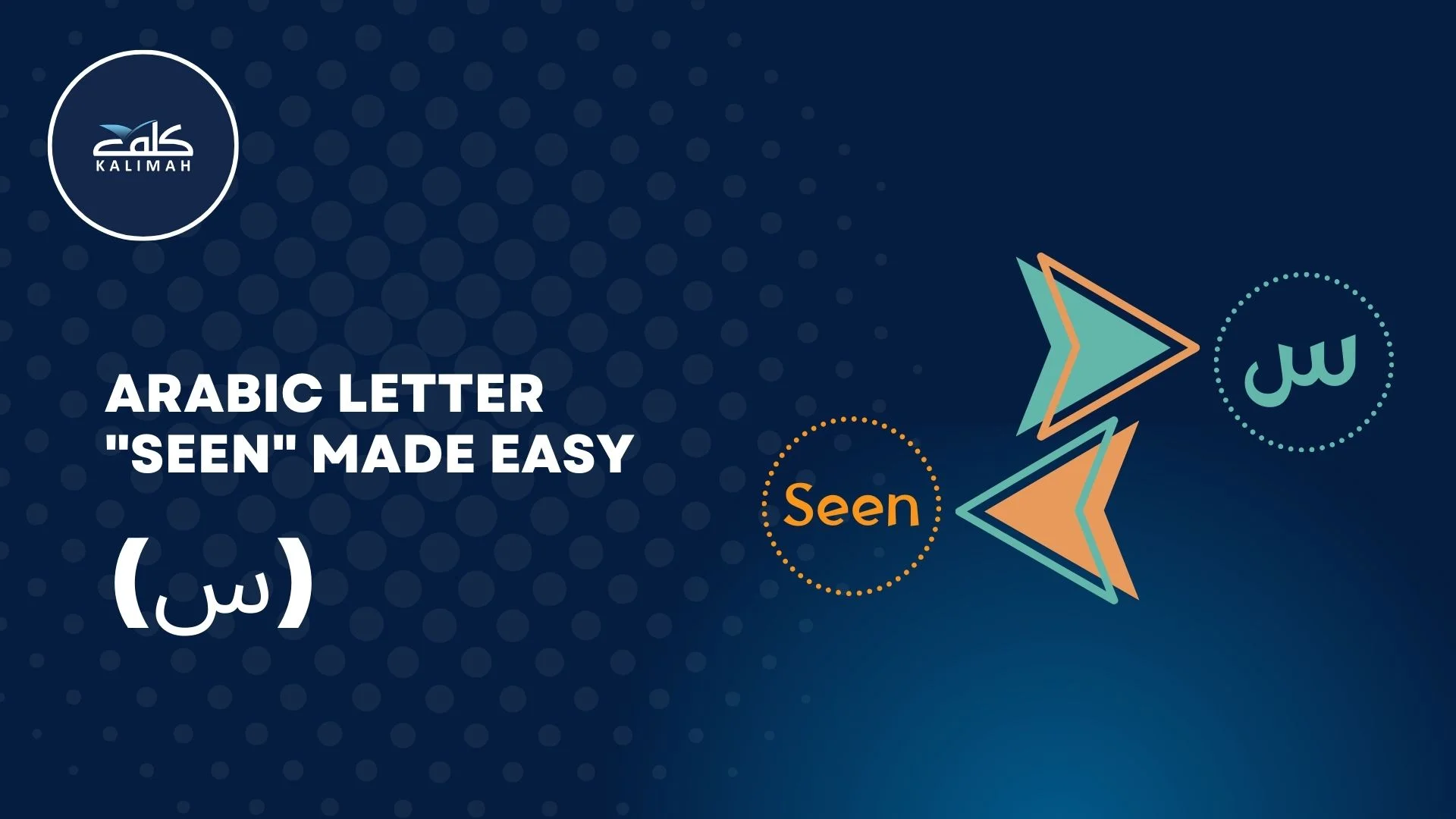
The Arabic letter “س” is pronounced as “s” (like “sun” or “sea” in English). Called “Seen” (سين), it is the 12th letter of the Arabic alphabet. It has no dots and takes four different written forms depending on its position in a word.
Quick Reference Table
| Feature | Details |
|---|---|
| Letter Name | Seen (سين) |
| Pronunciation | “s” as in “sun” or “sea” |
| Position in Alphabet | 12th letter |
| Sound Type | Voiceless alveolar fricative |
| IPA Symbol | /s/ |
| Connects? | Yes — to both sides |
| Dots | None (distinguishes it from ش) |
| Similar Letters | ش (sheen – has 3 dots), ص (saad – emphatic) |
| Written Forms | 4 forms: isolated (س), initial (سـ), medial (ـسـ), final (ـس) |
What Is the Arabic Letter “س” (Seen)? Quick Overview
“The Arabic letter ‘س’ (Seen) ranks as the 12th letter in the Arabic alphabet, positioned between ‘ز’ (Zayn) and ‘ش’ (Sheen). Its voiceless dental-alveolar sound—resembling the English ‘s’ in ‘sun’—is produced by directing airflow between the tongue and upper teeth. This clean, hissing quality distinguishes it from the emphatic ‘ص’ (Ṣād) and the palatalized ‘ش’ (Sheen). In the Abjad numerical system, Seen represents the value 60.”

Unlike some Arabic letters, “س” is relatively easy for native English speakers to pronounce because it closely resembles the “s” sound in English.
Arabic learners, however, must still become familiar with its various forms and contextual uses.
How to Recognize the Letter “س”: Shape and Design
Visually, “س” has a smooth, curvy body that could resemble the body of a snake. It is considered one of the simpler letters when it comes to structure, hence it may be easier to learn to write.
Most importantly, the letter “س” has no dot above or below; this helps distinguish it from other similar letters like “ش” (Sheen), with three dots on top of the letter. Below is how it changes according to its place within a word:
Different Forms Of The Letter “س”
The shape of “س” varies depending on whether it is isolated, at the beginning, middle, or at the end of a word. Let’s practice these different forms.

- Isolated Form: A letter stands alone at its full independent form. For example: “س”.
- Initial Form: At the beginning of a word, it connects to the next letter: for example, “سـ”.
- Medial Form: It connects both from the front and back, in the middle of a word; for example, “ـسـ”.
- Final Form: At the end of the word, this letter connects only from the front, for example, “ـس”.
Seen (س) vs Sheen (ش) vs Ṣād (ص): Key Differences
Learners often confuse Seen with similar-looking or similar-sounding letters. Here’s a clear comparison:
| Feature | Seen (س) | Sheen (ش) | Ṣād (ص) |
|---|---|---|---|
| Dots | None | 3 dots above | None |
| Sound | /s/ (sun) | /ʃ/ (shine) | /sˤ/ (emphatic s) |
| Tongue Position | Tip at upper teeth | Raised toward palate | Lowered, back of mouth |
| Emphasis | Light | Light | Heavy (mufakhkham) |
| Example Word | سلام (salām) | شمس (shams) | صباح (ṣabāḥ) |
Visual Tip: Think of س as a “smile” (three teeth), ش as a “smile with sprinkles” (three dots), and ص as a “deep loop” (emphatic depth).
Read also: Arabic Letter “ز” (Zayin)
How to Pronounce “س” (Seen) Correctly
The “س” is easy to pronounce. It is a voiceless sound, as the “s” in the English words “sun” or “snake.” The sound is produced by directing air over the surface of the tongue while the tip of the tongue lightly touches the upper teeth.
Unlike emphatic letters such as ص (Ṣād) or ط (Ṭā’), Seen is classified as a non-emphatic, voiceless consonant with no pharyngealization (tafkhīm). In Tajweed terminology, the makhraj (articulation point) of Seen is from the tip of the tongue against the edge of the upper front teeth (makhraj al-litha).
This forward placement creates a crisp, light sound that doesn’t resonate in the throat, making it one of the easiest Arabic letters for English speakers.
Master Arabic with Kalimah Center
Join our expert-led online classes and start your journey toward Arabic fluency today.
Book Your Free TrialCommon Arabic Words with “س” (Seen) — With Translations
To master “س,” it’s important to understand how it appears in different positions within words. Here are some examples for practice:

Initial Position:
- سهل (sahl) – easy
- سماء (samaa’) – sky
- سمكة (samaka) – Fish
Medial Position:
- فستان (fasl) – chapter
- حساس (hassas) – sensitive
- جسم (jism) – body
Final Position:
- شمس (shams) – sun
- مدرس (moddaris) – Teacher
- جسر (jasr) – bridge
Example Sentences:
- سافر سامى بالسيارة (Safar Samy belsyara) – Sami traveled by car.
- رسمت سارة سمكة جميلة (Rasamt Sara samaka jamila) – Sarah drew a
beautiful fish.
- سيد يجرى سريعا (Sayed yagry saryaan) – Sayed running fast.
How to Master “س” (Seen): Practice Tips and Exercises
The keyword towards getting used to “س” is consistency. Below are helpful tips to honing your understanding and usage practice:

Practice Writing: Practice writing “س” in its different forms until it becomes second nature. Focus on fluidity and the correct positioning of the letter inside words.
Listen and Imitate: Native speakers who are pronouncing the letter “س” to listen for nuances that may affect how you pronounce the letter.
Vocabulary Building: Build your vocabulary with words containing the letter “س” and practice them in sentences to strengthen retention.
Common Mistakes with “س” and How to Avoid Them
While “س” is a relatively simple sound to pronounce, beginners may face a few common challenges:
1. Confusing with Similar Sounds: Learners may confuse “س” with “ص” (Saad), which is a heavier version of the “s” sound. The main difference is in the intensity and pressure used while articulating.
2. Writing Difficulties: Just like any letter in Arabic, “س” takes different forms according to the position in a word. Hence, new learners find it rather tricky to make the transitions effortlessly.
3. Speed of Pronunciation: When there is rapid speech, “س” can sometimes integrate with the surroundings. Native content, like listening to songs and TV shows, will make one get used to its sound.
Read also: Arabic letter jeem
Master Arabic with Kalimah Center
Join our expert-led online classes and start your journey toward Arabic fluency today.
Book Your Free TrialInside Kalimah Center: Moments from Our Courses
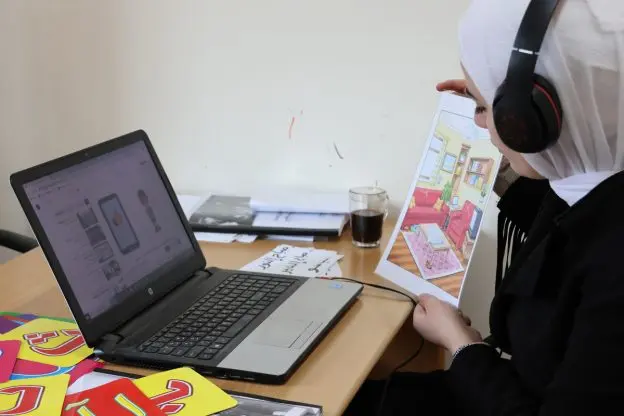
Get a glimpse into the vibrant learning experience at Kalimah Center. These snapshots capture real moments from our live classes—where students engage deeply, connect with passionate instructors, and grow in a welcoming, supportive environment.
Here Are The Reviews On Our Courses:
Our students frequently commend the excellence of our courses and the commitment shown by our instructors. You can read their complete reviews on Trustpilot.

Unlock Your Potential in Arabic and Quran with Kalimah Center!
Ready to deepen your connection with the Quran and enhance your understanding of Arabic? Join Kalimah Center today and embark on a transformative journey of learning and growth! Our professional, handpicked Online Arabic and Quran Tutors are dedicated to helping you master these essential skills with ease and expertise.
📚 Explore Our Courses:
Online Arabic Course: Tailored to your level, our comprehensive Arabic program includes 16 teaching levels and 400+ hours of personalized sessions.
Online Quran With Tajweed Course: Perfect for non-Arabic speakers, our course spans 13 levels and equips you with Tajweed mastery from beginner to advanced.
Online Arabic Course For Kids: Nurture your child’s love for Arabic with our engaging and structured program, available in 24 levels for primary, intermediate, and secondary stages.
🚀 Start Your Free Trial Today! 🚀
Don’t miss out on this life-changing opportunity to deepen your faith and knowledge. Sign up now for your free trial and take the first step towards becoming a better practicing Muslim with Kalimah Center!
Conclusion
The letter “س” is among the basic ones, whose good pronunciation, shape, and usage act as a root to Arabic development. It will be helpful in practicing it, either in writing or speaking.
FAQs about Arabic Letter “س” (Seen)
Q1: What is the Arabic letter “س” in English?
The Arabic letter “س” is pronounced as “s” in English — like the “s” sound in “sun,” “sea,” or “snake.”
Letter name: Seen (سين)
Sound: /s/ (voiceless alveolar fricative)
IPA notation: /s/
Examples:
سماء (samā’) — sky
شمس (shams) — sun
مدرسة (madrasa) — school
Q2: How do you pronounce “س” (Seen)?
Pronunciation: The letter “س” makes a soft “s” sound.
How to pronounce it:
Place the tip of your tongue near your upper teeth
Let air flow over your tongue
Do not use your vocal cords (it’s a voiceless sound)
The sound should be light and clear — like “s” in “sea“
IPA notation: /s/
Arabic name: Seen (سين)
Pronunciation: SEEN (rhymes with “bean”)
Q3: What are some common Arabic words with “س”?
Initial position (سـ):
– سهل (sahl) — easy
– سماء (samā’) — sky
– سمكة (samaka) — fish
Medial position (ـسـ):
– مدرسة (madrasa) — school
– حساس (ḥassās) — sensitive
– جسم (jism) — body
Final position (ـس):
– شمس (shams) — sun
– جسر (jasr) — bridge
– درس (dars) — lesson
Q4: What does “س” mean by itself?
“س” by itself is a prefix letter indicating future tense in Arabic.
When attached to the front of a present-tense verb, it indicates the action will happen (similar to “will” in English).
Example:
– أكتب (aktubu) — I write / I am writing
– سأكتب (sa-aktubu) — I will write
Note: The letter “س” alone is not a word, but a grammatical particle for future tense.
Q5: How is س different from ش (Sheen)?
The shapes differ: س has no dots, while ش has three dots above. Pronunciation-wise, س sounds like “s” (sun), but ش sounds like “sh” (shine). Both share the same base curved form.