Beginners can learn the Quran online or by themselves at home by following a structured path: start with Noorani Qaida to master Arabic letters, learn basic Tajweed rules for correct pronunciation, then memorize short Surahs from Juz’ Amma. The easiest approach combines a qualified online teacher with daily 20–30 minute practice sessions. Most beginners can read basic Quran within 3–6 months of consistent study.
Key Takeaway Table:
| Step | What to Do | Estimated Time |
|---|---|---|
| 1. Noorani Qaida | Learn Arabic letters, harakaat, pronunciation | 1–3 months |
| 2. Basic Tajweed | Learn pronunciation rules (Ikhfa, Qalqalah, Madd) | 2–4 months |
| 3. Find a Teacher | Ijazah-certified, online or local mosque | Ongoing |
| 4. Start Juz’ Amma | Memorize short Surahs (Al-Ikhlas, Al-Falaq, An-Nas) | 3–6 months |
| 5. Understand Meaning | Read translations, Tafsir, attend lectures | Ongoing |
| 6. Daily Practice | 20–30 min/day, consistent review | Lifelong habit |
Bismillah al-Rahman al-Rahim. Today, I’ll talk about learning the Holy Quran for beginners. This is a path of light and peace, and I’m here to guide you, step by step.
Learning Quran is not just about reading words; it is about connecting with Allah, the Most Merciful. Learning Quran is about understanding His message and living a life guided by His light. I am here to hold your hand, and together, inshallah, we will make it. Remember Allah’s words in Surah Al-Qamar:
“وَلَقَدْ يَسَّرْنَا ٱلْقُرْءَانَ لِلذِّكْرِ فَهَلْ مِن مُّدَّكِرٍ”
“And We have certainly made the Quran easy for remembrance, so is there any who will remember?” (al-Qamar, 54:17).
Allah has made it easy for us, and with patience and dedication, you will see how true this is.
Whether you want to learn Quran online, study by yourself at home, or find the easiest way to start reading — this guide covers everything a beginner needs.
Let us begin, Bismillah
What Does ‘Learning Quran for Beginners’ Actually Mean?
When we talk about “Learning Quran for Beginners,” we are referring to those who are taking their first steps in laying the foundation for a lifelong relationship with the Holy Quran. For a complete beginner, someone who is not an Arab and perhaps new to Islam, it means starting from the very beginning.
A “complete beginner” in Quran learning could be:
- A new Muslim (revert) with no prior exposure to Arabic
- A born Muslim who grew up in a non-Arabic-speaking household and never learned to read the Quran
- A child starting their first Quran lessons
- Someone who learned basic Arabic letters years ago but never progressed to actual Quran reading
Wherever you fall on this spectrum, this guide starts from absolute zero. No prior knowledge of Arabic is required.
Why Every Beginner Should Learn the Quran (And What to Expect)
Before we start anything, we must have the right niyyah (intention). Why do we learn Quran? Not just to say words, no. The Quran is the word of Allah, our Creator. It is the guide for our life, yes? It tells us how to be good Muslims, how to live a good life that pleases Allah.
Allah says in the Quran:
“كِتَـٰبٌ أَنزَلْنَـٰهُ إِلَيْكَ مُبَـٰرَكٌۭ لِّيَدَّبَّرُوٓا۟ ءَايَـٰتِهِۦ وَلِيَتَذَكَّرَ أُو۟لُوا۟ ٱلْأَلْبَـٰبِ”
“[This is] a blessed Book which We have revealed to you, [O Muhammad], that they might reflect upon its verses and that those of understanding would be reminded.” (Sad 38:29)
Allah says this book is “blessed.” Learning it brings blessings to your life, inshallah.
You must purify your heart and your intention. Why do you want to learn Quran? Is it to show off? No, no. We learn Quran to please Allah alone. This is the most important. Make du’a (supplication) to Allah to help you.
You can say, “Ya Allah, I want to learn Your Book to come closer to You. Please make it easy for me”.
How To Learn The Quran For Beginners?
Learning the Quran as a beginner follows a natural progression: foundation → recitation → memorization → understanding → daily practice. Each step builds on the previous one, and there’s no need to rush. Below, we break down each step in detail with practical examples, techniques, and resources to guide your journey.
Let’s discuss each step in details:
Step 1: Choose the Right Mushaf to Learn Quran Easily
If you’re learning Quran by yourself, a Mushaf with color-coded Tajweed and a side-by-side translation is essential — it acts as a built-in teacher for self-study. Now, you need a Mushaf, a copy of the Quran. There are many different ones. For beginners, I recommend a Mushaf with:
- Clear Arabic Script: Choose one with a simple, clear script, like the Uthmani script.
- Translation: It’s good to have a translation in your language, English, French, anything. This helps you understand the meaning. But remember, the translation is not the Quran, okay? The Quran is the Arabic words.
- Tajweed Marks: Some Mushafs have color-coded Tajweed marks. This can be helpful for beginners to see the rules visually.

My advice: Don’t just have a digital Quran on your phone. It is very good, yes, but also have a physical Mushaf. There is something special, a blessing, in holding the actual book.
Step 2: Learn Quran Basics with Noorani Qaida
For all beginners, children and adults, the best place to start is with the Noorani Qaida. This is important first step.
Why Noorani Qaida is Important for Beginners Learning Quran?
Arabic letters change shape and sound, Noorani Qaida helps you see these changes.
Noorani Qaida is like learning ABC, but more. For example, in Arabic, we have harakaat, these are like vowel sounds. Fatha, Damma, Kasra. You learn these in Noorani Qaida. This is very, very important for read Quran correctly.
For example, look:
- بِسْمِ (Bismi) – This means “In the name of.” See the Kasra under the Baa’? It makes the “bi” sound. Without it, you cannot read correct.
- اللَّهِ (Allah) – This is “Allah.” See the Shadda above the Lam? That means you double the sound, hold it little bit. All-lah.
Noorani Qaida teaches you to see these and say them right.
You can learn Noorani Qaida at Kalimah Center! Our expert, Ijazah-certified teachers will guide you through every letter, perfecting your pronunciation so you can recite with confidence.
Get Your Quran Course Free Trial

Step 3: Learn Essential Tajweed Rules
Tajweed is how we pronounce the Quran correctly. It’s not just about saying the words, but saying them beautifully, the way the Prophet Muhammad (peace be upon him) said them.
Important for Beginners Learning Tajweed: Don’t try to learn all Tajweed rules at once, okay? Start with the basic ones, like how to pronounce certain letters from the throat, how long to stretch some vowels. Your teacher will guide you, inshallah.
For example, you must know the rule of noon saakinah and tanween.
For example:
- مِنْ شَرِّ (Min Sharri) – “From the evil.” See the Noon Saakinah before the Shin? In Tajweed, we don’t say it clearly. We hide it a little. This is Ikhfa.
- خَلَقَ (Khalaqa) – “He created.” See the Qaf at the end? It has a special sound, like an echo. This is Qalqalah.
Our sheikhs (teachers) used to tell us to listen to famous reciters, like Sheikh Al-Minshawi or Sheikh Al-Husary. Listen many times, then try to imitate.
Read more about: Top Ayahs And Surahs to Recite Daily
Step 4: Find a Qualified Quran Teacher (Online or Local)
For those studying at home, online Quran classes for beginners have become the most accessible way to get qualified instruction — many platforms offer one-on-one sessions at flexible times. This is very, very important. You cannot learn Quran properly just from books or YouTube, no. You need a teacher, a qualified teacher who can guide you, correct your mistakes, and explain the difficult things.
Look for a Teacher with Ijazah to Ensure Authentic Quran Teaching
Ijazah means a certificate. A teacher with Ijazah has learned from another qualified teacher, who learned from another, all the way back to the Prophet Muhammad (peace be upon him). This is the chain of knowledge. It’s very important for learning Quran.
How to Find a Good Teacher:
- Your Local Mosque: Ask the Imam at your local mosque. He can recommend a good teacher, maybe even teach you himself.
- Online Quran Centers: Many good online centers now, like Kalimah Center, offer Quran classes with expert, Ijazah-certified teachers. You can learn from home.
Get Your Quran Course Free Trial
Don’t be shy to ask the teacher about their Ijazah. A good teacher will be happy to show you. Also, listen to them recite. Does their recitation touch your heart? Do you feel a connection? This is important.
Read more about: How to learn Quran online For Kids?
Step 5: Start Memorizing from Juz’ Amma
This is also the easiest part of the Quran to learn by heart, making it the perfect starting point for anyone asking “how do I start memorizing the Quran? The Quran is divided into 30 parts, called Juz’, yes? We usually start with Juz’ Amma, the last Juz’. Why? Because it has the shortest Surahs (chapters), easier to memorize for beginners.
Start with Surahs like Al-Ikhlas (The Sincerity), Al-Falaq (The Daybreak), and An-Nas (Mankind).

Step 6: Easy Quran Memorization Techniques for Beginners
There are many techniques, but I will share with you some of the most effective ones.
1. Repetition (Takrar) for Memorizing Quran
This is the most common and most important technique. You repeat an ayah many times until you have memorized it. But there is a right way and a wrong way to do Takrar.
- Don’t try to memorize a whole page at once. Start with one ayah, or even half an ayah if it is long.
- Don’t just repeat mindlessly. Focus on the words, the meaning, the Tajweed.
- Repeat each verse many, many times. I used to repeat each verse 20 times, 30 times, even more, until it was stuck in my head.
- After memorizing one ayah, go back and recite it together with the previous one. This helps you connect the ayat and remember the order.
Example: Let’s say you want to memorize this ayah:
“فَإِنَّ مَعَ ٱلْعُسْرِ يُسْرًا”
“For indeed, with hardship [will be] ease.” (al-Sharh 94:5)
- Repeat it 5 times, looking at the Mushaf.
- Repeat it 5 times, trying to look less at the Mushaf.
- Repeat it 5 times without looking at the Mushaf.
- If you make a mistake, go back and repeat more times.
2. Writing (Kitabah) for Memorizing Quran
Writing is a very powerful tool for memorization. When you write something down, you are engaging more of your senses.
- Write the ayah you are memorizing several times: This helps you remember the shape of the words and the spelling.
- Write from memory: After writing the ayah a few times while looking at the Mushaf, try to write it from memory.
3. The Linking Method (Rabt) for Memorizing Quran
This technique is very helpful for remembering the order of the ayat. You create a mental link between each ayah and the one that follows it.
Look for a word or a phrase in the current ayah that is similar to a word or a phrase in the next ayah.
Example: Let’s say you want to memorize the first two ayat of Surah Al-Falaq:
“قُلْ أَعُوذُ بِرَبِّ الْفَلَقِ”
(Qul a’udhu bi Rabb il-falaq)
(Say, “I seek refuge in the Lord of daybreak)
“مِن شَرِّ مَا خَلَقَ”
(Min sharri ma khalaq)
(From the evil of that which He created)
You can connect them by focusing on the word “falaq” (daybreak) and “khalaq” (created).
How to Memorize (Learn) Quran by Heart
Memorizing the Quran “by heart” (Hifz) is one of the greatest acts of worship in Islam. For beginners, the key is starting small and building momentum:
The 5-5-5 Memorization Technique:
- Read the verse 5 times while looking at the Mushaf
- Recite it 5 times looking away (check the Mushaf if you stumble)
- Write it 5 times from memory
If you can complete all 15 repetitions without error, the verse is memorized. If not, repeat the cycle.
Daily memorization capacity for beginners:
- Week 1–4: 1 short verse per day
- Month 2–3: 2–3 verses per day
- Month 4+: 3–5 verses per day (with review)
At this pace, a beginner can memorize all of Juz’ Amma (37 Surahs) within 8–12 months.
Read Also about: Noorani Qaida Course
Step 7: Understand the Meaning of What You Recite
Memorizing the Quran is a noble achievement, but understanding its message transforms your relationship with it. The Quran was revealed as guidance — and guidance requires comprehension.
1. Read a Reliable Translation
Keep a translation alongside your Mushaf. Recommended English translations include Sahih International, Dr. Mustafa Khattab’s “The Clear Quran,” and Abdul Haleem’s translation. Read the translation of every Surah you memorize — even a few verses at a time.
2. Study Tafsir (Quranic Exegesis)
Tafsir provides the context, reasons for revelation (Asbab al-Nuzul), and deeper scholarly explanations. For beginners, start with:
- Tafsir Ibn Kathir (abridged version) — widely available in English
- Tafsir As-Sa’di — clear and accessible language
- The Gracious Quran by Ahmad Zaki Hammad — modern English with Arabic context
3. Listen to Thematic Lectures
Scholars like Nouman Ali Khan (Bayyinah Institute), Mufti Menk, and Omar Suleiman offer accessible Quran explanation series on YouTube that connect verses to daily life.
4. Discuss with Your Teacher
After each lesson, ask your teacher to explain the meaning and context of the verses you studied. Understanding why a verse was revealed deepens both comprehension and emotional connection.
5. Journal Your Reflections
Keep a simple notebook where you write one reflection per day about a verse you read. What does it mean to you? How does it apply to your life? This practice, called tadabbur (contemplation), is specifically encouraged in the Quran itself (Sad 38:29).
Step 8: How to Learn Quran at Home — Build a Daily Routine
Consistency matters more than quantity. A beginner who studies 20 minutes daily will progress faster than someone who studies 3 hours once a week.
Sample Beginner Schedule (30 minutes/day):
| Time | Activity | Duration |
|---|---|---|
| After Fajr | New memorization (1–2 new verses) | 10 min |
| After Fajr | Review previous memorization | 10 min |
| Before sleep | Listen to recitation of tomorrow’s verses | 10 min |
Practical Tips:
- Anchor it to Salah: The easiest way to build a Quran habit is to attach it to a prayer you already perform. After Fajr is ideal — your mind is fresh and distractions are minimal.
- Start with 10 minutes: If 30 minutes feels overwhelming, start with 10. The goal in your first month is building the habit, not maximizing output.
- Use the “2-Day Rule”: Never skip more than one day in a row. Missing one day is human. Missing two days starts breaking the habit.
- Review is non-negotiable: Scholars say “the Quran leaves faster than a camel escaping its rope.” Dedicate at least half your study time to reviewing what you’ve already memorized.
- Track your progress: Use a simple app like Ayah App or even a paper checklist to mark which Surahs you’ve memorized and when you last reviewed them.
Step 9: Make Du’a — Never Underestimate Its Power
Finally, never underestimate the power of du’a (supplication). Pray to Allah to make your Quran learning journey easy and to grant you understanding and wisdom. Ask Him to bless your efforts and to make the Quran a source of guidance and light in your life.
“وَقَالَ رَبُّكُمُ ادْعُونِي أَسْتَجِبْ لَكُمْ”
“And your Lord says, ‘Call upon Me; I will respond to you.'” (Ghafir 40:60)
Allah loves those who call upon Him. So, raise your hands and make du’a sincerely.
For a du’a related to learning the Quran, you might say:
“O Allah, make the Quran the spring of my heart, the light of my chest, the banisher of my sadness, and the reliever of my distress.”
“O Allah, I ask you for beneficial knowledge, a goodly provision, and accepted deeds.”
“O Allah, make learning the Quran easy for me, open my heart to its wisdom, and grant me success in this life and the hereafter.”
Master Arabic with Kalimah Center
Join our expert-led online classes and start your journey toward Arabic fluency today.
Book Your Free TrialBeginner’s Quran Learning Roadmap: Your First 6 Months
Here’s a realistic timeline for what a consistent beginner (20–30 min/day) can expect:
| Month | Milestone | Focus Area |
|---|---|---|
| Month 1 | Recognize all 28 Arabic letters and their forms | Noorani Qaida (Lessons 1–8) |
| Month 2 | Read letters with harakaat (Fatha, Damma, Kasra) | Noorani Qaida (Lessons 9–17) |
| Month 3 | Read short Quranic words and phrases fluently | Complete Noorani Qaida + begin basic Tajweed |
| Month 4 | Recite short Surahs with basic Tajweed | Memorize Al-Fatiha, Al-Ikhlas, Al-Falaq, An-Nas |
| Month 5 | Apply Tajweed rules (Noon Sakinah, Madd) while reading | Continue Juz’ Amma memorization (5–8 Surahs) |
| Month 6 | Read unfamiliar Quran pages with moderate fluency | Independent reading practice + ongoing review |
Important: This timeline assumes consistent daily practice with teacher guidance. Progress varies by individual — some learners move faster, others need more time. Neither is wrong. The Prophet ﷺ said: “The one who recites the Quran and struggles with it, stammering, will have a double reward.” (Sahih Muslim)
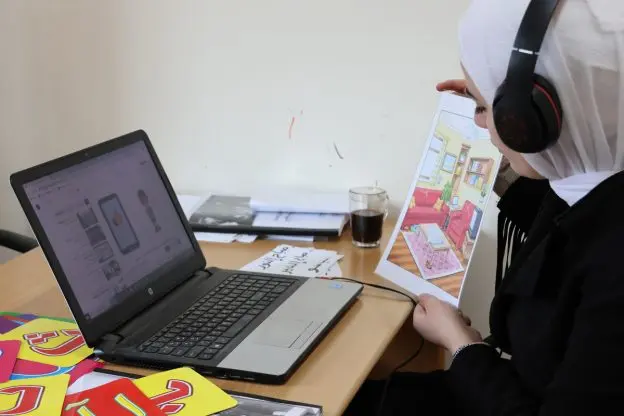
Inside Kalimah Center: Moments from Our Courses
Get a glimpse into the vibrant learning experience at Kalimah Center. These snapshots capture real moments from our live classes—where students engage deeply, connect with passionate instructors, and grow in a welcoming, supportive environment.
Can You Learn the Quran By Yourself at Home?
Yes — with the right resources and structure, you can begin learning the Quran by yourself. Many Muslims around the world start their Quran journey independently, especially those without access to local mosques or teachers.
What you CAN learn by yourself:
- Arabic letter recognition using Noorani Qaida books or apps
- Basic reading skills through guided audio resources
- Memorization of short Surahs using recitation apps like Tarteel AI
- Quran meaning and context through translations and Tafsir
What you NEED a teacher for:
- Tajweed correction — subtle pronunciation errors are nearly impossible to catch alone
- Makharij al-Huroof (letter articulation points) — requires someone to listen and correct in real-time
- Advanced memorization review — a teacher tests your retention and identifies weak spots
Self-study plan for beginners learning Quran alone:
| Week | Daily Activity (20–30 min) | Resource |
|---|---|---|
| Weeks 1–4 | Learn Arabic letters and harakaat | Noorani Qaida book + app |
| Weeks 5–8 | Practice connecting letters into words | Noorani Qaida (advanced lessons) |
| Weeks 9–12 | Read short Surahs with audio guidance | Quran.com + Sheikh Al-Husary audio |
| Week 13+ | Begin memorizing Al-Fatiha, last 3 Surahs | Ayah App for tracking |
My honest advice: Start by yourself if you must, but find a qualified teacher as soon as possible — even online. A teacher in one hour can correct mistakes that would take you months to discover alone. Many online Quran academies offer affordable one-on-one sessions that fit any schedule.
7 Common Mistakes Beginners Make When Learning the Quran
Avoid these pitfalls to make your journey smoother:
- Skipping Noorani Qaida and jumping straight to Quran reading. This is like trying to write essays before learning the alphabet. Your pronunciation will have foundational errors that become harder to fix later.
- Memorizing without understanding Tajweed. Memorizing verses with incorrect pronunciation means you’ll need to re-learn them later. Learn Tajweed alongside memorization from the start.
- Trying to memorize too much too fast. Enthusiasm is beautiful, but overloading yourself leads to burnout and poor retention. One verse perfected is better than one page forgotten.
- Neglecting review (Muraja’ah). The biggest regret of Quran students worldwide: memorizing new content while old memorization fades. Follow the rule: spend at least 50% of your study time on review.
- Learning without a teacher. Apps and YouTube are excellent supplements, but they cannot hear your pronunciation, catch subtle errors, or adjust to your specific weaknesses. A qualified teacher is irreplaceable.
- Comparing your progress to others. Every learner’s journey is unique. Someone who grew up hearing Arabic will naturally progress faster than someone encountering the language for the first time. Focus on your own growth.
- Waiting for the “perfect time” to start. There is no perfect time. The best time to begin learning the Quran was years ago. The second best time is today.
Best Quran Learning Apps & Resources for Beginners
Complement your teacher-guided learning with these trusted tools:
Apps:
| App | Best For | Free/Paid |
|---|---|---|
| Quran.com | Reading, translations, audio recitations | Free |
| Tarteel AI | AI-powered recitation feedback and mistake detection | Freemium |
| Ayah App | Memorization tracking and review scheduling | Free |
| Learn Quran Tajwid | Interactive Tajweed lessons with visual guides | Paid |
| Noorani Qaida App (FanzStudio) | Interactive letter-by-letter Noorani Qaida | Free |
Reciters to Listen To (for pronunciation modeling):
- Sheikh Mahmoud Khalil Al-Husary — slow, clear, perfect for beginners learning Tajweed
- Sheikh Muhammad Siddiq Al-Minshawi (Mu’allim version) — repeats each verse, ideal for memorization
- Sheikh Mishary Rashid Alafasy — beautiful, clear recitation widely available online
Recommended Books:
- Noorani Qaida by Molvi Noor Muhammad Ludhyanvi
- Tajweed Rules of the Quran by Kareema Carol Czerepinski (3-part series)
- The Clear Quran translation by Dr. Mustafa Khattab
- Tafsir Ibn Kathir (abridged, 10-volume English edition)
The Easiest Way to Learn Quran for Beginners
If you’re feeling overwhelmed by steps and techniques, here’s the simplest possible approach that works:
The “3-Before-3” Method:
- 3 letters per day (when learning Noorani Qaida) — you’ll finish the Arabic alphabet in under 2 weeks
- 3 repetitions per session of your current memorization — morning, afternoon, before bed
- 3 minutes of listening to a reciter before you sleep — your brain processes audio during sleep
Why this works: It removes decision fatigue. You don’t need to plan elaborate study sessions. Just do your “3-before-3” every single day, and within 6 months you’ll be reading and memorizing Quran with confidence.
The easiest Surahs to start with (ranked by length and difficulty):
| Rank | Surah | Verses | Why It’s Easy |
|---|---|---|---|
| 1 | Al-Ikhlas (112) | 4 | Shortest, simple vocabulary, recited in daily prayers |
| 2 | Al-Kawthar (108) | 3 | Only 3 verses, very short words |
| 3 | Al-Asr (103) | 3 | 3 verses with profound meaning |
| 4 | An-Nas (114) | 6 | Repetitive structure makes memorization natural |
| 5 | Al-Falaq (113) | 5 | Pairs with An-Nas (learn them together) |
| 6 | Al-Fatiha (1) | 7 | Essential for Salah — most frequently recited Surah |
Best Way to Learn Quran Online for Beginners
Online Quran learning has transformed how beginners access quality instruction. Whether you live in a non-Muslim country, have a busy schedule, or simply prefer learning from home, online Quran classes offer flexibility without sacrificing quality.
What to look for in an online Quran course:
| Feature | Why It Matters |
|---|---|
| Ijazah-certified teachers | Ensures your teacher’s recitation traces back to the Prophet ﷺ through an unbroken chain |
| One-on-one sessions | Personalized feedback on your specific pronunciation mistakes |
| Structured curriculum | Clear progression from Noorani Qaida → Tajweed → Recitation → Memorization |
| Flexible scheduling | Lets you maintain consistency without disrupting work or school |
| Free trial available | Test the teacher and platform before committing financially |
| Male and female teacher options | Important for comfort and cultural preferences |
Online vs. in-person Quran learning:
| Factor | Online | In-Person (Mosque/Teacher) |
|---|---|---|
| Accessibility | Available anywhere with internet | Requires proximity to a mosque/teacher |
| Scheduling | Highly flexible | Fixed class times |
| One-on-one attention | Common (private sessions) | Often group settings |
| Cost | Generally more affordable | Varies widely |
| Social/community aspect | Limited | Strong — peer motivation |
| Best for | Busy adults, remote learners, self-paced study | Children, learners who need in-person structure |
Top platforms for online Quran classes for beginners:
- Look for academies with Ijazah-certified teachers (preferably Al-Azhar trained)
- Prioritize platforms offering structured Noorani Qaida → Tajweed → Recitation pathways
- Choose platforms with free trials so you can assess teacher quality before paying
- Ensure the platform offers progress tracking and regular assessments
Here Are The Reviews On Our Courses:
Our students frequently commend the excellence of our courses and the commitment shown by our instructors. You can read their complete reviews on Trustpilot.

Learn Quran Online with Expert Teachers
If you want to learn Quran correctly, with Tajweed, like Prophet Muhammad (peace be upon him) recited, you need a good teacher. Like in Kalimah Center
Here is what we offer in our Quran & Tajweed Learning Courses, simple and clear:
- Start from the very beginning: We teach you Arabic letters, how to pronounce them right. This is with Noorani Qaida. Very important first step. If your pronunciation isn’t good, your Quran reading also not good.
- Learn Tajweed rules step by step: We don’t throw everything at you at once. We have levels, from easy to hard. You learn rules of Noon and Meem, rules of prolongation, where letters come from in your mouth – all these things.

- We have teachers with Ijazah, most of them from Al-Azhar University.
- We offer one-on-one classes, so the teacher can focus on you.
- We have classes for all levels, from beginners to advanced.
- We teach Arabic, Quran, and Islamic studies.
- We have male and female teachers.
- Affordable.
📚 Explore Our Courses:
Online Arabic Course: Tailored to your level, our comprehensive Arabic program includes 16 teaching levels and 400+ hours of personalized sessions.
Online Quran With Tajweed Course: Perfect for non-Arabic speakers, our course spans 13 levels and equips you with Tajweed mastery from beginner to advanced.
Online Arabic Course For Kids: Nurture your child’s love for Arabic with our engaging and structured program, available in 24 levels for primary, intermediate, and secondary stages.
🚀 Start Your Free Trial Today! 🚀
Don’t miss out on this life-changing opportunity to deepen your faith and knowledge. Sign up now for your free trial and take the first step towards becoming a better practicing Muslim with Kalimah Center!
Get Your Quran Course Free Trial

Conclusion:
Choose a Mushaf that suits beginners—clear script, translations, and Tajweed marks. Start with Noorani Qaida for letter recognition and basic Tajweed rules with a skilled teacher to perfect pronunciation. A certified teacher ensures you recite correctly and authentically.
Focus on Juz’ Amma’s shorter Surahs and use repetition, writing, and connections between ayahs to memorize effectively. Pair this with translations, Tafsir, and consistent practice. Dedicate time daily, review often, and rely on du’a for guidance and success in your Quranic journey.
FAQs about Learning Quran for Beginners
Q1: How can I learn the Quran by myself at home?
Start with Noorani Qaida to learn Arabic letters, then use audio resources like Sheikh Al-Husary’s recitation to practice reading. Apps like Tarteel AI can give you pronunciation feedback. However, for Tajweed accuracy, supplement self-study with at least one weekly session with a qualified teacher — many are available online at affordable rates.
Q2: What is the easiest way to learn the Quran for beginners?
The easiest approach is to start with the shortest Surahs (Al-Ikhlas, Al-Kawthar, Al-Asr), memorize just one verse per day, and listen to a slow reciter like Sheikh Al-Husary before sleeping. Consistency of 15–20 minutes daily is more effective than long, irregular study sessions.
Q3: How long does it take to learn to read the Quran for beginners?
With consistent daily practice (20–30 minutes), most beginners can read basic Quranic Arabic within 3–6 months. This includes completing Noorani Qaida (1–3 months) and basic Tajweed (2–4 months). Full memorization of Juz’ Amma takes an additional 6–12 months.
Q4: What is the best way to learn Quran online?
Choose an online academy with Ijazah-certified teachers, one-on-one sessions, and a structured curriculum (Noorani Qaida → Tajweed → Recitation → Memorization). Look for platforms offering free trials so you can test teacher quality before committing. Flexible scheduling and progress tracking are also important features.
Q5: Can I learn Quran without knowing Arabic?
Absolutely. Most Quran learning programs for beginners are designed for non-Arabic speakers. You’ll start with Noorani Qaida, which teaches Arabic letters and sounds from scratch. You don’t need to learn conversational Arabic — Quranic Arabic reading is a separate skill that follows its own learning path.