Online Arabic speaking courses teach you to communicate in Arabic through live conversation practice with native tutors, pronunciation coaching, and structured dialogue training. The best programs combine real-time speaking sessions, cultural context, and consistent feedback. Beginners can hold basic conversations within 2–3 months; conversational fluency typically takes 6–12 months with daily practice.
Key Takeaway Table
| Factor | Details |
|---|---|
| Best for | Beginners to intermediate English speakers |
| Top method | Live 1-on-1 sessions with native tutors |
| Time to basic conversation | 2–3 months |
| Time to fluency | 6–12 months |
| Key skill focus | Speaking, listening, pronunciation |
| Dialect options | MSA, Quranic, Conversational |
| Best platform | Kalimah Center — structured + native teachers |
| Starting price | From £42/month |
What Is an Arabic Speaking Course and How Does It Work?
Arabic-speaking classes and courses help you speak Arabic confidently and fluently. Unlike traditional grammar-based courses, these classes and courses emphasize real-time practice. You won’t just memorize vocabulary or study in isolation; instead, you will speak Arabic. You’ll engage in conversations, role-play everyday situations, and receive feedback to help improve your pronunciation and fluency.
MSA vs Colloquial Arabic — Which Should You Learn to Speak?
This is the first question every new learner should answer — and most courses don’t explain it clearly enough.
Modern Standard Arabic (MSA / Fusha)
Understood across all 22 Arabic-speaking countries. Used in news, formal writing, education, and official speech. If you want one form of Arabic that works everywhere and gives you access to books, media, and formal communication — start here.
Colloquial / Dialectal Arabic
What people actually speak at home and in the street. Egyptian Arabic is the most widely understood dialect globally (thanks to Egyptian cinema and TV). Levantine (Syria, Lebanon, Jordan) is common in digital media. Gulf Arabic is useful for business in the Gulf states.
Quranic Arabic
Classical Arabic used in the Qur’an. Shares the grammatical foundation of MSA but with specific vocabulary and syntax. The right choice if your primary goal is religious understanding, not everyday conversation.
Our recommendation for English speakers: Start with MSA. It gives you a grammatical foundation that makes every dialect easier to learn later. Once you can hold a basic MSA conversation, picking up Egyptian or Levantine colloquial takes a fraction of the time.
How to Choose the Right Arabic Speaking Course: 5 Things to Check
With so many options available, choosing the best Arabic speaking course online can feel overwhelming. The key is to look for structured programs that combine live speaking practice, guided lessons, and consistent feedback. While many platforms promise fast results, the most effective courses focus on long-term fluency through regular conversation and real-world practice.
Ask yourself these questions when choosing a course:
- Do I prefer learning at my own pace, or do I want live interaction?
- Do I want an intensive course, or am I looking for something more casual?
- What is my learning goal—fluent conversation, travel phrases, or religious study?
Regardless of your learning style, I recommend finding a course that includes speaking practice, whether it’s online or in person.
A well-structured Arabic-speaking course provides a balance between practice and theory, covering essential topics like How to introduce yourself, ask questions, and engage in basic dialogues. Learn phrases relevant to different Arab countries and their dialects. Correcting and improving your Arabic sounds, which are quite different from English.
When choosing an Arabic-speaking course, here are a few things you should keep in mind:
1. Interactive Speaking Practice
Choose courses that focus on speaking Arabic. Some courses focus more on grammar or writing, but for conversation, you need real-time speaking practice.
2. Native Qualified Arabic Teachers
The best way to learn how to speak like a native is to learn from a native speaker. Native Arabic teachers can help you with pronunciation, common phrases, and correct use of vocabulary.

3. Real-Life Conversations
One of the best ways to learn to speak is to practice real-life conversations. Many courses just teach you phrases, but these are not always helpful in daily life. You need to learn how to speak in context. For example, when going to a restaurant, you should know how to order:
- أريد قائمة الطعام من فضلك (Uridu qaa’imat at-ta’am min fadlik) – “I want the menu, please.”
Look for lessons that make you practice real conversations like this, not just random phrases.
Read Also: Best 15 Learn Arabic Courses And Classes
4. Cultural Integration
When learning to speak Arabic, it’s very important to also understand the culture. For example, in many Arab countries, greetings are very important.
For example, at Kalimah Center, we teach students how to greet people according to Arabic customs, which is important if you are learning for travel or work in the Arab world. You don’t just say “hello” and move on. There’s more to it:
- السلام عليكم (As-salamu alaykum) – “Peace be upon you.”
- وعليكم السلام (Wa alaykum as-salam) – “And peace be upon you, too.”
Good lessons will teach you not only the language but also the cultural context, so you know how to interact politely and naturally.
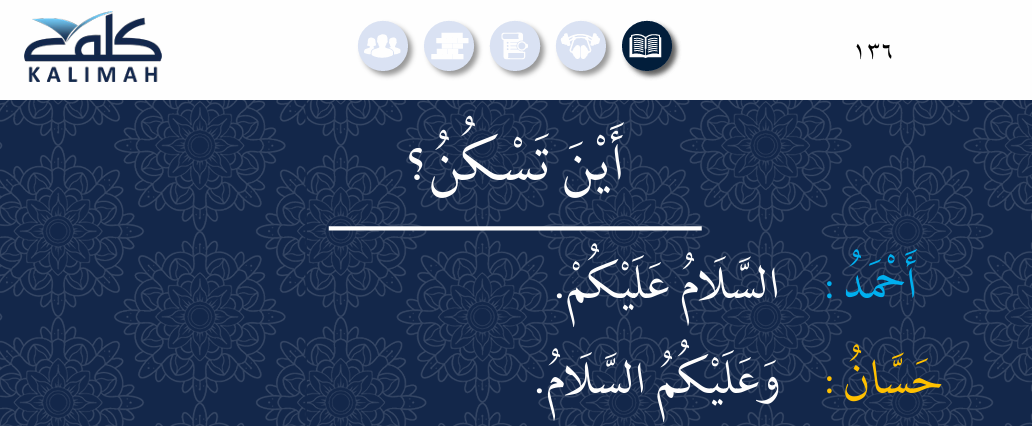
* Excerpted from Kalimah’s Arabic Course Curriculum.
5. Feedback on Pronunciation
Your pronunciation is very important when learning Arabic. Many students learn words but still make mistakes in pronunciation. You should look for a teacher who gives detailed feedback on how you say each word.
For example, the letter ع (Ayn) can be very difficult for non-native speakers. It’s not just a sound, it’s a feeling in the throat.
A good teacher will help you practice this sound by repeating and correcting it until it feels natural.
What Makes Arabic Pronunciation Difficult for English Speakers?
Arabic has several sounds that simply don’t exist in English, and mispronouncing them doesn’t just sound wrong — it can change the meaning of a word entirely. Here are the four most common challenges for English speakers:
1. Emphatic consonants — Letters like ص (Saad) vs س (Seen) sound similar to untrained ears but are completely different in Arabic. Mixing them changes word meanings.
2. Guttural sounds — ع (Ayn) and غ (Ghayn) are produced deep in the throat. There is no English equivalent. These require physical practice with a native speaker — not just listening to recordings.
3. The letter ح (Ha) — A strong, breathy H sound from the throat. Not the same as the English H in “hello.” Getting this wrong is one of the most common beginner errors.
4. Short vs long vowels — Arabic distinguishes between short and long vowels in ways that affect meaning. English speakers often flatten these distinctions instinctively.
The solution to all four is the same: regular sessions with a native tutor who gives immediate pronunciation feedback. No app or recording can replicate this.
Master Arabic with Kalimah Center
Join our expert-led online classes and start your journey toward Arabic fluency today.
Book Your Free TrialRead more about Top 15 Arabic Tutors for High School Students: Master Arabic with Native Expert Guidance
Best Arabic Speaking Courses Online (Compared)
With so many options available, how do you find the best Arabic speaking course online? You need to find a course that is structured and consistent. Many online courses promise fast results, but learning Arabic takes time and patience.
When you look for Arabic speaking courses, there are many options, but not all of them are the same.
In this section, I will share with you some of the best options for Arabic speaking courses and why they are helpful.
1. Kalimah Center’s Structured Arabic Course
At Kalimah Center, we offer one of the best Arabic courses. What makes it different? We focus on structured learning. Every lesson is planned carefully. First, we start with basic phrases like:
- كيف حالك؟ (Kayfa haluka?) – “How are you?”
- أنا بخير، شكراً (Ana bikhayr, shukran) – “I’m fine, thank you.”
We practice these phrases until students are comfortable. After that, we slowly add more difficult sentences. This helps you build confidence step by step.
One of the most popular courses at Kalimah Center is Learn Everyday Life Topics & Start A Dialogue in Arabic. This course is for beginners who want to talk about daily life activities like shopping (التسوق), school (المدرسة), family (العائلة), and work (العمل). The course uses the book “Al-Arabiyya Bayna Yadayka” (العربية بين يديك) and includes many dialogue training sessions with your teacher to help you speak confidently.
One of the things that sets Kalimah Center’s Arabic-speaking course apart is its focus on real conversations that you can use in everyday life. In our classes, we don’t just teach isolated words or phrases. Instead, we guide you through dialogues like this one, where a family introduces each member:

Translation:
Ali: Peace be upon you.
Uthman: And peace be upon you, too.
Ali: This is a picture of my family.
Uthman: Masha’Allah! Who is this?
Ali: This is my father, Adnan. He is an engineer.
Uthman: And who is this?
Ali: This is my mother, Saeeda. She is a doctor.
This is just one example of the many dialogues you will practice in our Arabic course. Each conversation is designed to help you master important vocabulary, understand sentence structure, and improve your ability to hold natural conversations in Arabic.
For those who are already at an intermediate Arabic level, Kalimah Center offers the Learn To Speak About Societal Topics in Arabic. This course focuses on discussing important societal topics like marriage (الزواج), education (التعليم), and pollution (التلوث).

At Kalimah Center, we focus a lot on speaking. Why? Because your speaking skill is a mirror of your listening skill. If you don’t hear enough Arabic, it will be hard for you to speak confidently. That’s why, in our Arabic speaking courses, teachers speak mostly in Arabic. We encourage students to listen and then repeat what they hear.
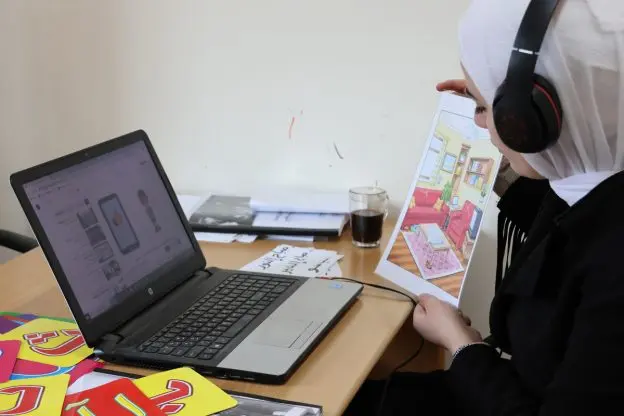
Watch this video showcasing a lesson from Kalimah Center Arabic course in action! You’ll see teacher Hamada Mohamed guiding a student through conversation practice, focusing on introductions. The teacher reads phrases and the student repeats, building confidence in spoken Arabic.
Our experienced native Arabic teachers provide personalized guidance and support, helping you overcome challenges and achieve your language goals. Ready to start speaking Arabic with confidence?
Join us for a FREE trial lesson today!
2. ArabicPod101 — Best for Self-Paced Audio Learners
ArabicPod101 delivers structured lessons through audio and video, making it ideal for learners who prefer studying at their own pace. Lessons are bilingual (Arabic/English), which helps beginners follow along without getting lost. The platform covers vocabulary, grammar, and cultural notes effectively.
Limitation: No live speaking practice. You listen and repeat, but there’s no real-time feedback on your pronunciation or fluency — which is the single most important element of a speaking course. Best used as a supplement to live tutoring, not a standalone solution.
Best for: Commuters, self-studiers, and learners building passive comprehension alongside a live course.
Browse the best Arabic speaking Course from here.
3. Preply — Best for Flexible 1-on-1 Scheduling
Preply connects you with independent Arabic tutors for private lessons. You can filter by price, native language, teaching style, and availability — giving you strong control over who you learn from. Ideal for learners who want maximum schedule flexibility or have specific goals (dialect, business Arabic, exam prep).
Limitation: Tutor quality varies significantly. Without a standardized curriculum, lesson structure depends entirely on your chosen tutor. Progress can be inconsistent without a clear learning path.
Best for: Intermediate learners who already know what they need to work on and want targeted, flexible practice sessions.
Join us for a FREE trial lesson today!
Read more about Speaking Arabic Classes in UAE, Dubai And Sharijah
Benefits of Taking an Arabic Speaking Course Online
Online Arabic speaking courses offer flexibility and accessibility that traditional classrooms cannot match. You can learn from native Arabic tutors regardless of your location, schedule lessons at convenient times, and access learning materials anytime.
Another major benefit is personalized learning. Many online platforms provide one-on-one sessions, allowing you to focus on your weaknesses—especially pronunciation and fluency. Additionally, online courses often include recorded sessions, interactive exercises, and real-time feedback, all of which accelerate your speaking progress.
How Long Does It Take to Speak Arabic Fluently?
The time required to learn spoken Arabic depends on your goals, consistency, and learning method. For basic conversation, most learners can start speaking simple Arabic within 2–3 months with regular practice.
However, reaching conversational fluency typically takes 6–12 months, especially if you practice speaking daily with native tutors. Intensive Arabic speaking courses can significantly shorten this timeline by immersing you in real conversations.
Arabic Speaking Course for English Speakers: What to Expect
For beginners, taking an Arabic speaking course in English can be a great help. Sometimes, learning everything in Arabic right from the start can be overwhelming, especially if you don’t know any Arabic yet. By having explanations in English, students can better understand the structure of the language before jumping into full conversations.
At Kalimah Center, we offer classes where English is used to explain the more complex rules, but then switch to Arabic for speaking practice. This method has been successful for many students, helping them build confidence without feeling lost.
How to Start Speaking Arabic as a Complete Beginner: A Step-by-Step Roadmap
This practical roadmap streamlines your language journey by prioritizing phonetics and high-frequency phrases to build immediate conversational confidence. By following these progressive steps, you will transition from basic sounds to consistent daily fluency through immersive and structured practice.
Step 1 — Learn to make Arabic sounds before words (Week 1–2)
Arabic has sounds that don’t exist in English — like ع (Ayn), خ (Kha), and غ (Ghayn). Before memorizing phrases, spend your first two weeks training your mouth and ear on these sounds. A native tutor is essential here — apps cannot correct your throat positioning.
Step 2 — Master 50 core phrases, not 500 random words (Week 2–4)
Vocabulary lists don’t make you a speaker. Focus on 50 high-frequency, conversational phrases you can use immediately: greetings, introductions, asking for directions, ordering food. Practice each one until it’s automatic — not just recognized.
Step 3 — Join a live speaking course with a structured curriculum (Week 3 onwards)
Self-study has limits. By week three, you need real conversation with a native speaker who can correct you in real time. Choose a course with a clear progression path — not just open-ended tutoring sessions.
Step 4 — Speak daily, even for 15 minutes (Ongoing)
Daily short practice outperforms weekly long sessions every time. Use your commute, lunch break, or morning routine. Talk to yourself in Arabic. Narrate what you’re doing. Fluency is built in frequency, not marathon study sessions.
Step 5 — Add listening immersion alongside your lessons (Month 2+)
Your speaking ability is directly capped by your listening ability. Add Arabic podcasts, YouTube channels, or news (Al Jazeera Arabic) as background listening once you’ve built a foundation. You’ll start recognizing words from your lessons in the wild — and that’s when confidence accelerates.
Why Structured Arabic Speaking Courses Get Faster Results
At Kalimah Center, we’ve seen time and time again how our students go from hesitant speakers to confident Arabic conversationalists. Our Arabic course is designed to get you talking from day one.
We provide a comfortable environment where you can practice without fear of mistakes.
Enroll in our Learn Everyday Life Topics & Start A Dialogue in Arabic course today!
- Learn about family, work, shopping, and more.
- Practice dialogues with your teacher.
- Build the confidence to speak Arabic in everyday situations.
Get started today for a FREE trial class and start speaking Arabic confidently!

Plus, our group classes are great for interaction with other learners.
Join Kalimah Intensive Group Classes now and benefit from:
- More interactive lessons at a fraction of the cost
- Increased motivation and better results
- Opportunity to practice and ask questions in a small group
- Latest Kalimah books and teaching materials
- Flexible online format – learn from anywhere!
- Connect with Fellow learners from around the world
Master Arabic with Kalimah Center
Join our expert-led online classes and start your journey toward Arabic fluency today.
Book Your Free TrialFAQs About Arabic Speaking Courses
Q1. What is the best Arabic speaking course online for English speakers?
The best Arabic speaking courses for English speakers combine live native-tutor sessions, pronunciation correction, and real-life dialogue practice. Kalimah Center, ArabicPod101, and Preply are strong options — but Kalimah Center is the only one offering a fully structured curriculum with Al-Azhar qualified teachers and a free trial lesson.
Q2. What’s the difference between spoken Arabic and Modern Standard Arabic?
Spoken Arabic (colloquial/dialect) is used in daily conversation and varies by country — Egyptian, Levantine, Gulf. Modern Standard Arabic (MSA/Fusha) is formal, used in media, education, and writing. Most learners start with MSA as a base, then layer in a dialect. Quranic Arabic is a separate track for religious study.
Q3. Can I learn conversational Arabic online without prior experience?
Yes. Structured online courses like Kalimah Center’s beginner programme start from zero — covering the alphabet, pronunciation, and everyday phrases before progressing to full conversations. Most complete beginners can hold simple Arabic dialogues within 8–12 weeks of consistent practice.
Q4. Is an Arabic speaking course taught in English helpful for beginners?
For most English-speaking beginners, yes. Having grammar rules and vocabulary explained in English reduces overwhelm in the early stages. The key is that lessons should switch to Arabic for actual speaking practice — not stay in English throughout. Kalimah Center uses this blended approach effectively.
Q5. How many hours per week do I need to practice spoken Arabic to improve?
Research on language acquisition suggests a minimum of 3–5 hours per week of active speaking practice for noticeable progress. Even 20 minutes of daily tutor-led conversation is more effective than longer, infrequent sessions. Consistency matters more than total hours.