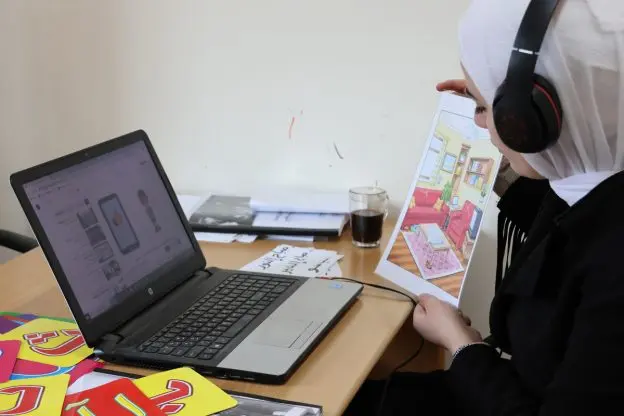
To practice Arabic speaking effectively, engage in daily activities like shadowing native speakers, narrating your routine in Arabic, and using language exchange apps such as HelloTalk or Tandem. Combine structured lessons with real-world practice: talk to yourself, record your voice, and role-play common scenarios like ordering food or asking directions. Consistent 15-30 minute daily sessions yield better results than sporadic longer study periods.
Key Takeaway Table:
| Practice Method | Best For | Time Needed | Cost |
|---|---|---|---|
| Shadowing native speakers | Pronunciation & rhythm | 10-15 min/day | Free |
| Language exchange apps | Real conversation | 20-30 min/day | Free |
| Self-narration in Arabic | Building confidence | 5-10 min/day | Free |
| Online tutoring (Kalimah) | Structured feedback | 30-60 min/session | Paid |
| Role-playing scenarios | Practical fluency | 15 min/day | Free |
Over 15 years teaching Arabic, I’ve noticed one pattern: students who prioritize speaking from day one progress 3x faster than those who focus solely on grammar. Yet most learners struggle to find the right practice methods.
The challenge isn’t talent—it’s technique. Arabic requires specific practice strategies that differ from European languages. Your mouth needs to form unfamiliar sounds (ع, ح, غ). Your brain must process right-to-left text while building conversational reflexes. Standard study methods fall short.
This guide shares 11 field-tested methods I use with students at Kalimah Center, from complete beginners to advanced learners. You’ll discover free daily techniques, technology tools, and structured approaches that build real speaking ability—not just theoretical knowledge. By the end, you’ll have a personalized practice plan that fits your schedule and learning style.
Why Arabic Speaking Practice Matters More Than Grammar Study
Research in second language acquisition shows that production (speaking/writing) creates stronger neural pathways than reception (reading/listening). When you speak Arabic, your brain simultaneously processes meaning, retrieves vocabulary, applies grammar rules, and coordinates mouth movements.
This multi-system activation is why 30 minutes of conversation equals roughly 2 hours of passive study in terms of retention.
The Arabic-specific challenge: Unlike Spanish or French, Arabic’s diglossia means you’re essentially learning two languages—Modern Standard Arabic (MSA) for formal contexts and a colloquial dialect for daily life. Early speaking practice helps you internalize which register to use when, a skill no textbook teaches effectively.
11 Proven Methods to Practice Arabic Speaking Daily
If you want to speak Arabic well, you must practice Arabic speaking every day. It’s like exercising; the more you do, the stronger you get. So, how do you start? Here are some ideas that I recommend. These are not the usual ideas you find everywhere. These tips come from my years of experience teaching students just like you.
The good news? Most of the techniques facilitate practicing Arabic speaking for free.
1. Shadowing Technique: Listen and Repeat Like a Native Speaker
A very simple but powerful method to practice Arabic speaking is to listen and repeat. Find short dialogues in Arabic, listen carefully, and then repeat what you hear.
Watch this video showcasing a lesson from Kalimah Center Arabic course in action! You’ll see teacher Hamada Mohamed guiding a student through a conversation practice, focusing on introductions. The teacher reads phrases and the student repeats, building confidence in spoken Arabic.
Our experienced native Arabic teachers provide personalized guidance and support, helping you overcome challenges and achieve your language goals. Ready to start speaking Arabic with confidence?
Join us for for a FREE trial lesson today!
Master Arabic with Kalimah Center
Join our expert-led online classes and start your journey toward Arabic fluency today.
Book Your Free Trial2. Speak Out Loud to Yourself
This may sound strange, but trust me, it works! When you’re alone, talk to yourself in Arabic. Start with easy sentences.
For example, when you wake up, say, “صباح الخير” (Sabah al-khair) – Good morning. When you get dressed, say “أنا أرتدي قميص أزرق” (Ana artadi qamees azraq) – I am wearing a blue shirt.
Why do this? Because your brain needs to hear your own voice speaking Arabic. It gets you used to thinking in Arabic. It’s okay if you make mistakes. You are your own best teacher sometimes!
3. Create a Daily Routine in Arabic
Choose a few activities you do every day and speak about them in Arabic. For example, when you make coffee, say each step out loud:
- “أنا أضع الماء في الغلاية” (Ana ada’ al-ma’ fi al-ghalayah) – I am putting water in the kettle.
- “أنا أشرب القهوة” (Ana ashrab al-qahwah) – I am drinking coffee.
By repeating these sentences every day, you build confidence. You are practicing speaking, not just learning new words. This is very important! It makes Arabic feel like part of your life, not just a subject you study.
4. Talk to Objects Around You
Here’s a fun one! Look around the room and talk to the objects. Pretend the chair is your friend and ask it, “كيف حالك؟” (Kayfa halak?) – How are you? Or say, “أنتَ كبير جدًا” (Anta kabeer jiddan) – You are very big.
This may sound silly, but it’s a very creative way to practice speaking without pressure. You are still using your mouth, tongue, and brain to speak Arabic. The more you use them together, the better you get.
5. Narrate Your Day in Arabic
Before you go to bed, try to tell the story of your day in Arabic. For example, you can say:
- “اليوم ذهبت إلى السوق” (Al-yawm dhahabtu ila as-souq) – Today, I went to the market.
- “اشتريت خضروات وفاكهة” (Ishtaraytu khadrawat wa fawakih) – I bought vegetables and fruits.
Don’t worry about perfect grammar. This is about practicing speaking. The more you practice, the more your brain starts thinking in Arabic. Soon, you will find it easier to speak without translating from your language.
6. Record Yourself Speaking Arabic
One powerful technique is to record yourself speaking Arabic. Pick a topic, set a timer for one minute, and just speak. For example, talk about your family, your hobbies, or what you ate for lunch.
Don’t stop. Even if you don’t know the words, try to describe them. You might say, “أنا أكلت شيئًا لذيذًا جدًا، لكن لا أعرف اسمه بالعربي” (akaltu shay’ lazeez jiddan, lakin la a’rif ismuh bil-arabi) – I ate something very delicious, but I don’t know its name in Arabic.
After you finish, listen to your recording. You will hear where you can improve. You might also feel proud of how much you already know! This method helps you track your progress over time.
7. Practice Speaking Arabic Apps and Websites
Connect with native Arabic speakers who want to learn your language. You can chat, voice call, or even video chat for free! Some popular options include HelloTalk, Tandem, and Speaky.
- ِHelloTalk
Connect with native speakers worldwide for language exchange. Chat, voice call, or even video call to practice in real-time.

- Tandem
Similar to HelloTalk, this app focuses on connecting language learners for conversation practice. Find a partner and start chatting!

8. Volunteer with Arabic-speaking communities
Offer your skills and time to organizations that serve Arabic speakers. You’ll gain valuable conversation practice while making a difference.
9. Shadow Native Arabic Speakers
We use this technique a lot in the classroom. Find a short video or audio of a native speaker talking. It can be anything – a news clip, a podcast, even a cartoon. Now, play it and try to copy what they say at the same time, exactly as they say it.
- It’s like you’re their shadow, following their every word.
- Try to match their speed, their tone, even their little pauses.
This helps your mouth and brain get used to the sounds of Arabic. It’s like training for a sport. The more you practice, the better you become.
Example:
- Video: يقول المذيع: “الطقس اليوم سيكون مشمسًا” (Al-yawm sayakoon al-taqs mushimsan) – The weather today will be sunny.
- You: Try to say it at the same time as the speaker: “الطقس اليوم سيكون مشمسًا”
Here’s a video where you can see a native English speaker practicing the shadowing technique in Arabic (during the second half of the video)
Shadowing Technique | Arabic and Persian
10. Join a Conversation Group
Talking to yourself is great, but you also need real conversations. Find a group where you can practice Arabic speaking online. At Kalimah Center, we have group classes that focus on conversation. In these classes, you practice speaking with other students and native teachers. This way, you can hear different accents and learn how to respond quickly.

When you practice in a group, you get used to the flow of real conversations. You learn to understand when someone asks you, “ماذا تفعل؟” (Mada taf’al?) – What are you doing? And how to respond, “أنا أدرس اللغة العربية” (Ana adrus al-lughah al-arabiyah) – I am studying the Arabic language.
Experience Kalimah Center Classes
Watch real excerpts from our live sessions at Kalimah Center and see how we bring learning to life. These clips highlight our interactive, student-centered teaching approach across all our courses—designed to keep learners engaged, motivated, and actively involved every step of the way.
Master Arabic with Kalimah Center
Join our expert-led online classes and start your journey toward Arabic fluency today.
Book Your Free Trial11. Use Real-Life Situations
This is one of the best methods for improving your speaking. When you are out in the world, try to use Arabic in real-life situations. If you go to an Arabic restaurant, order your food in Arabic. Say, “أريد شاورما” (Ureed shawarma) – I want shawarma. Even if you are in an English-speaking country, many places have Arabic speakers.
The idea is to take advantage of every opportunity to practice speaking Arabic in real situations. The more you do this, the more confident you will feel.
Read more about Top 10 Arabic Conversation Tutors For Learning and Practicing Arabic Speaking
Beginner vs Advanced: Choose Your Practice Level
Not all methods work at every stage. Match techniques to your current level:
Absolute Beginners (0-3 months)
Focus: Sounds, basic phrases, simple sentences
Best methods:
- Listening and repeating (#1)
- Speaking to yourself (#2)
- Daily routine narration (#3)
- Memorizing key phrases (see examples table)
Avoid: Shadowing complex content, advanced conversation groups
Intermediate (3-12 months)
Focus: Conversation fluency, expanding vocabulary, reducing hesitation
Best methods:
- Language exchange apps (#7)
- Shadowing native speakers (#9)
- Role-playing scenarios (#5)
- Recording yourself (#6)
- Conversation groups (#10)
Avoid: Perfectionism, advanced grammar deep-dives
Advanced (12+ months)
Focus: Nuance, idioms, cultural fluency, specialized vocabulary
Best methods:
- All methods above plus:
- Volunteering in Arabic communities (#8)
- Debating complex topics
- Consuming native content without subtitles
- Teaching Arabic to others
Starting Basic Arabic Conversations: A Step-by-Step Guide
Starting a basic conversation in Arabic is not as difficult as you might think. You don’t need to know many words to communicate simple ideas. It’s more important to learn simple Arabic conversation phrases and know how to use them in everyday situations.
Let me share some steps and tips with you. These are things we teach our students, and they are very helpful when you’re just starting with conversational Arabic.
Step 1: Start by Learning Key Greetings and Introductions
The first step in any conversation is saying “hello.” In Arabic, we have several ways to greet someone. The most common one is “السلام عليكم” (As-salamu alaykum) – Peace be upon you. The response to this is “وعليكم السلام” (Wa alaykum as-salam) – And upon you be peace. It’s a polite and respectful way to start.
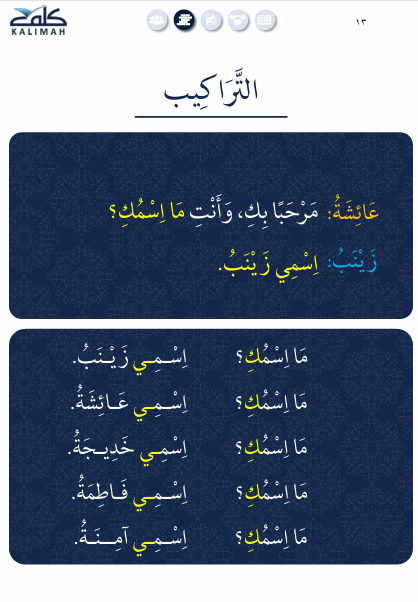
After this, you can introduce yourself. Say, “اسمي [Your Name]” (Ismi [Your Name]) – My name is [Your Name]. Then ask, “ما اسمك؟” (Ma ismuka/ismuki?) – What is your name? For a man, use “ismuka,” and for a woman, use “ismuki.”
In Kalimah’s Arabic course, we make it easy to learn how to talk in Arabic. We show you simple examples and give you lots of practice.
Look at this picture from our lesson. We learned how to say “What’s your name?” – Ma Ismuki (ما اسمكِ؟) and “My name is…” – Ismi – (…اسمي)
We do fun activities and use real-life examples so you can start speaking Arabic right away!”
Step 2: Practice Asking and Answering Simple Questions
In a basic conversation, you need to ask and answer questions. One useful phrase is, “كيف حالك؟” (Kayfa halak/halik?) – How are you? Again, “halak” is for a man and “halik” for a woman. To answer, you can say, “أنا بخير” (Ana bikhayr) – I am fine, or “الحمد لله” (Alhamdulillah) – Praise be to God, which is very common in Arabic conversations.
You can then ask a follow-up question like, “من أين أنت؟” (Min Aynna Anta?) – Where are you from? This will help you build your skills through Arabic conversation practice.
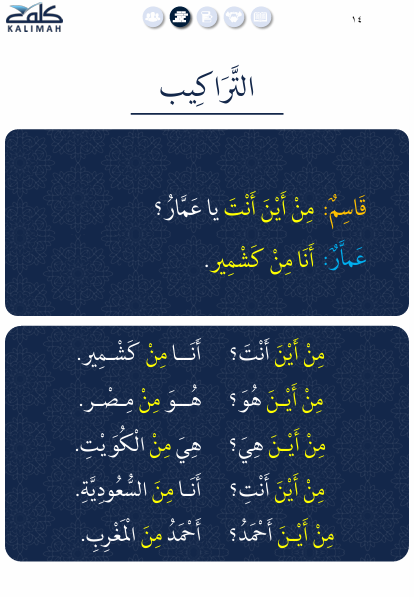
* Excerpted from our Arabic course curriculum
Step 3: Memorize Useful Phrases for Daily Conversations
One thing we always tell our students is to memorize useful phrases. You don’t need to understand every single word at first. Just memorize the whole phrase and use it in your conversations.
For example, if you want to express that you don’t understand something, you can say, “لا أفهم” (La afham) – I don’t understand.
If you want someone to repeat something, you can say, “من فضلك، كرر” (Min fadlik, karrir) – Please, repeat. These are practical sentences that will help you in basic conversations.
Step 4: Use the “Fillers” to Keep the Conversation Going
Sometimes, when we’re speaking in a new language, we need time to think. In Arabic, we have words that help fill the silence while you think of the next thing to say. For example, “يعني” (Ya’ni) – It means or kind of. This word is very common in conversations. You can use it to give yourself a second to think.
Another word is “طيب” (Tayyib) – Okay, fine. It’s used to agree or move on in the conversation. For example, if someone says something you understand, you can respond with “طيب” to show you are ready to continue.
Step 5: Role-Play Conversations in Different Scenarios
To master how to learn conversational Arabic, try role-playing common situations. This is one of the techniques that I use with my students, and it’s very effective. Choose different scenarios and role-play basic conversations in Arabic.
For example, imagine you are in a café. Practice how to order coffee:
- أريد قهوة من فضلك” (Ureed qahwa min fadlak/fadlik) – I want coffee, please.
Then practice how to ask for the price:
- “كم سعر القهوة؟” (Kam si’r al-qahwa?) – How much is the coffee?
These role-playing exercises help you get used to common conversations you might have when traveling or meeting Arabic speakers. You will feel more confident when you actually face these situations.
Real Arabic Conversation Examples: 3 Common Scenarios
To help you get started with Arabic, it’s best to focus on Modern Standard Arabic (MSA) for formal situations or Levantine/Egyptian dialects for daily life.
Below are three common scenarios with the Arabic script, transliteration (to help with pronunciation), and English translation.
1. Meeting Someone New (Formal/Standard)
This is the “textbook” way to greet someone, understood across all Arab countries.
| Arabic | Transliteration | English |
| السلام عليكم | As-salaamu ‘alaykum | Peace be upon you (Hello) |
| وعليكم السلام | Wa ‘alaykum as-salaam | And upon you be peace (Reply) |
| ما اسمك؟ | Ma ismuka? (m) / ismuki? (f) | What is your name? |
| اسمي يوسف، تشرفنا | Ismee Youssef, tasharrafna | My name is Youssef, nice to meet you |
| كيف حالك؟ | Kayfa haluka? (m) / haluki? (f) | How are you? |
| أنا بخير، شكراً | Ana bikhayr, shukran | I am fine, thank you |
2. Ordering at a Café (Spoken/Dialect)
This uses common “Street Arabic” phrases you’d hear in cities like Cairo, Amman, or Beirut.
- Customer: لو سمحت، أريد قهوة سكر خفيف.
- (Law samaht, ureed qahwa sukkar khafeef)
- “Excuse me, I want a coffee with a little sugar.”
- Server: تفضل. أي شيء آخر؟
- (Tafaddal. Ay shay’ aakhar?)
- “Here you go. Anything else?”
- Customer: لا، شكراً. كم الحساب؟
- (La, shukran. Kam al-hisab?)
- “No, thank you. How much is the bill?”
- Server: عشرة دراهم.
- (Ashara darahim)
- “Ten Dirhams.”
3. Asking for Directions
Useful phrases for navigating a new city.
- You: عفواً، أين أقرب محطة مترو؟
- (Afwan, ayna aqrab mahattat metro?)
- “Excuse me, where is the nearest metro station?”
- Stranger: اذهب مباشرة ثم اتجه يميناً.
- (Ith-hab mubasharatan thumma ittaji yameenan)
- “Go straight, then turn right.”
- You: هل هي بعيدة من هنا؟
- (Hal hiya ba’eeda min huna?)
- “Is it far from here?”
- Stranger: لا، هي قريبة جداً.
- (La, hiya qareeba jiddan)
- “No, it is very close.”
7 Expert Strategies to Improve Your Arabic Speaking Skills
The key to improving your Arabic speaking is to use the language every day. Here are some additional tips for getting better at Arabic conversation:
1- Set SMART Goals Specific to Arabic Speaking
Vague goals like “speak Arabic fluently” lead nowhere. Instead, use measurable milestones:
- Month 1: Hold 2-minute self-introductions, order food, ask basic questions
- Month 3: Sustain 10-minute conversations on familiar topics without English
- Month 6: Discuss current events, express opinions, understand native-speed speech
- Month 12: Handle complex discussions, use idioms naturally, switch between formal/informal registers
Arabic-specific metrics to track:
- Pronunciation accuracy of emphatic consonants (ص، ض، ط، ظ)
- Vocabulary active usage (words you actually speak vs. recognize)
- Response time (how quickly you formulate answers)
- Dialect comprehension percentage when watching media
Use weekly voice recordings to measure progress objectively, not just feelings.
2- Maintain the Right Attitude
While learning, your mind can often be your toughest critic. “You’re not good enough!” “Hopeless Case!” “Stop Wasting Your Time!” All these doubts may arise whenever you encounter challenges in Arabic speaking.
So, give up any thoughts that might demotivate you and only keep the positive ones.
You are a student, and the need to improve will always be there. Learning languages, especially Arabic, requires curiosity and discipline as well. Maintaining a positive routine, filled with activities to hone your Arabic speaking and enhance your skills, can be immensely rewarding.
Also, boldness and getting out of your comfort zone will have a great impact on your learning journey. Try to put yourself in situations where you’re not sure if your Arabic language will help or not.
This breaks the boundaries, and you will know how simple it is to make mistakes with the aim of learning.
3- Monitor Your Arabic Speaking
Pronouncing the words multiple times could be enough for some learners. However, developing your Arabic speaking skills requires patience. This cannot be achieved without monitoring your progress.
Put metrics that define how good you are at speaking a category of sentences, like in the market, in a social club, etc.
Review metrics including tone of voice, accent, body language, speech speed, and primarily, pronunciation.
If you find that your grades are leveling up according to the sources you revise, then you’re adopting the right learning technique. If not, try a new method.
read more about Arabic numbers and how to count, read, and write them
4- Read Texts Out Loud
Reading texts out loud is an effective method for improving Arabic speaking, especially if you’re learning Modern Standard Arabic (MSA).
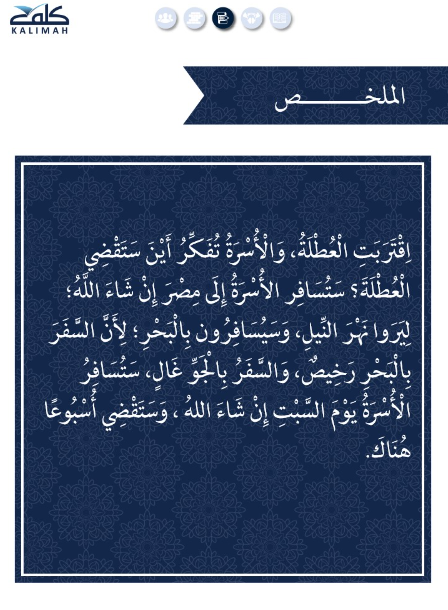
For example, Kalimah uses interactive exercises to help learners practice their Arabic reading comprehension. Here’s an interactive exercise based on the following image of our curriculum in Online Arabic Learning Courses For Adults:
Instructions:
- Read the passage out loud carefully. (Use the transliteration and transliteration below to help you if needed).
Passage:
Transliteration:
iqtarabat al-‘utlah, wa al-usrah tufakkiru ayna sataqdee al-‘utlah. satusaafir al-usrah ila misr in shaa’a allah; liyaraw nahra al-nil, wa sayusafiruna bil-bahr; li’anna al-safar bil-bahr rakhees, wa al-safar bil-jaw ghal, satusaafir al-usrah yawma al-sabt in shaa’a allah, wa sataqdee usbu’an hunak.
Translation:
The vacation is approaching, and the family is thinking about where they will spend the vacation. The family will travel to Egypt, God willing, to see the Nile River, and they will travel by sea because travel by sea is cheap, and air travel is expensive. The family will travel on Saturday, God willing, and will spend a week there.
Beginners should start with children’s books, comic books, or ads that have accompanying illustrations.
You can also check the tweets from Arabic news agencies with images attached. This will elevate your vocabulary gradually and may help you discover more interesting aspects of Arab reality.
Choose texts where you predominantly know the word meanings. This ensures you focus on pronunciation without frequently consulting a dictionary or Google Translate for unknown words.
The primary aim is to train your tongue for Arabic pronunciation rather than expanding your vocabulary.
Focusing on a certain genre will also help you get used to pronouncing its words. As you learn more Arabic words, you will be able to read more complicated texts out loud.
Consider bilingual texts, allowing you to refer to your native language if you don’t understand certain parts.
Lastly, reading aloud helps you generate unfamiliar sounds by utilizing the muscles of your mouth and diaphragm and managing the air through them.
Read more about the best tips to improve your Arabic writing
5- Make up Scenarios and Prepare Ahead
Where will you speak the Arabic you’ve acquired? Is it at an office? At the gym? Or an educational institute? Anticipate situations you’re likely to encounter.
These situations will include dialogues and group conversations that you should be part of. Play the role of every character, imagine the scenarios, and build your responses based on them.
This technique ensures you’re always prepared. No hesitating or voice shaking! Every word has been preset for a while, and you’ve practiced it multiple times.
This will also help you determine the common phrases that you might pronounce in different situations and on various sites.
6- Increase Your Vocabulary Base
At a certain point, you will find that you are out of words. If you are repeating the same words in every conversation, then it’s time to expand your vocabulary.
Expanding your vocabulary will enrich your conversations that last longer and help you make new friends with mutual interests. In Arab culture, formality is an important quality that represents respect for elders.
It’s essential to learn how to add the correct honorary titles and names throughout your conversation.
Learn also to link sentences and other parts of speech that require certain accepted expressions and conjunctions, so that the recipient can understand and interact with them.
You can use this technique with the help of online dictionaries, Google Translate, and any other search engines that might help you learn new words.
7- Improve Your Arabic Grammar
Arabic grammar is more significant if you are speaking modern standard Arabic. Considering a local dialect, it is essential to use the correct adjectives for males and females. As it’s considered an insult when you address a male with a feminine title or vice versa.
Also, the differentiation between the plural and singular forms is critical, as is knowing how to deal with the verbs following them. Multiple Arabic resources can help you reinforce your grammar.
What to Expect: Your 90-Day Arabic Speaking Progress Timeline
Week 1-2: The Awkward Phase
- What you’ll feel: Overwhelmed, tongue-tied, frustrated by sounds
- What you’ll achieve: Greetings, self-introduction, 20-30 memorized phrases
- Practice focus: Listening and repeating, talking to yourself
- Milestone: Order coffee in Arabic without switching to English
Week 3-6: Breaking the Ice
- What you’ll feel: Small victories, occasional “I understood that!” moments
- What you’ll achieve: Basic conversations (2-3 minutes), asking/answering simple questions
- Practice focus: Language exchange apps, daily narration
- Milestone: Have a 5-minute conversation with one topic change
Week 7-12: Building Momentum
- What you’ll feel: Growing confidence, faster recall, understanding patterns
- What you’ll achieve: Extended conversations (10+ minutes), expressing opinions simply
- Practice focus: Shadowing, conversation groups, role-playing
- Milestone: Discuss your day, hobbies, and opinions without preparation
Reality check: Progress isn’t linear. Week 8 might feel harder than Week 4. This is normal—your brain is reorganizing information.
Common Mistakes Arabic Learners Make (And How to Avoid Them)
Mistake #1: Translating Word-by-Word from English
Arabic structure differs significantly. Instead of “I am going to the market,” think in Arabic patterns: “I + going + to + the market” becomes more natural as “ذاهب أنا إلى السوق” in some contexts.
Fix: Learn phrases as chunks, not individual words. Memorize “كيف حالك؟” as one unit, not “how + your + condition.”
Mistake #2: Neglecting Dialect vs MSA Strategy
Students waste months learning MSA vocabulary no one uses in daily conversation (like classical words for “telephone”).
Fix: Decide your goal. Quranic study? MSA. Working in Egypt? Egyptian Arabic. Living in Lebanon? Levantine. Split your time 70/30 between primary goal and MSA fundamentals.
Mistake #3: Waiting Until “Ready” to Speak
Perfectionist learners delay conversation until their grammar is perfect. This backfires—speaking skills atrophy.
Fix: Use the “50% rule.” If you understand 50% of what you want to say, start speaking. Fill gaps with gestures, simpler words, or asking “كيف أقول…؟” (How do I say…?).
Mistake #4: Ignoring Pronunciation from Day One
Arabic has sounds that don’t exist in English (ع، ح، خ، غ، ق). Poor early habits fossilize.
Fix: Spend 5 minutes daily on pronunciation drills. Use YouTube videos showing mouth/tongue position for difficult letters.
Master Arabic with Kalimah Center
Join our expert-led online classes and start your journey toward Arabic fluency today.
Book Your Free TrialInside Kalimah Center: Moments from Our Courses
Get a glimpse into the vibrant learning experience at Kalimah Center. These snapshots capture real moments from our live classes—where students engage deeply, connect with passionate instructors, and grow in a welcoming, supportive environment.
Here Are The Reviews On Our Courses:
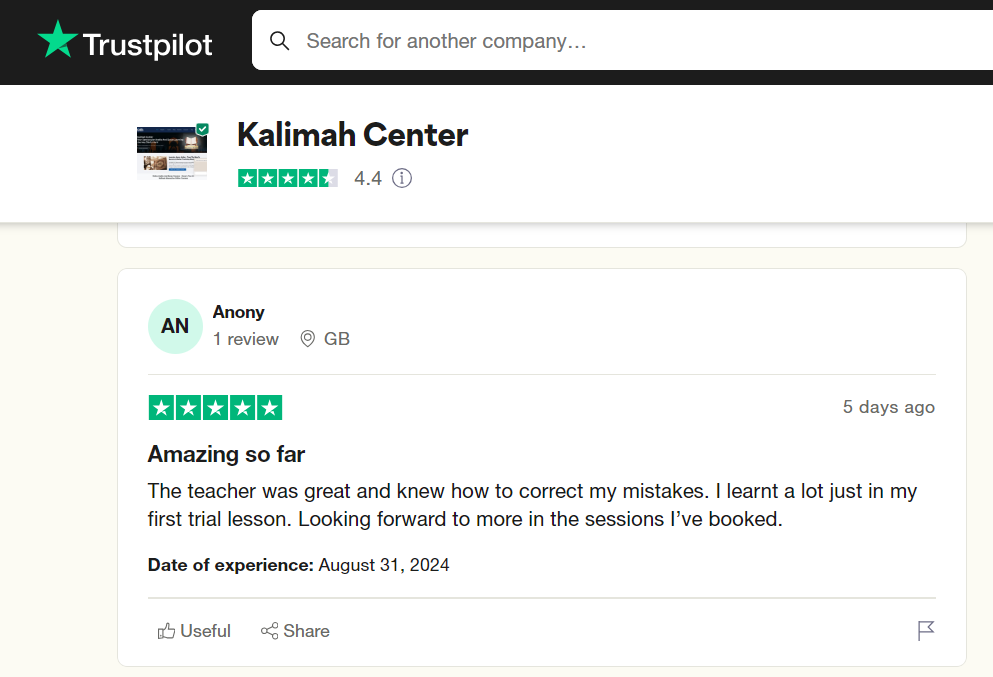
Our students frequently commend the excellence of our courses and the commitment shown by our instructors. You can read their complete reviews on Trustpilot.

Start Practicing Arabic Speaking Today with Kalimah
As I have shared, the most important part of learning Arabic is practicing your speaking skills.
If you’re serious about improving your Arabic, I encourage you to try the Arabic course for Adults and the Arabic course for kids at Kalimah Center. Our structured lessons are designed to give you lots of speaking practice.
Kalimah Center can help you:
- Our online courses focus on speaking skills.
- Talk about everyday topics and more with our teachers.
- Learn at your own pace, from beginner to advanced.
- Our teachers are native speakers and very experienced.
Get started today for a FREE trial class and start speaking Arabic confidently!
📚 Explore Our Courses:
Online Arabic Course: Tailored to your level, our comprehensive Arabic program includes 16 teaching levels and 400+ hours of personalized sessions.
Online Quran With Tajweed Course: Perfect for non-Arabic speakers, our course spans 13 levels and equips you with Tajweed mastery from beginner to advanced.
Online Arabic Course For Kids: Nurture your child’s love for Arabic with our engaging and structured program, available in 24 levels for primary, intermediate, and secondary stages.
🚀 Start Your Free Trial Today! 🚀
Don’t miss out on this life-changing opportunity to deepen your faith and knowledge. Sign up now for your free trial and take the first step towards becoming a better practicing Muslim with Kalimah Center!
Conclusion:
To master Arabic speaking, consistent practice is essential. Engaging daily in conversation, whether through listening and repeating dialogues, speaking aloud to yourself, or narrating your day, can significantly enhance fluency.
For more engaging Arabic speaking practice, using fun techniques like talking to inanimate objects, recording your voice, or practicing in real-life situations builds confidence and reinforces language skills. Using apps for Arabic language exchange, joining conversation groups, and volunteering with Arabic-speaking communities provide valuable opportunities for real-world practice.
When it comes to initiating conversations, start with key greetings, simple questions, and useful phrases. Role-playing common scenarios can help you navigate everyday interactions while reading texts aloud boosts pronunciation. Expanding your vocabulary and grasping grammar fundamentals will also enrich your conversational skills. For structured support, consider enrolling in courses that focus on speaking practice, like those offered at Kalimah Center.
Frequently Asked Questions About Practicing Arabic Speaking
How long does it take to speak Arabic fluently?
With consistent daily practice (30-60 minutes), most learners achieve conversational fluency in 12-18 months. Basic conversation skills develop within 3-6 months. Your pace depends on your native language, practice intensity, and whether you focus on Modern Standard Arabic or a dialect.
Can I learn Arabic speaking for free?
Yes. Use free resources like language exchange apps (HelloTalk, Tandem), YouTube channels, Arabic podcasts, and self-practice techniques like shadowing and self-narration. Paid tutoring accelerates progress but isn’t mandatory for beginners.
Should I learn Modern Standard Arabic or a dialect first?
For media, formal settings, and pan-Arab communication, start with Modern Standard Arabic (MSA). For daily conversation in a specific country, learn that region’s dialect (Egyptian, Levantine, Gulf). Many learners study both simultaneously.
How can I practice Arabic speaking if I’m shy?
Start with solo methods: talk to yourself, narrate your day, record voice memos, and shadow YouTube videos. Progress to text-based language exchange, then voice messages, and finally live calls as confidence grows. Remember: everyone makes mistakes while learning.
What’s the fastest way to improve Arabic pronunciation?
Practice shadowing: play audio from native speakers and repeat simultaneously, mimicking their tone, speed, and rhythm. Record yourself and compare. Focus on difficult sounds (ع, ح, خ, غ, ق) with targeted drills. Daily 10-minute shadowing sessions show results within weeks.