Have you ever read a Quran verse about life and felt it described your exact situation — centuries before you were born? That is the quality of the Quran’s address to the human condition.
The Arabic word الدنيا (al-dunya), meaning this worldly life, appears in 115 places in the Quran. Yet in every single occurrence, it carries no possessive pronoun — you never read “your dunya” or “my dunya.” The language itself signals a truth the Quran makes explicit: this world belongs to no one.
Below are the most important Quran quotes about life in Arabic, organized by theme, with their Arabic text, transliteration, and meaning, together with the context that makes each verse useful rather than decorative.
What You’ll Learn in This Article
- The Quran’s three-part view of worldly life: warning, comparison, and balance
- Key Arabic verses on the nature of this life (al-dunya), its purpose, and its end
- Verses on human stages of life from weakness to strength and back
- The Quran’s position on working for both this world and the next
- How to practically engage with these verses in daily reflection
Quran Quotes About Life And the Nature of Al-Dunya in Arabic
The Quran does not treat worldly life as evil in itself. It addresses it with precision — describing what it is, what it offers, and what it conceals. The verses below form the clearest Quranic portrait of الحياة الدنيا (al-hayat al-dunya) — the life of this world.
1- The World Is a Temporary Pleasure
The Quran’s most direct statement on worldly life is also its shortest. This verse strips away every illusion in a single sentence.
“وَمَا الْحَيَاةُ الدُّنْيَا إِلَّا مَتَاعُ الْغُرُورِ”
Wa mā al-ḥayātu al-dunyā illā matāʿu al-ghurūr
“And what is the life of this world except the enjoyment of delusion.” — (Surah Aal Imran 3:185)
The Arabic word مَتَاعُ الْغُرُورِ (matāʿ al-ghurūr) means something that deludes through its apparent value — like packaging that looks appealing but holds nothing lasting.
This verse closes a longer passage about death, deeds, and accountability, making its conclusion deliberate: the entire framework of this life, taken on its own terms, is a distraction from what is real.
2- The World Compared to a Rain Shower
Where the previous verse states the warning plainly, this one delivers it through a complete image, the Quran’s agricultural metaphor for the entire human lifespan.
“إِنَّمَا مَثَلُ الْحَيَاةِ الدُّنْيَا كَمَاءٍ أَنْزَلْنَاهُ مِنَ السَّمَاءِ فَاخْتَلَطَ بِهِ نَبَاتُ الْأَرْضِ مِمَّا يَأْكُلُ النَّاسُ وَالْأَنْعَامُ”
Innamā mathalu al-ḥayāti al-dunyā ka-māʾin anzalnāhu mina al-samāʾi fakhtalata bihi nabātu al-arḍi mimmā yaʾkulu al-nāsu wa-al-anʿām
“The example of this worldly life is but like rain which We send down from the sky so that the plants of the earth absorb it — those from which men and cattle eat.” — Surah Yunus 10:24
The verse continues: when the earth looks its most beautiful, and its people think they are in full control, the command of Allah arrives — by night or day — and the harvest becomes as though it had never existed. This is the Quran’s agricultural metaphor for life: a cycle that looks permanent from the inside and is clearly finite from above.
3- Five Descriptors of Worldly Life
This verse goes further than warning or metaphor. It lists the actual stages worldly attachment moves through, from a child’s first instinct to an adult’s last ambition.
“اعْلَمُوا أَنَّمَا الْحَيَاةُ الدُّنْيَا لَعِبٌ وَلَهْوٌ وَزِينَةٌ وَتَفَاخُرٌ بَيْنَكُمْ وَتَكَاثُرٌ فِي الْأَمْوَالِ وَالْأَوْلَادِ”
Iʿlamū annamā al-ḥayātu al-dunyā laʿibun wa-lahwun wa-zīnatun wa-tafākhurun baynakum wa-takāthurun fī al-amwāli wa-al-awlād
“Know that the life of this world is but amusement and diversion and adornment and boasting to one another and competition in increase of wealth and children.” ( Surah Al-Hadid 57:20)
This verse from Surah Al-Hadid provides the Quran’s most structured definition of dunya. The five Arabic terms move in sequence: from childlike play (لَعِبٌ), to distraction (لَهْوٌ), to decoration (زِينَةٌ), to social competition (تَفَاخُرٌ), to accumulation (تَكَاثُرٌ). Each stage is more adult than the last — yet the verse treats them all as equally temporary.
Read Also: Why the Quran in Arabic
Quran Quotes About the Purpose of Life in Arabic
Why are we here? The Quran answers directly, and the answer contains more than one layer: worship as the reason for existence, and trial as its working mechanism.
1- Creation for Worship
The first answer the Quran gives is also its most concise statement of purpose in the entire text.
“وَمَا خَلَقْتُ الْجِنَّ وَالْإِنْسَ إِلَّا لِيَعْبُدُونِ”
Wa mā khalaqtu al-jinna wa-al-insa illā li-yaʿbudūn
“And I did not create the jinn and mankind except to worship Me.” (Surah Al-Dhariyat 51:56)
The Arabic verb لِيَعْبُدُونِ (li-yaʿbudūn) — “to worship” — in classical Arabic carries a broader meaning than ritual prayer alone. It encompasses servitude, acknowledgment of God’s sovereignty, and alignment of one’s entire life to divine guidance. This verse defines the purpose of existence in eight words.
2- Creation as a Test
If worship is the why, this verse explains the how: life functions as a test, and the sequencing of its wording is itself a clue to what is being measured.
“الَّذِي خَلَقَ الْمَوْتَ وَالْحَيَاةَ لِيَبْلُوَكُمْ أَيُّكُمْ أَحْسَنُ عَمَلًا وَهُوَ الْعَزِيزُ الْغَفُورُ”
Alladhī khalaqa al-mawta wa-al-ḥayāta li-yabluwakum ayyukum aḥsanu ʿamalā wa-huwa al-ʿazīzu al-ghafūr
“Who created death and life to test you as to which of you is best in deed — and He is the Exalted in Might, the Forgiving.” (Surah Al-Mulk 67:2)
Notice that the Quran here says death was created before life in the verse’s order. Scholars of tafsir such as Al-Qurtubi, note this sequencing is deliberate — death frames life, not the other way around. The test is not about quantity of deeds but quality: أَحْسَنُ عَمَلًا means “best in deed,” not “most in deed.”
Kalimah Center offers structured Quranic Arabic courses that allow students to read verses like this one in their original language — not through translation, but through understanding.

Quran Quotes on Life Stages in Arabic
Beyond purpose, the Quran also describes the physical and moral arc a human being moves through, from infancy to old age and from idle hope to earned outcome.
1. From Weakness To Strength To Return
This verse maps the entire human lifecycle in a single sentence, and the repetition of one word inside it carries the lesson.
“اللَّهُ الَّذِي خَلَقَكُمْ مِنْ ضَعْفٍ ثُمَّ جَعَلَ مِنْ بَعْدِ ضَعْفٍ قُوَّةً ثُمَّ جَعَلَ مِنْ بَعْدِ قُوَّةٍ ضَعْفًا وَشَيْبَةً”
Allāhu alladhī khalaqakum min ḍaʿfin thumma jaʿala min baʿdi ḍaʿfin quwwatan thumma jaʿala min baʿdi quwwatin ḍaʿfan wa-shaybah
“Allah is the one who created you from weakness, then made after weakness strength, then made after strength weakness and white hair.” (Surah Al-Rum 30:54)
This verse is the Quran’s most compact statement on the human lifecycle. The word ضَعْف (ḍaʿf, weakness) appears three times — framing strength as a temporary middle phase rather than the defining state. It is a corrective against the illusion of permanence that physical vitality creates.
2. Man Gets Only What He Strives For
True maturity in a person’s life stage is reached when they realize that their ultimate destiny is shaped solely by their own actions and intentions.
“وَأَنْ لَيْسَ لِلْإِنْسَانِ إِلَّا مَا سَعَى”
Wa an laysa lil-insāni illā mā saʿā
“And that there is not for man except what he strives for.” — Surah Al-Najm 53:39
Eight Arabic words that have been cited by scholars across centuries as a complete philosophy of personal accountability. No one carries your deeds for you, and no one’s deeds reach you. The verse closes the door on passive expectation and opens it to directed effort.
Read also: Quran Verses About Death in Arabic and English – Complete Guide With Meaning
Experience Kalimah Center Classes
Watch real excerpts from our live sessions at Kalimah Center and see how we bring learning to life. These clips highlight our interactive, student-centered teaching approach across all our courses—designed to keep learners engaged, motivated, and actively involved every step of the way.
Master Arabic with Kalimah Center
Join our expert-led online classes and start your journey toward Arabic fluency today.
Book Your Free TrialQuran Quotes About the Hereafter vs. This Life in Arabic
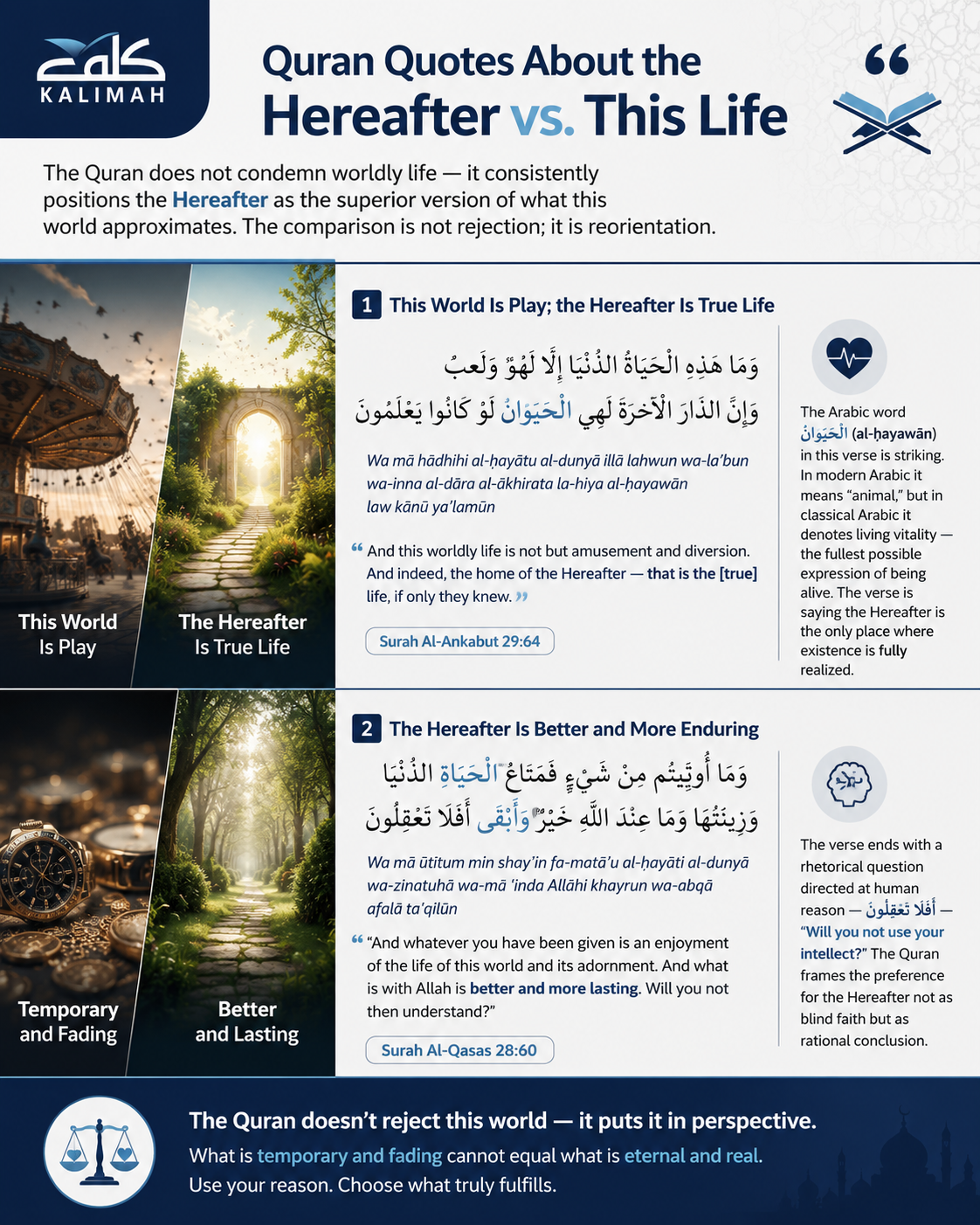
The Quran does not condemn worldly life. It consistently positions the Hereafter as the superior version of what this world approximates. The comparison is not rejection; it is reorientation.
1. This World Is Play; The Hereafter Is True Life
This verse contains one of the most linguistically loaded words in the entire Quran, and its meaning changes depending on whether you read it in classical or modern Arabic.
“وَمَا هَذِهِ الْحَيَاةُ الدُّنْيَا إِلَّا لَهْوٌ وَلَعِبٌ وَإِنَّ الدَّارَ الْآخِرَةَ لَهِيَ الْحَيَوَانُ لَوْ كَانُوا يَعْلَمُونَ”
Wa mā hādhihi al-ḥayātu al-dunyā illā lahwun wa-laʿibun wa-inna al-dāra al-ākhirata la-hiya al-ḥayawān law kānū yaʿlamūn
“And this worldly life is not but amusement and diversion. And indeed, the home of the Hereafter — that is the [true] life, if only they knew.” (Surah Al-Ankabut 29:64)
The Arabic word الْحَيَوَانُ (al-ḥayawān) in this verse is striking. In modern Arabic it means “animal,” but in classical Arabic it denotes living vitality — the fullest possible expression of being alive. The verse is saying the Hereafter is the only place where existence is fully realized.
2. The Hereafter Is Better And More Enduring
This verse makes the same comparison from a different angle: not what the Hereafter is, but why choosing it is the more reasonable conclusion.
“وَمَا أُوتِيتُمْ مِنْ شَيْءٍ فَمَتَاعُ الْحَيَاةِ الدُّنْيَا وَزِينَتُهَا وَمَا عِنْدَ اللَّهِ خَيْرٌ وَأَبْقَى أَفَلَا تَعْقِلُونَ”
Wa mā ūtītum min shayʾin fa-matāʿu al-ḥayāti al-dunyā wa-zīnatuhā wa-mā ʿinda Allāhi khayrun wa-abqā afalā taʿqilūn
“And whatever you have been given is an enjoyment of the life of this world and its adornment. And what is with Allah is better and more lasting. Will you not then understand?” (Surah Al-Qasas 28:60)
The verse ends with a rhetorical question directed at human reason — أَفَلَا تَعْقِلُونَ — “Will you not use your intellect?” The Quran frames the preference for the Hereafter not as blind faith but a rational conclusion.
Read Also: Which Ayah in the Quran Contains All Arabic Letters?
Quran Quotes on Balancing This Life and the Next
The Quran’s position is not withdrawal from the world. The balanced Muslim engages with life fully, without forgetting where it leads.
1. Seek The Hereafter Without Neglecting Your Share Of This World
This verse was addressed to a specific man whose story makes its lesson concrete: wealth itself was never the problem; forgetting its source was.
“وَابْتَغِ فِيمَا آتَاكَ اللَّهُ الدَّارَ الْآخِرَةَ وَلَا تَنْسَ نَصِيبَكَ مِنَ الدُّنْيَا وَأَحْسِنْ كَمَا أَحْسَنَ اللَّهُ إِلَيْكَ”
Wabtagh fīmā ātāka Allāhu al-dāra al-ākhirata wa-lā tansa naṣībaka mina al-dunyā wa-aḥsin kamā aḥsana Allāhu ilayk
“But seek, through that which Allah has given you, the home of the Hereafter; and yet do not forget your share of the world. And do good as Allah has done good to you.” (Surah Al-Qasas 28:77)
This verse — addressed to Qarun, the man of excessive wealth who forgot gratitude — contains the Quran’s clearest statement on balance. نَصِيبَكَ مِنَ الدُّنْيَا (naṣībaka mina al-dunya) means “your rightful portion of this world.” The Quran does not ask you to abandon your share. It asks you to remember it is a share, not the whole.
2. Ask for Good in Both Worlds
This final verse is less a description and more a model: the exact words the Quran teaches a believer to say when asking for balance between both lives.
“رَبَّنَا آتِنَا فِي الدُّنْيَا حَسَنَةً وَفِي الْآخِرَةِ حَسَنَةً وَقِنَا عَذَابَ النَّارِ”
Rabbanā ātinā fī al-dunyā ḥasanatan wa-fī al-ākhirati ḥasanatan wa-qinā ʿadhāba al-nār
“Our Lord, give us in this world good and in the Hereafter good, and protect us from the punishment of the Fire.” (Surah Al-Baqarah 2:201)
This is one of the most recited duas in the Islamic tradition, drawn directly from a Quranic verse. The Prophet Muhammad ﷺ recited it frequently. It is the Quran’s own model prayer for a believer who wants both worlds, and the very next verse (2:202) says those who ask this will receive a share of what they earn.
Understanding the Arabic of these verses — not just their translation — transforms how you connect with them. Kalimah’s Quranic Arabic programs are built for exactly this: helping learners move from reading to understanding, at their own pace, from anywhere.
Inside Kalimah Center: Moments from Our Courses
Get a glimpse into the vibrant learning experience at Kalimah Center. These snapshots capture real moments from our live classes—where students engage deeply, connect with passionate instructors, and grow in a welcoming, supportive environment.
Here Are The Reviews On Our Courses:
Our students frequently commend the excellence of our courses and the commitment shown by our instructors. You can read their complete reviews on Trustpilot.
Read more reviews on Trustpilot

Read also: Learn Arabic In Your Sleep
Start Reading the Quran in Arabic with Kalimah
If reading verses like these and wanting to understand every word is familiar to you, Kalimah’s online Arabic and Quran courses were designed for that moment. Learn directly from certified instructors, at times that fit your schedule, without needing to travel anywhere.
Start your Arabic learning journey today with Kalimah Center and take your communication skills to the next level.
Explore Our Courses:
- Online Arabic Course: tailored to your level, with 16 teaching levels and 400+ hours of personalized sessions.
- Online Quran With Tajweed Course: built for non-Arabic speakers, spanning 13 levels from beginner to advanced Tajweed mastery.
- Online Arabic Course for Kids: a structured program in 24 levels covering primary, intermediate, and secondary stages.
Start Your Free Trial Today!
Sign up now for your free trial and take the first step toward reciting these verses with confidence and understanding.
Master Arabic with Kalimah Center
Join our expert-led online classes and start your journey toward Arabic fluency today.
Book Your Free TrialConclusion
The Quran quotes about life in Arabic covered here represent a complete and carefully structured worldview — not a rejection of existence, but a framework for living it well.
The Quran warns against over-attachment to the material world, consistently places the Hereafter above it, and yet explicitly instructs believers to take their rightful share of this life and fill it with good deeds.
The word الدنيا appears 115 times in the Quran and never once with a possessive pronoun — this world belongs to no one, and the Quran’s verses on life make that clear from every angle.
Reading these verses in Arabic, rather than only in translation, reveals dimensions of meaning — like the difference between الْحَيَوَانُ meaning “animal” in modern Arabic and “full living vitality” in its classical Quranic usage — that no translation can fully carry. The closer you are to the original language, the more the Quran speaks directly to you.
Read Also: 16 Most Beautiful Arabic Words in the Quran
Frequently Asked Questions
These are the most common questions readers ask about Quranic verses on life, drawn directly from the themes covered above.
1- What does the Quran say about life in Arabic?
The Quran describes worldly life (الحياة الدنيا) as temporary, deceptive in its attractions, and inferior to the Hereafter. Key verses include Al-Hadid 57:20, which calls life a sequence of play, boasting, and competition, and Al-Mulk 67:2, which defines life as a test of who does the best deeds, not the most.
2- What is the most famous Quran verse about life?
Surah Al-Imran 3:185 — “وَمَا الْحَيَاةُ الدُّنْيَا إِلَّا مَتَاعُ الْغُرُورِ” — is widely considered the most direct Quranic statement on worldly life. It translates as: “And what is the life of this world except the enjoyment of delusion.” Surah Al-Baqarah 2:201, the dua for good in both worlds, is likely the most recited verse on this theme.
3- How many times does the Quran mention the word دنيا (dunya)?
The word دنيا appears in 115 places in the Quran. In every instance, it appears without a possessive pronoun — never “your dunya” or “my dunya” — which scholars read as a deliberate linguistic signal that this world belongs to no one permanently.
4- What does the Quran say about the purpose of life?
Surah Al-Dhariyat 51:56 states the primary purpose directly: “وَمَا خَلَقْتُ الْجِنَّ وَالْإِنْسَ إِلَّا لِيَعْبُدُونِ” — “I did not create jinn and mankind except to worship Me.” Surah Al-Mulk 67:2 adds a second dimension: life is a test of the quality of one’s deeds.
5- Does the Quran say to enjoy this life?
Yes, Surah Al-Qasas 28:77 explicitly says “do not forget your share of this world.” The Quran condemns excessive attachment to worldly life but equally condemns those who forbid what Allah has made lawful (Al-A’raf 7:32). The Quranic position is balanced: use this world as a means, not as an end.
6- How can I understand Quran verses on life in their original Arabic?
Learning Quranic Arabic is the most direct route. Even a foundational understanding of Arabic grammar (nahw) and vocabulary allows a reader to grasp the precise word choices — like why الدنيا carries no pronoun, or what الْحَيَوَانُ meant classically — that make these verses far richer than any translation.