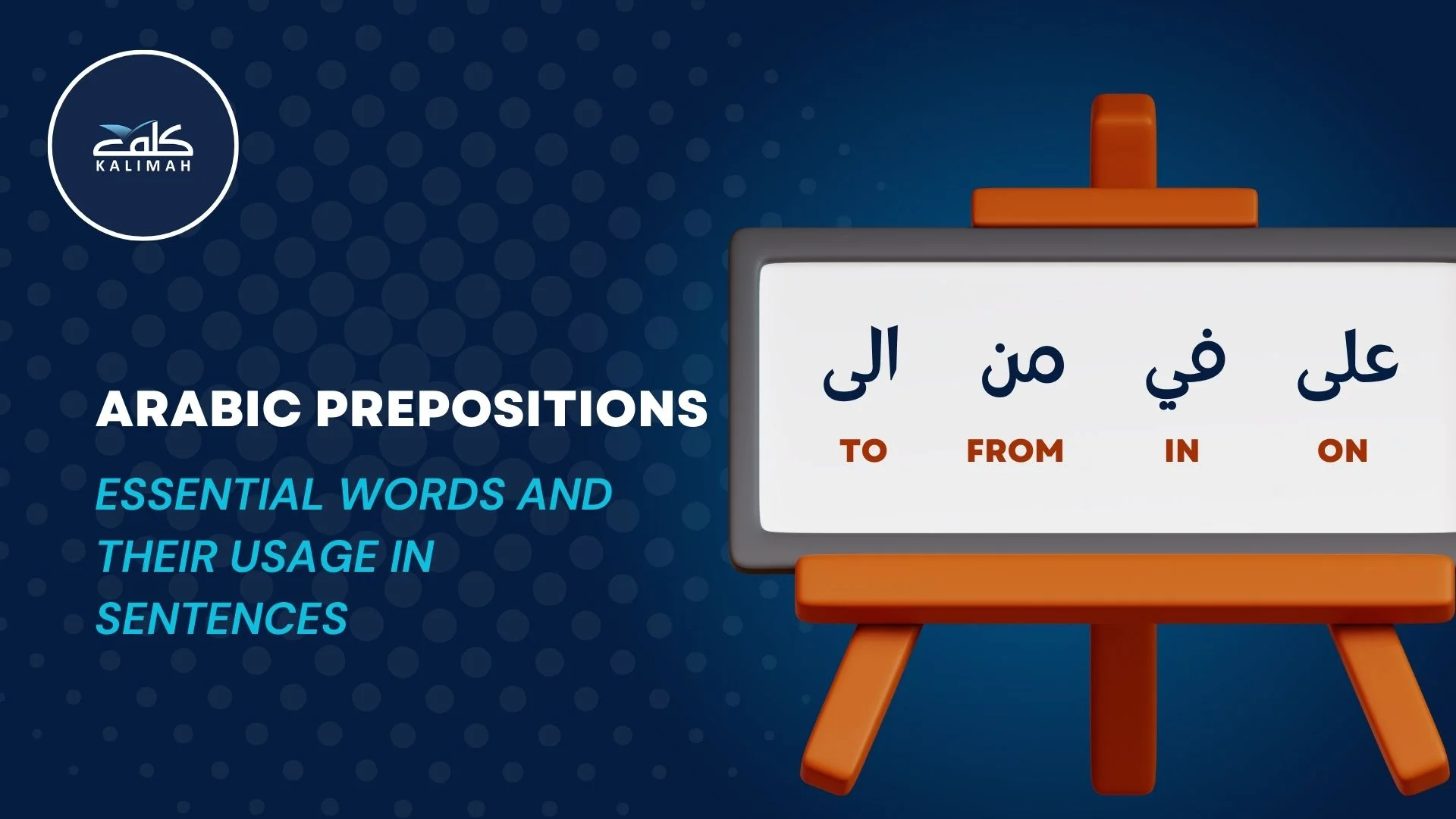
In a nutshell: Arabic prepositions are key to linking words and expressing relationships like time, place, and direction with around 21 prepositions. Unlike English, Arabic prepositions have fixed uses, often tied to specific verbs or expressions. Mastering the most common ones, like “في” (in), “من” (from), and “إلى” (to), is essential for fluent communication.
In this article, we will explore one of the most important topics of Arabic grammar, which is the Arabic prepositions, their definition, importance, usage, and common mistakes to avoid while using them.
We’ll also explore how many prepositions there are in Arabic, how they function, and compare them with English prepositions. This knowledge will enhance your understanding of the language and help you communicate more effectively.
What are Arabic prepositions?
Prepositions in Arabic (حروف الجر, huruf al-jar) are words that connect nouns or pronouns to clarify the meaning. They also change the case of the word that follows them, making it genitive.
However, Arab grammarians have not agreed on a precise definition of prepositions, which are considered a subcategory of particles (الحروف).
Particles are words that have a linking function with other parts of speech but do not have a meaning in themselves.
However, an Arabic preposition (حَرْفُ الْجَرِّ- Harfu al-jarri) can be defined as a single letter or a single word that is used to connect two nouns or a verb and a noun to form a complete sentence.
What is Harf al Jarr in Arabic?
Harf Al Jarr is the Arabic word for “preposition”, it denotes the word or phrase connecting nouns to other parts of the sentence.
How Many Prepositions Are There in Arabic?
The Arabic prepositions, as mentioned by Ibn Malik in his Alfiya, are twenty-one prepositions grouped in the following verses, except for the preposition “لولا” (if not for), which is considered rare.
هاك حروف الجرّ وهي من إلى … حتى خلا حاشا عدا في عن على
مذ منذ ربّ اللام كي واو ّ وتا … والكاف والبا ولعلّ ومتى
بالظاهر اخصص منذ مذ وحتى … والكاف والواو وربّ والتا
Arabic Prepositions List
Let’s look at a detailed Arabic prepositions list. Below is a chart that includes all the Arabic prepositions along with their meanings and examples:
| Preposition (Arabic) | Transliteration | Meaning | Example (Arabic) | Example (Transliteration) | Example (Translation) |
| مِن | min | from, of | شربتُ مِن الماءِ | sharibtu min al-ma’i | I drank from the water. |
| إلى | ila | to, towards | ذهبتُ إلى السوقِ | dhahabtu ila al-suq | I went to the market. |
| على | ‘ala | on, upon | الكتابُ على الطاولةِ | al-kitabu ‘ala al-tawila | The book is on the table. |
| في | fi | in, inside | القلمُ في الحقيبةِ | al-qalamu fi al-haqiba | The pen is in the bag. |
| عن | ‘an | about, concerning | سألتُهُ عن الدرسِ | sa’altuhu ‘an al-dars | I asked him about the lesson. |
| حتى | hatta | until, even | سأنتظرُ حتى المساءِ | sa’antaziru hatta al-masa’ | I will wait until the evening. |
| خلا | khala | except | حضَرَ الجميعُ خلا خالدٍ | hadara al-jami’u khala Khalid | Everyone attended except Khalid. |
| عدا | ‘ada | except | قرأْتُ كلَّ الكتبِ عدا هذا | qara’tu kulla al-kutub ‘ada hadha | I read all the books except this one. |
| حاشا | hasha | except | نجحَ الطلابُ حاشا عليٍّ | najaha al-tullabu hasha ‘Ali | The students succeeded except Ali. |
| مذ | muth | since | لم أرَهُ مذ يومِ الجمعةِ | lam arahu muth yawm al-jumu’a | I haven’t seen him since Friday. |
| منذ | mundhu | since | أنا أعيشُ هنا منذ سنتينِ | ana a’ishu huna mundhu sanatain | I have been living here for two years. |
| ربّ | rabb | perhaps, maybe | رُبَّ أخٍ لك لم تلِدْهُ أمُّك | Rubba akhin laka lam talidhu ummuka | Perhaps you have a brother whom your mother did not give birth to. |
| اللام | al-lam | for, to | هذا الكتابُ للمجتهدِ | hadha al-kitabu lilmujtahid | This book is for the hardworking. |
| كي | kay | The word ‘كي’ was once used as a preposition in archaic Arabic, but it is no longer used as a preposition in modern Arabic | |||
| الواو | al-waw | and, by | واللهِ لأفعلَنَّ ذلكَ | wallahi la’af’alanna dhalik | By God, I will certainly do that! |
| التاء | al-ta’ | by | تاللهِ ما كذبتُ | tallahi ma kadhabtu | By God, I did not lie! |
| الكاف | al-kaf | like, as | هو كالأسدِ | huwa ka al-asad | He is like a lion. |
| الباء | al-ba’ | with, by | كتبتُ بالقلمِ | katabtu bil-qalam | I wrote with the pen. |
| لعلّ | la’alla | The word ‘لعل’ too was once used as a preposition in archaic Arabic, but it is no longer used as a preposition in modern Arabic | |||
| متى | mata | The word ‘متى’ also was once used as a preposition in archaic Arabic, but it is no longer used as a preposition in modern Arabic | |||
Experience Kalimah Center Classes
Watch real excerpts from our live sessions at Kalimah Center and see how we bring learning to life. These clips highlight our interactive, student-centered teaching approach across all our courses—designed to keep learners engaged, motivated, and actively involved every step of the way.
Master Arabic with Kalimah Center
Join our expert-led online classes and start your journey toward Arabic fluency today.
Book Your Free TrialThe Most Common Prepositions in Arabic-Speaking
Now, my dear learners, let me share this with you. While this list may seem long, some prepositions are like your best friends – you see them all the time! These are the ones you should focus on mastering first:
في (fi)
This little word is everywhere! It’s like the “in” of Arabic, telling you where something is located. “في بيت” (fi bayt) – in a house, “في المدرسة” (fi al-madrasa) – in the school, you get the idea!

على (‘ala)
This one is also very popular, like a celebrity among prepositions! It means “on” and is used for things on surfaces. “على المكتب” (‘ala al-maktab) – on the desk, “على الحائط” (‘ala al-ha’it) – on the wall.

مِن (min)
Ah, “min,” the source of all things! It means “from” and tells you where something originates. “مِن العراق” (min al-Iraq) – from Egypt, “مِن البيت” (min al-bayt) – from the house.

إلى (ila)
This preposition points the way, like a guide. It means “to” and shows direction. “إلى المدرسة” (ila al-madrasa) – to the school, “إلى السوق” (ila al-suq) – to the market.

By following these insights and examples, you will strengthen your understanding of Arabic prepositions. To continue your learning journey, consider enrolling at Kalimah Center. Our structured online Arabic courses are designed to make your Arabic learning experience engaging and effective.
Read also: Interrogative particles in Arabic
How do prepositions function in Arabic sentences?
In Arabic grammar, prepositions ( or حروف الجر ) act as connectors between a noun and the other elements of a sentence. Their primary function is to provide information about time, place, and direction.
Location: Indicating where something is.
الولد في الحديقة.
Al-walad fī al-ḥadīqa.
(The boy is in the garden.)
Direction: Showing the direction of movement.
أذهب إلى السوق
Azhabu ilā as-sūq.
(I go to the market.)
Time: Indicating when something happens.
نستيقظ كل صباح في الساعة السابعة.
Nastaīquẓ kull ṣabāḥ fī al-sāʿa al-sābiʿa
We wake up every morning at seven o’clock
This example demonstrates the use of time to indicate when a recurring action (waking up) takes place. It uses the preposition “fī” (في) to mean “at” a specific time.
Accompaniment: Showing who or what is with someone.
أحب اللعب مع أصدقائي
Uḥibb al-laʿb maʿ aṣdiqāʾī.
(I love playing with my friends.)
As you can notice, Arabic prepositions always come before a noun or pronoun. This structure is similar to English but can have unique characteristics. The preposition links the noun to the rest of the sentence, helping to clarify meaning.
الكتاب على الطاولة
Al-kitāb ʿalā al-ṭāwila.
(The book is on the table.)
Here, على (ʿalā) shows the relationship between the book and the table, indicating location.
This noun is called the مجرور (majroor) and takes the genitive case. Remember, the genitive case usually involves adding a كسرة (kasra) to the end of the word.
Just to refresh your memory, there are three main harakat:
- Fatha (فَتْحَة) – a small line above the letter, creating the “a” sound.
Example: فَ (fa) with fatha = fa. - Kasra (كَسْرَة) – a small line below the letter, creating the “i” sound.
Example: فِ (fi) with kasra = fi. - Damma (ضَمَّة) – a small loop above the letter, creating the “u” sound.
Example: فُ (fu) with damma = fu.

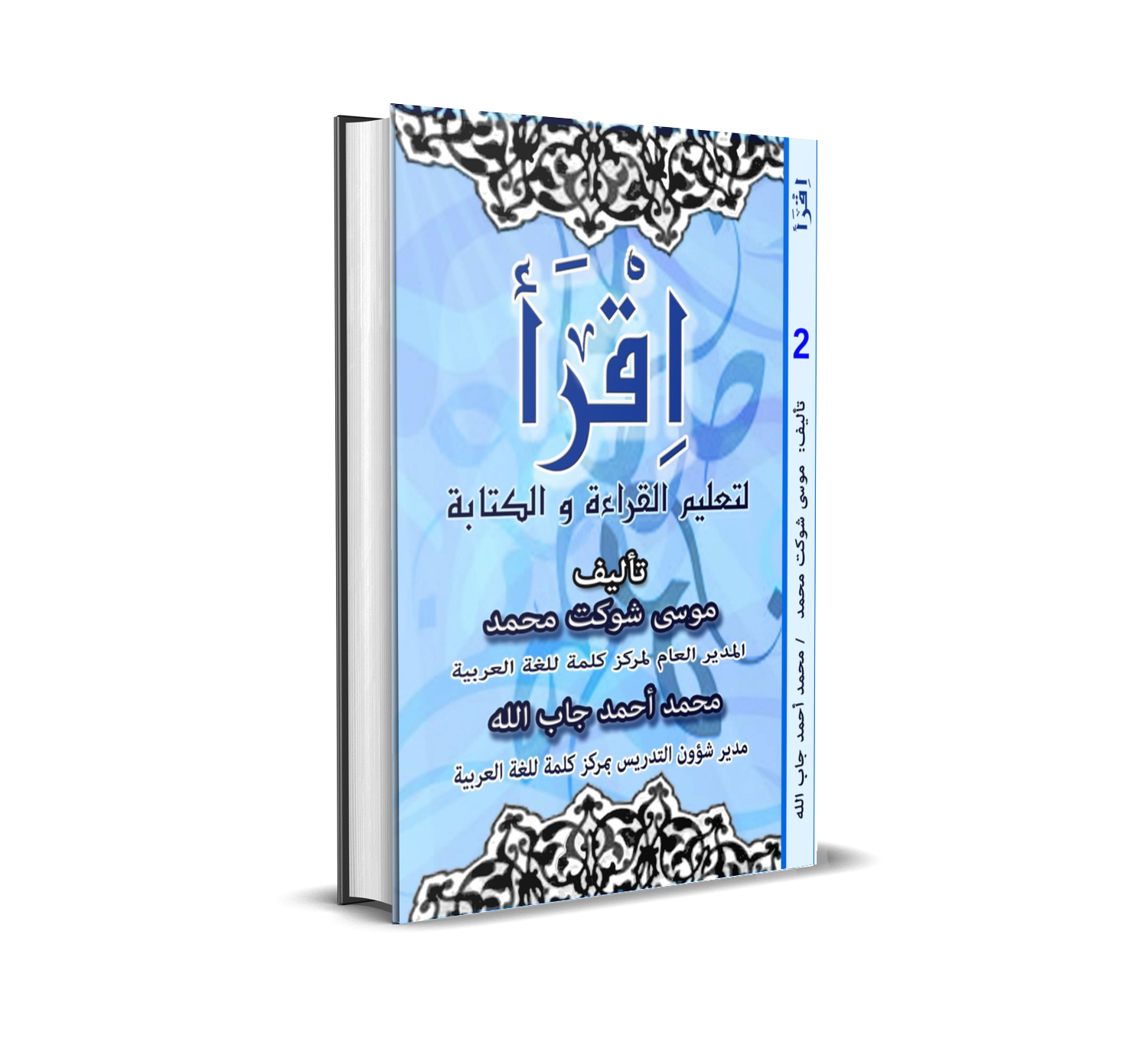
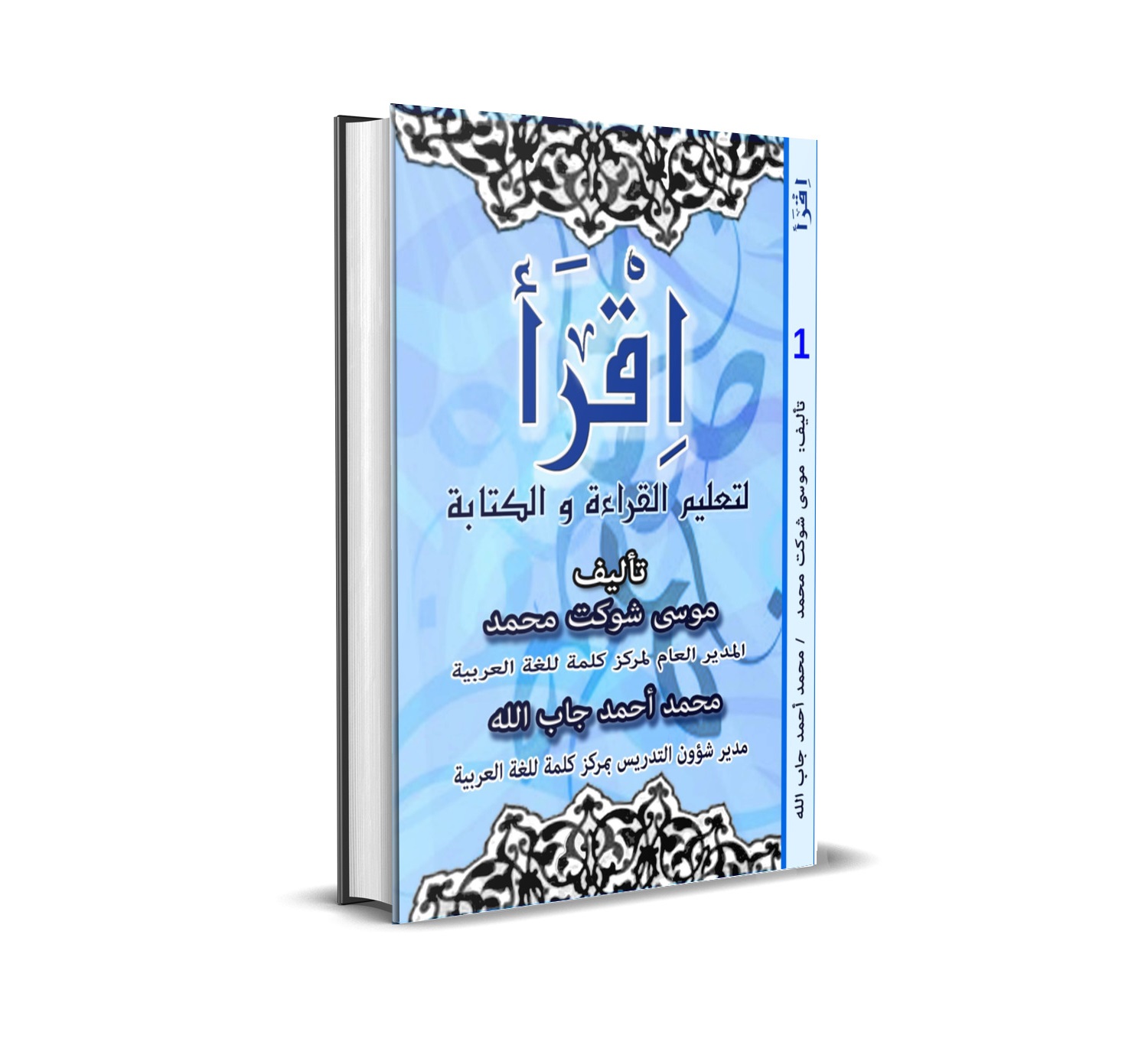
* From Kalimah’s Iqraa book, the key resource we use in our online Arabic course.
What are the prepositions in Arabic and their English translation?
There are around 21 prepositions in the Arabic language. These prepositions are classified into detached (separable) and attached (nonseparable) prepositions.
From the Ajrumiyyah:
وَهَِيِ مْن وَإلى وَعَْن وَعَلَى وَفِْي وَُرّب وَالْباءُ وَالْكَاُف وَالّلاُم وَُحُروُْف الَْقْسمِ، وَهَِي الْواوُ وَالْباءُ وَالتّاء
What are the detached Arabic prepositions?
A detached Arabic preposition stands alone and is written separately from the noun following it. The table below shows some examples of detached Arabic prepositions:
| Arabic preposition | Meaning in English |
| في | in, at, with |
| عدا | except |
| عن | about, on behalf of, away from |
| حتى | up to, to, at |
| من | from, of, than |
| إلى | to, till |
| على | on |
| منذ – مذ | since |
Read More: THE COMPREHENSIVE GUIDE TO ARABIC CONNECTING LETTERS
What are the attached Arabic prepositions?
The attached prepositions are made up of one letter and are always linked to the word following them. Examples of attached Arabic prepositions are:
| Arabic preposition | Meaning in English |
| ك | like, similar to |
| ل | to, for |
| ب | with, by, in |
| ت | used to make oaths |
| و | used to make oaths |
| بِ | used to make oaths |
Other Classification of Arabic Prepositions
Arabic prepositions can also be classified according to the meaning they add to the sentence into three types: true prepositions, redundant prepositions, and quasi-redundant prepositions.
- True prepositions ( حروف الجر الأصلية) add meaning to the sentence in which they appear, cannot be preceded by other prepositions, and can combine with a verb to create a verb-preposition idiom.
- Redundant prepositions ( حروف الجر الزائدة ) do not add any new meaning and are used for emphasis.
- Quasi-redundant prepositions ( حروف الجر شبه الزائدة ) add a limited meaning, such as “perhaps – رُب”
How are prepositions used in Arabic?
Prepositions are either a single letter or a word that links two nouns or a noun and a verb to create a sentence.
In Arabic, a preposition always comes before the word it’s associated with and never follows it. For example:
- ذهب علي إلى المدرسة
- Ali went to school.
- عاد خالد من العمل
- Khaled came from work.
The unique characteristics of Arabic prepositions
Now let’s discuss some of the unique characteristics of Arabic prepositions.
- The meaning of Arabic preposition depends on its place in the sentence; in other words, the Arabic preposition may be used to indicate different meanings according to the words that come before and after it.
- Arabic preposition particles are considered Mabni words كلمات مبنية, meaning they typically possess the same pronunciation regardless of their location in the sentence.
Differences between Arabic prepositions and locative adverbs
Locative adverbs, also known as adverbs of place and time (ظرف المكان وظرف الزمان), share similarities with prepositions as they always require a genitive noun. They are sometimes referred to as semi-prepositions.
Examples of common locative adverbs include “with” (مَع), “at” (عَنْد), and “between” (بَيْن). Locative adverbs are derived from trilateral lexical roots and are grammatically considered a type of noun.
The genitive noun that follows them is considered part of an iḍafa construction, such as “at the house” (عَنْد البَيْت) and “with my friends” (مَع أَصْدِقَائِي).
What do we call the noun that follows a preposition in Arabic?
In Arabic grammar, this noun is referred to as “majroor مجرور”. It is in the genitive case (jarr جرّ). When a noun comes after a preposition, it will end in either “kasrah” or “tanween kasra” depending on whether it is definite or not.
However, for dual or sound masculine plural nouns, the change occurs in the second-to-last letter, which becomes a ي, while the final vowel remains the same. As a result, they end in يْنِ if they are dual, definite or not, and ينَ if they are sound masculine plural, definite or not.
Contrastive Analysis between English and Arabic Prepositions
Prepositions in English and Arabic differ in usage, form, and underlying syntactic principles. For learners of Arabic, especially those accustomed to English preposition rules, these differences can often lead to errors in both comprehension and expression.
In this section, we’ll break down these distinctions and focus on the practical aspects of understanding and using Arabic prepositions accurately.
1. Structure and Form: Simple vs. Compound Prepositions
In English, prepositions can be simple (“in,” “on,” “at”) or compound phrases (“in front of,” “next to,” “in spite of”). They often carry abstract meanings that rely on context and are sometimes ambiguous without clear guidelines.
Arabic prepositions, known as ḥurūf al-jarr (حروف الجر), are mostly simple, single words (e.g., في /fi/ “in,” على /ʿalā/ “on,” من /min/ “from”). Compound prepositions are rare; instead, Arabic relies on prepositional phrases with pronouns to convey complex ideas.
2. Fixed Verb-Preposition Pairs
English prepositions often change meaning based on their accompanying verbs. For instance, “look at” and “look for” mean entirely different things, and these prepositional changes are often arbitrary and need to be memorized.
Arabic has specific, often less flexible, verb-preposition pairs that native speakers instinctively know. An example is the verb يفكر في /yufakkir fi/ (“think about”) as opposed to the direct translation يفكر عن /yufakkir ʿan/, which would be incorrect.
3. Spatial Relationships and Metaphorical Meanings
English prepositions often denote physical or spatial relationships. Arabic prepositions do the same but are applied more directly. For example, the preposition في /fi/ usually means “in” or “inside” and is rarely used metaphorically as broadly as “in” is in English (e.g., “in trouble,” “in love,” etc.).
Arabic speakers use prepositions like على /ʿalā/ (“on”) for support or emphasis, as in عليك أن /ʿalayka ʾan/ (“you must”), whereas in English, this would be indirect, with phrases like “you have to” or “you need to.”
4. Prepositions with Time Expressions
English prepositions “at,” “in,” and “on” change meaning based on the specificity of time (e.g., “at 5 p.m.,” “on Monday,” “in June”).
Arabic primarily uses في /fi/ for all time expressions, regardless of specificity, making it less complicated but often challenging for English speakers who overthink its usage. For instance, في الصباح /fi al-ṣabāḥ/ means “in the morning,” while في الليل /fi al-layl/ means “at night.”
Common Mistakes in Using Arabic Prepositions
Prepositions pose a challenge for Arabic learners who struggle to choose and use them correctly. Here is what makes learning Arabic prepositions daunting for non-Arabs:
- Preposition usage can be highly idiomatic and may not correspond to their English equivalents. As a result, learners of Arabic make errors and need guidance on preposition use and related structures.
- Both Arabic and English have prepositions with multiple meanings that change based on the sentence’s context.
- Certain prepositions are fixed expressions used with specific nouns, verbs, and adjectives.
- One difference between Arabic and English is that a preposition might be necessary in Arabic but not in English and vice versa.
- Additionally, prepositions in English may differ significantly from Arabic in meaning and usage, so direct equivalence should not be assumed.
learn more: YOUR COMPLETE GUIDE TO ARABIC VERB CONJUGATION
Understanding Arabic prepositions used in time expressions
Prepositions of time indicate the exact time an event or action took place. In the Arabic language, several prepositions are used to convey different time frames. The following are some of the most commonly used prepositions of time in Arabic and their usage.
Preposition “في” (at-in)
The preposition “في” (fi) is utilized to signify a specific time or period of occurrence. It commonly indicates the time of the day or a day of the week. For instance:
- في الصباح (fī al-ṣabāḥ) = “in the morning”
- في نهاية الأسبوع (fī nihāyat al-ʾusbūʿ) = “at the end of the week”
- في اللحظة (fī al-laḥẓah) = “at the moment”
Preposition “منذ” (since)
The preposition “منذ” (mundhu) is utilized to indicate the duration of an event or action since a specific time or occurrence. It is commonly paired with time expressions, such as:
- منذ سنة (mundhu sana) – since a year
- منذ يوم (mundhu yawm) – since a day
- منذ أسبوع (mundhu usbu’) – since a week
Preposition “حتى” (until)
The preposition “حتى” (hata) is used to indicate the end of a certain event or time. It works with both specific and general time references. Examples include:
- حتى الصباح (hata al-sabah) – until morning
- حتى الظهر (hata al-dhuhr) – until noon
- حتى المساء (hata al-masa) – until evening
Prepositions for indicating location and direction
Prepositions of place describe the location of an event or action. Arabic has various commonly used prepositions of place, similar to prepositions of time.
Use of Arabic prepositions in locative phrases with examples
Below are some of the most frequently used prepositions of place and their usage:
Preposition “في” (at-in):
The word “في” (fi) is a preposition that signifies the location of an event or action. It is commonly used to indicate the location of a building, city, or country. For example:
- في البيت (fi al-bayt) – at home
- في المدرسة (fi al-madrasa) – at school
Preposition “علي” (upon- on):
The preposition “على” (ala) is utilized to show the location of an object or the surface on which an action occurs. It signifies that an action or event is taking place on or upon something. Some examples of its usage include:
- على المنضدة (ala al-mindada) – on the table
- على الأرض (ala al-ard) – on the ground
- على الجبل (ala al-jabal) – on the mountain
Arabic Prepositions for indicating abstract relationships
Arabic, like other languages, uses prepositions to indicate relationships between words in a sentence. However, Arabic prepositions can also indicate more abstract relationships, such as possession, association, and causality. Some common prepositions used for these purposes include:
Preposition “مِن” – “min” (from/of)
The preposition “min” is used to express the source of something, such as “I received a gift from my friend” which would be “Istalamtu hadiya min sadeeqi” “استلمت هدية من صديقي” in Arabic.
preposition “بِ” – “bi” (by/with)
The preposition “bi”- “بِ” is used to express the instrument of an action, such as “I wrote with a pen” which would be “ktabt bi al-qlam” “كتبت بالقلم” in Arabic.
How to construct prepositional phrases in Arabic?
Prepositional phrases are a group of words that begin with a preposition and end with a noun or pronoun. Essentially, they describe the relationship between the noun or pronoun and other words in a sentence.
The preposition itself indicates the relationship, such as location, direction, time, or manner. Prepositional phrases can also add detail and specificity to sentences, making them more descriptive and informative.
What are the examples of Arabic prepositional phrases?
Examples of prepositional phrases in Arabic include:
- “fawqa ra’see”, “فوق رأسي” meaning “above my head”.
- “ba’dal-‘ashaa’i”, “بعد العشاء” meaning “after dinner”.
- “khalfash-shajarati”, “خلف الشجرة” meaning “behind the tree”.
- and “amaamas-sayyaarati”, “أمام السيارة” meaning “in front of the car.”
Bottom line
Prepositions play a crucial role in both Arabic writing and speech structure. They serve as fundamental elements in constructing sentences and contribute significantly to their coherence.
As a beginner, you may find it challenging to master the use of Arabic prepositions as they widely differ from other languages.
No need to worry! Kalimah Online Arabic Teaching Academy is here to help you learn Arabic grammar in the easiest and most efficient way.
Begin your journey towards mastering the Arabic language by joining Kalimah Arabic language classes today!
Test Your Knowledge!
Now that you have learned everything about Arabic prepositions. Test your knowledge by sorting out Arabic prepositions from this random page of the Quran
Answer:
- بزعمهم
- عليها
- عليه
- بما
- في بطون
- فيه
- بغير
- على الله
- من ثمره
- ومن الأنعام
- مما رزقكم
Master Arabic with Kalimah Center
Join our expert-led online classes and start your journey toward Arabic fluency today.
Book Your Free TrialInside Kalimah Center: Moments from Our Courses
Get a glimpse into the vibrant learning experience at Kalimah Center. These snapshots capture real moments from our live classes—where students engage deeply, connect with passionate instructors, and grow in a welcoming, supportive environment.
Here Are The Reviews On Our Courses:
Our students frequently commend the excellence of our courses and the commitment shown by our instructors. You can read their complete reviews on Trustpilot.

Master Arabic Prepositions with Kalimah
To truly use Arabic prepositions correctly, you need more than just rules. You need to hear them in action, practice them in conversation, and get feedback from expert teachers.
That’s what Kalimah Center offers.
Our online Arabic courses will help you:
- Build a strong foundation: We start with the basics, ensuring you understand how prepositions work in Arabic.
- Go beyond the rules: You’ll learn how prepositions are used in different contexts, with plenty of examples and practice.
- Gain confidence in speaking: Our interactive classes will help you use prepositions naturally in conversations.
📚 Explore Our Courses:
Online Arabic Course: Tailored to your level, our comprehensive Arabic program includes 16 teaching levels and 400+ hours of personalized sessions.
Online Quran With Tajweed Course: Perfect for non-Arabic speakers, our course spans 13 levels and equips you with Tajweed mastery from beginner to advanced.
Online Arabic Course For Kids: Nurture your child’s love for Arabic with our engaging and structured program, available in 24 levels for primary, intermediate, and secondary stages.
🚀 Start Your Free Trial Today! 🚀
Don’t miss out on this life-changing opportunity to deepen your faith and knowledge. Sign up now for your free trial and take the first step towards becoming a better practicing Muslim with Kalimah Center!

FAQs
Can one Arabic preposition have multiple meanings?
Yes, Several English prepositions can be represented by a single Arabic preposition. It may seem that each Arabic preposition has a singular meaning and usage. However, this is not the case.
For example, the letter ب (baa) can signify numerous things, including ‘with’ and ‘by’. The meaning of the Arabic preposition depends on its place in the sentence and what comes before and after the preposition.
How do prepositions affect the case of the following nouns in Arabic?
The nouns following Arabic prepositions change from nominative case (dammah– Marfou’) to genitive case (Kasrah- Majrour).
How do you tell if a word is a preposition?
A preposition is a “Harf” or “particle” that adds meaning to the word following it, in addition to changing the case of the noun following it from nominative to genitive case.
What are some of the most common mistakes non-native speakers make with Arabic prepositions?
One of the most common mistakes non-native speakers make with Arabic prepositions is using them incorrectly or inconsistently. For example, confusing the prepositions “fi” and “bi” which both can mean “in” but are used in different contexts. Additionally, some prepositions have multiple meanings and can be used in different ways depending on the context, leading to confusion for non-native speakers.
Does Arabic have prepositions or postpositions?
Yes, Postpositions are sometimes used in Arabic after a noun or pronoun to provide additional information about their location, direction or relationship to other elements in the sentence. For instance:
أنا ذاهب إلى المدرسة بعد الظهر. (I am going to school this afternoon.)
سألت عن الكتاب من دونهِ. (I asked about the book without him.)
تحدثتُ معهُ في مكتبهِ. (I spoke with him in his office.)
هذا المنزل خلف المسجد. (This house is behind the mosque.)
لقد رأيتُهُ في الشارعِ قبل الفجرِ. (I saw him in the street before dawn.)
What are Arabic prepositions and how do they function?
Arabic prepositions, known as Huruf al-Jar (حروف الجر), are particles used to connect nouns, pronouns, or verbs to complete a sentence’s meaning. They primarily establish relationships of time, place, direction, or abstraction, and always precede the noun they modify, shifting it into the genitive case (Majroor).
How many prepositions are there in the Arabic language?
There are approximately 21 prepositions in Arabic grammar, as famously detailed by Ibn Malik in his Alfiya. While archaic Arabic included particles like Kay, Mata, and La’alla, modern Arabic heavily relies on a smaller core group of detached and attached prepositions for daily communication.
What is the difference between attached and detached Arabic prepositions?
Detached prepositions stand alone as separate words (e.g., في / fi / in, من / min / from, إلى / ila / to). Attached prepositions consist of a single letter that prefixes directly onto the following noun (e.g., بِ / bi / with, كَ / ka / like, لِ / li / for).
What grammatical case follows an Arabic preposition?
Any noun or pronoun that follows an Arabic preposition automatically enters the genitive case, known as Majroor (مجرور). Definite singular nouns display this change with a Kasra (ِ) or Tanween Kasra at the end, while dual and sound masculine plural nouns change their ending to include a Yaa (ي).
How do Arabic prepositions differ from English prepositions?
Arabic prepositions are primarily simple, single words, whereas English frequently uses compound phrases (like “in front of”). Additionally, Arabic time expressions overwhelmingly rely on the single preposition Fi (في), unlike English which shifts dynamically between “at,” “on,” and “in” depending on specificity.
Conclusion:
Arabic prepositions (حروف الجر) are essential in linking nouns or pronouns to other parts of a sentence, influencing the meaning and case of the words they connect. These prepositions, totaling around 21, function to express relationships of time, place, and direction. They can be simple, like “في” (in), “من” (from), or “إلى” (to), and often differ from English prepositions in usage.
For example, Arabic uses prepositions to indicate location, direction, and time consistently, while English prepositions can be more flexible. Additionally, Arabic prepositions affect the case of the noun that follows, marking it as genitive.
Common mistakes occur when learners directly translate prepositions from English, as Arabic prepositions are sometimes used differently, both in terms of meaning and structure. Some prepositions are idiomatic and don’t align with their English counterparts, requiring careful study of their usage.
Arabic prepositions also function in fixed expressions with verbs or adjectives, and understanding their correct application is crucial for fluent communication. For effective learning, focusing on the most frequently used prepositions like “في,” “من,” “إلى,” and “على” is a good starting point.