In a nutshell: Arabic adverbs (Zarf) modify verbs and provide details about time and place, with two main types—Adverbs of Time and Adverbs of Place. These are typically accusative nouns answering “when?” or “where?”. Additionally, “Al-Maf’ulat al-Khamsah” includes objects like “Al-Maf’ul Fihi,” which relate to adverbs, specifying time, place, manner, or purpose, enriching sentence structure.
If you’re learning about Arabic adverbs from English sources, you might encounter unfamiliar classifications. This is because some explanations apply English grammar concepts to Arabic. However, Arabic grammar traditionally recognizes two primary types of adverbs.
We will explore these types, along with other expressions that function as adverbs, and discuss their usage and grammatical roles within a sentence.
What is an Adverb (Zarf ظرف) Meaning in Arabic Grammar?
The Arabic adverb is called “Zarf” (ظرف), which literally means “container” or “envelope”, is a word that modifies a verb, an adjective, or another adverb. al-Zarf gives more information about time or place. so , Arabic adverbs often come under a special category of nouns that answer questions like:
- “متى؟” (Mataa?) – When?
- “أين؟” (Ayna?) – Where?
The Types of Adverbs in Arabic Grammar
Adverbs in Arabic grammar divided into two types: Adverbs of Time (ظرف الزمان | Ẓarf al-Zamān) which indicate when an action occurs, and Adverbs of Place (ظرف المكان | Ẓarf al-Makān), which indicate where an action happens.
Adverbs of Time, such as “صباحًا” (ṣabāḥan, in the morning) or “مساءً” (masāʾan, in the evening), are nouns in the accusative case that implicitly carry the meaning of “in.” Adverbs of Place, like “أمام” (ʾamāma, in front of) or “فوق” (fawqa, above), also function as accusative nouns, answering the question “Where?”. Other types of adverbs, like manner, degree, and frequency, exist but may be categorized differently in Arabic grammar, such as “حال” (circumstantial qualifier).
Let’s explain each type with simple examples.
1. Adverbs of Time in Arabic (ظرف الزمان | Ẓarf al-Zamān)
An adverb of time in Arabic indicates when an action occurs. Arabic adverb of time is a noun in the accusative case (منصوب | mansūb) that acts as the container for the event, answering the question “When?”
Key Features of Adverbs of Time in Arabic:
- Must be a noun.
- Must indicate time (like “in the morning,” “in the evening”).
- Must carry the meaning of “in” implicitly.
Examples of Adverbs of Time in Arabic:
أذهب إلى المدرسة صباحًا وأعود مساءً
(ʾadhhabu ʾilā al-madrasah ṣabāḥan wa-ʾaʿūdu masāʾan)
“I go to school in the morning and return in the evening.”
- صباحًا (ṣabāḥan): Adverb of time indicating “in the morning.”
- مساءً (masāʾan): Adverb of time indicating “in the evening.”
Here, “ṣabāḥan” and “masāʾan” are accusative nouns that mean “in the morning” and “in the evening.” Notice the implicit “in” (في | fī).

* From Kalimah’s online Arabic courses curriculum.
يرتدي الناس الملابس الخفيفة صيفًا والثقيلة شتاءً
(yartadī al-nās al-malābis al-khafīfah ṣayfan wa-al-thaqīlah shitāʾan)
“People wear light clothes in summer and heavy clothes in winter.”
- صيفًا (ṣayfan): Adverb of time for “in the summer.”
- شتاءً (shitāʾan): Adverb of time for “in the winter.”
Subcategories of Adverbs of Time in Arabic:
| Category | Definition | Examples |
| Limited Time | Indicates a fixed amount of time. | ساعة (sāʿah – hour), يوم (yawm – day) |
| Unlimited Time | Indicates an indefinite time period. | لحظة (laḥẓah – moment), حين (ḥīn – time) |
Most Common Adverbs of Time in Arabic
| مساءً | in the evening, PM | صباحًا | in the morning, AM | ليلًا | at night |
| نهارًا | during the day | فجرًا | at dawn | ظهرًا | at noon |
| عصرًا | in the afternoon | مغربًا | in the evening, at sunset | عشاءً | at dinner time |
| لحظة | moment | برهة | a while, a short period | ثانية | second |
| دقيقة | minute | ساعة | hour | يومًا | day |
| أسبوعًا | week | شهرًا | month | عامًا | year |
| سنة | year | قرنًا | century | حينًا | time, while |
| دهرًا | a long time, an eternity | أبدًا | never, ever | فترة | period |
| صيفًا | in summer | شتاءً | in winter | ربيعًا | in spring |
| خريفًا | in autumn | وقتًا | time | أمس | yesterday |
| غدًا | tomorrow | قديمًا | in the past, formerly | حديثًا | recently, lately |
| الآن | now | أثناء | during, while | بينما | while |
| إذ | when, as | إذا | if, when | متى | when |
Experience Kalimah Center Classes
Watch real excerpts from our live sessions at Kalimah Center and see how we bring learning to life. These clips highlight our interactive, student-centered teaching approach across all our courses—designed to keep learners engaged, motivated, and actively involved every step of the way.
Master Arabic with Kalimah Center
Join our expert-led online classes and start your journey toward Arabic fluency today.
Book Your Free Trial2. Arabic Adverbs of Place (ظرف المكان | Ẓarf al-Makān)
An Arabic adverb of place tells where an action occurs. Like time adverbs, place adverbs are accusative nouns that act as the container for the event, answering the question “Where?”
Key Features of Adverbs of Place:
- Must be a noun.
- Must indicate a location (like “under the tree,” “on the table”).
Examples of Adverbs of Time in Arabic:
وقف الطفل أمامَ المعلم
(waqafa al-ṭifl ʾamāma al-muʿallim)
“The child stood in front of the teacher.”
- أمامَ (ʾamāma): Adverb of place indicating “in front of.”
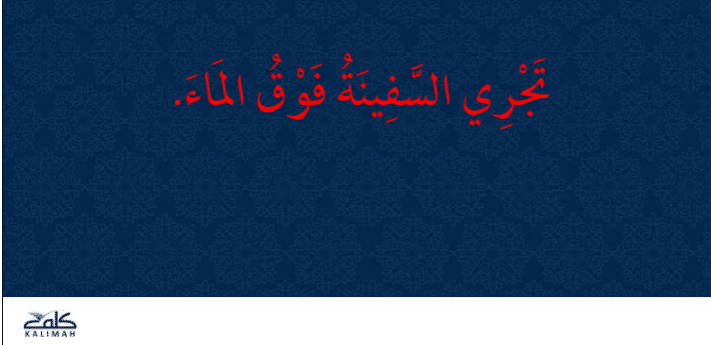
تجري السفينة فوق الماء
(tajrī al-safīnah fawqa al-māʾ)
“The ship sails over the water.”
- فوق (fawqa): Adverb of place for “above.”
* From Kalimah’s online Arabic courses curriculum.
Most Common Adverbs of Place in Arabic
| العربية | الإنجليزية | العربية | الإنجليزية | العربية | الإنجليزية |
| يمين | right | شمال | left, north | جنوب | south |
| شرق | east | غرب | west | أمام | in front of, before |
| خلف | behind | قدام | in front of | وراء | behind |
| هنا | here | هناك | there | فوق | above, on top of |
| تحت | below, under | حول | around | بين | between, among |
| وسط | middle, center | نحو | towards | تلقاء | towards |
| حيث | where | دون | without, less than | داخل | inside |
| خارج | outside | ثم | then | إزاء | facing, opposite |
| حذاء | beside, next to |
Comparison Chart of Time and Place Adverbs in Arabic
| Feature | Adverb of Time (ظرف الزمان) | Adverb of Place (ظرف المكان) |
| Question Answered | “When?” | “Where?” |
| Examples | صباحًا (ṣabāḥan – in the morning) | فوق (fawqa – above) |
| Used in Sentences | يدرس ليلاً (yadrusu laylan – studies at night) | وقف أمامي (waqafa ʾamāmī – stood in front of me) |
Now, where are the rest of the adverb types we find in English, like adverbs of manner, frequency, and degree?
Of course, we express these meanings in Arabic too. But in terms of grammatical function, some of these words primarily fall under the category of adverbs of time (ظرف الزمان). Sometimes the word can be analyzed as a حال (circumstantial qualifier) or even a نائب مفعول مطلق (we’ll discuss this later cognate object). Generally, these words are parsed based on their position and function within the sentence.
My point is: I’ll categorize these words under their usual English headings, but keep in mind that they’re not strictly limited to being adverbs in Arabic grammar. In short, the key difference lies in the richness of Arabic’s grammatical system.
To avoid confusion, I’ll provide a brief overview of words that can be considered adverbs in English grammar. However, their Arabic grammatical analysis may use different terminology, such as “حال” or “نائب مفعول مطلق” instead of “ظرف”:
3. Adverbs of Manner in Arabic
These adverbs describe how an action is performed, providing information about the manner or way in which it occurs.
Examples:
- جيدًا (jayyidan) – well
- بسرعة (bisurʿah) – quickly
- ببطء (bibuṭʾ) – slowly
- بصعوبة (biṣuʿūbah) – with difficulty
- بسهولة (bisahūlah) – easily
- بهدوء (bihudūʾ) – calmly
4. Adverbs of Degree in Arabic
These adverbs indicate the intensity or extent of an action or quality.
Examples:
- جدًا (jiddan) – very
- كثيرًا (kathīran) – much, a lot
- قليلًا (qalīlan) – a little
- تمامًا (tamāman) – completely
- تقريبًا (taqrīban) – approximately
5. Adverbs of Frequency in Arabic
These adverbs specify how often an action occurs.
Examples:
- دائمًا (dāʾiman) – always
- غالبًا (ghālibān) – often
- أحيانًا (ʾaḥyānan) – sometimes
- نادرًا (nādiran) – rarely
- أبدًا (ʾabadan) – never
What Are al-Maf’ulat al-Khamsah (المفعولات الخمسة)?
The term al-Maf’ulat al-Khamsah (المفعولات الخمسة), or more accurately al-Maf’eel al-Khamsah (المفاعيل الخمسة), refers to five types of grammatical objects in Arabic that act as complements to the verb, giving us extra information about the action. All five objects are marked by the accusative case ( nasb نصب), which usually appears as a fatḥa الفتحة on the last letter of the word.
Now, you might be wondering, what does this have to do with adverbs? Well, one of these objects, al-maf’ūl fihi المفعول فيه, is closely related to the function of adverbs in Arabic. Let’s explore each object and see how they relate to adverbs.
1. Al-Maf‘ul Fihi (المفعول فيه): The Adverbial Object of Time and Place in Arabic
Al-Maf‘ul Fihi (المفعول فيه) is a noun that is put in the accusative case to show when or where the action of the verb takes place, encompassing both adverbs of time and adverbs of place. When Al-Maf‘ul Fihi (المفعول فيه) specifies the location of the action, it is referred to as an adverb of place (ظرف مكان), and when it specifies the time of the action, it is referred to as an adverb of time (ظرف زمان).
An we have mentioned the details and the examples at the beginning of the article.
2. Al-Maf‘ul Al-Muṭlaq (المفعول المطلق): Cognate Object in Arabic
Al-Maf‘ul Al-Muṭlaq (المفعول المطلق) emphasizes or specifies the action by repeating its root in a nominal form. Al-Maf‘ul Al-Muṭlaq (المفعول المطلق) is like a cousin to adverbs of manner. It’s formed using the verbal noun (maṣdar) of the verb and can describe how the action is done.
The maf‘ul al-muṭlaq serves to clarify or magnify the verb, adding an artistic flair to speech or writing.
ضحكتُ ضحكاً عالياً
Daḥaktu ḍaḥkan ‘āliyan
I laughed a loud laugh.
Here, ضحكاً (ḍaḥkan) amplifies the intensity of laughing.
3. Al-Maf‘ul Ma‘ahu (المفعول معه): The Accompanying Object in Arabic
Al-Maf‘ul Ma‘ahu (المفعول معه) indicates something that occurs alongside the action. Al-Maf‘ul Ma‘ahu (المفعول معه) often follows a waw (و) meaning “with.”
سرتُ والنهرَ
Sirtu wa al-nahr
I walked along with the river.
النهرَ (al-nahr) is the maf‘ul ma‘ahu, accompanying the action of walking.
This type emphasizes companionship or simultaneity, often in poetic or descriptive contexts in Arabic literature.
4. Al-Maf‘ul Li-Ajlīhi (المفعول لأجله): The Causal Object in Arabic
l-Maf‘ul Li-Ajlīhi (المفعول لأجله) answers “Why?” It explains the reason or motive behind the action, often linked to emotions or intentions.
درستُ إجلالاً للعلمِ
Darastu ijlālan lil-‘ilm
I studied out of respect for knowledge.
إجلالاً (ijlālan) explains the purpose behind studying.
This object adds emotional depth to sentences, reflecting intentions often tied to cultural practices like generosity or respect.
5. Al-Maf‘ul Bihi (المفعول به): The Direct Object in Arabic
Al-Maf‘ul Bihi (المفعول به) is the verb directly acts upon, it answers the question “What?” or “Whom?” after the verb.
أحببتُ الكتابَ
Aḥbabtu al-kitab
I loved the book.
الكتابَ (al-kitab) is the direct object of love.
Master Arabic with Kalimah Center
Join our expert-led online classes and start your journey toward Arabic fluency today.
Book Your Free TrialInside Kalimah Center: Moments from Our Courses
Get a glimpse into the vibrant learning experience at Kalimah Center. These snapshots capture real moments from our live classes—where students engage deeply, connect with passionate instructors, and grow in a welcoming, supportive environment.
Here Are The Reviews On Our Courses:
Our students frequently commend the excellence of our courses and the commitment shown by our instructors. You can read their complete reviews on Trustpilot.

Want to go beyond just reading about Arabic adverbs?
At Kalimah Center, we make learning adverbs an exciting part of your Arabic journey. Our online Arabic courses combine expert instruction with engaging materials, so you can grasp the nuances of “zuruf in Arabic” and use them confidently in your conversations.
- Our courses guide you step-by-step, from the Arabic alphabet to other grammar concepts like adverbs.
- We use dynamic presentations and exercises to make learning fun and effective.
- Our native Arab teachers will support you throughout your journey.
We’ll empower you to use adverbs effectively, enriching your Arabic communication and deepening your understanding of the language.
📚 Explore Our Courses:
Online Arabic Course: Tailored to your level, our comprehensive Arabic program includes 16 teaching levels and 400+ hours of personalized sessions.
Online Quran With Tajweed Course: Perfect for non-Arabic speakers, our course spans 13 levels and equips you with Tajweed mastery from beginner to advanced.
Online Arabic Course For Kids: Nurture your child’s love for Arabic with our engaging and structured program, available in 24 levels for primary, intermediate, and secondary stages.
🚀 Start Your Free Trial Today! 🚀
Don’t miss out on this life-changing opportunity to deepen your faith and knowledge. Sign up now for your free trial and take the first step towards becoming a better practicing Muslim with Kalimah Center!

Conclusion:
In Arabic, adverbs (Zarf – ظرف) modify verbs, adjectives, or other adverbs, providing details about time and place. They are mainly divided into Adverbs of Time (ظرف الزمان), like “صباحًا” (in the morning), and Adverbs of Place (ظرف المكان), like “أمام” (in front of).
These adverbs are accusative nouns, answering questions like “When?” and “Where?”. Other adverbs in Arabic, such as those of manner, degree, and frequency, may be categorized differently, sometimes as “حال” (circumstantial qualifiers) or “نائب مفعول مطلق” (cognate objects).
The concept of “Al-Maf’ulat al-Khamsah” (المفاعيل الخمسة) includes five objects that complement verbs. “Al-Maf’ul Fihi” (المفعول فيه) corresponds to adverbs of time and place, while others, like “Al-Maf’ul Al-Muṭlaq” (manner) and “Al-Maf’ul Li-Ajlīhi” (causal object), add context or specify the action’s manner, purpose, or recipient. These grammatical elements enhance the richness of Arabic sentences.
FAQs about Arabic Adverbs
Q1: What is a Zarf (ظرف) in Arabic grammar?
A1: In Arabic grammar, a Zarf (ظرف) is an adverbial noun in the accusative case (mansub) that modifies a verb by providing specific details about when or where an action occurs. Literally meaning “container,” a Zarf implicitly carries the meaning of the word “in” (fi) and directly answers the questions “When?” (Mataa?) or “Where?” (Ayna?).
Q2: What is the difference between Zarf al-Zaman and Zarf al-Makan?
A2: The primary difference is their function: Zarf al-Zaman (ظرف الزمان) is an adverb of time that specifies when an action occurs (e.g., ṣabāḥan / in the morning), while Zarf al-Makan (ظرف المكان) is an adverb of place that specifies where an action occurs (e.g., fawqa / above). Both are traditionally categorized as accusative nouns.
Q3: How does Arabic grammar express English adverbs of manner, degree, and frequency?
A3: While English treats these as distinct types of adverbs, traditional Arabic grammar often classifies words expressing manner, degree, or frequency under different grammatical roles. Depending on their sentence structure, they are usually parsed as a Hal (حال – circumstantial qualifier) or a Na’ib Maf’ul Mutlaq (نائب مفعول مطلق – cognate object placeholder).
Q4: What are Al-Maf’ulat Al-Khamsah (المفعولات الخمسة) in Arabic?
A4: Al-Maf’ulat Al-Khamsah (or Al-Mafa’il Al-Khamsah) are the five types of grammatical objects in Arabic that act as verb complements to add extra context to a sentence. All five objects always take the accusative case (nasb), typically marked by a fatha. They include:
Al-Maf’ul Bihi (Direct Object)
Al-Maf’ul Fihi (Adverbial Object of Time/Place)
Al-Maf’ul Al-Mutlaq (Cognate Object)
Al-Maf’ul Li-Ajlihi (Causal Object)
Al-Maf’ul Ma’ahu (Accompanying Object)
Q5: What is the relationship between Al-Maf’ul Fihi and Arabic adverbs?
A5: Al-Maf’ul Fihi (المفعول فيه) is the exact grammatical classification for Arabic adverbs of time and place. It literally translates to “the object in which [an action occurs].” When Al-Maf’ul Fihi points to a location, it is called Zarf Makan, and when it points to a timeframe, it is called Zarf Zaman.