Arabic pronouns (الضمائر – al-ḍamāʾir) are words that replace nouns, varying by person (1st/2nd/3rd), number (singular/dual/plural), and gender (masculine/feminine)—creating 14 personal pronouns in total. They divide into detached pronouns (stand-alone: أنا – I, هو – he) and attached pronouns (suffixes: ـي – my, ـه – his). Additional types include demonstrative (هذا – this), relative (الذي – who/which), and interrogative (من – who?) pronouns. Mastering pronoun gender agreement and attachment rules is essential for Arabic fluency.
Quick-Start Beginner Table
| Essential Pronouns (Learn First) | Arabic | Transliteration | Usage Example |
|---|---|---|---|
| I | أنا | ana | أنا طالب (I am a student) |
| You (m) | أنتَ | anta | أنتَ معلم (You are a teacher) |
| You (f) | أنتِ | anti | أنتِ طالبة (You are a student-f) |
| He | هو | huwa | هو طبيب (He is a doctor) |
| She | هي | hiya | هي معلمة (She is a teacher-f) |
| We | نحن | naḥnu | نحن طلاب (We are students) |
| They (m) | هم | hum | هم مهندسون (They are engineers) |
| My (attached) | ـي | -ī | كتابي (my book) |
| Your (m) (attached) | ـكَ | -ka | كتابكَ (your book) |
| His (attached) | ـه | -hu | كتابه (his book) |
Beginner Tip: Start with these 10 pronouns before learning dual and complex forms. They cover 80% of everyday usage.
Imagine trying to speak Arabic without pronouns. Every sentence would sound like this:
‘Khalid went to Khalid’s house. Khalid opened Khalid’s door. Khalid sat on Khalid’s chair.’
Exhausting, right? That’s why Arabic pronouns (الضمائر – al-ḍamāʾir) exist—to replace nouns and make speech natural and efficient:
‘Khalid went to his house. He opened his door. He sat on his chair.’
But here’s what makes Arabic pronouns both fascinating and challenging:
- 14 personal pronouns (vs English’s 7) thanks to dual forms
- Two attachment systems: detached (stand-alone) and attached (suffixes)
- Strict gender agreement: even objects like ‘car’ and ‘book’ have gender
- Multiple pronoun categories: personal, demonstrative, relative, interrogative
This comprehensive guide teaches you:
- All 14 personal pronouns with pronunciation
- How attached vs detached pronouns work
- Demonstrative pronouns (هذا، ذلك)
- Relative pronouns (الذي، التي)
- Interrogative pronouns (من، ما، أين)
- Common mistakes and how to avoid them
- Free downloadable worksheet for practice
Whether you’re a beginner learning your first pronouns or an intermediate student mastering attachment rules, this guide provides clear charts, practical examples, and actionable learning strategies.
Let’s start with the foundation: what exactly are pronouns in Arabic?
What Are Arabic Pronouns (الضمائر)? Definition for Learners
In Arabic grammar, pronouns are called الضمائر (al-ḍamāʾir), singular ضمير (ḍamīr). The root ض-م-ر relates to ‘hidden’ or ‘implied’—because pronouns ‘hide’ the original noun they replace.
Core Function:
Pronouns replace nouns to avoid repetition and streamline communication.
Example of pronoun replacement:
Without pronouns (awkward):
محمد ذهب إلى مدرسة محمد. في مدرسة محمد، التقى محمد بأصدقاء محمد.
Muhammad went to Muhammad’s school. At Muhammad’s school, Muhammad met Muhammad’s friends.
With pronouns (natural):
محمد ذهب إلى مدرسته. في مدرسته، التقى بأصدقائه.
Muhammad went to his school. At his school, he met his friends.
How Arabic Pronouns Differ from English:
1. Dual Forms Exist
English: you (2 people or 100 people—same word)
Arabic: أنتما (you-two, exactly 2), أنتم (you-plural, 3+)
2. Gender Matters for Everything
English: it (gender-neutral for objects)
Arabic: هو (he/it-masculine), هي (she/it-feminine) even for non-living things
Example: السيارة… هي (the car-feminine… she/it)
3. Pronouns Attach to Words
English: my book (separate words)
Arabic: كتابي (book**-my** – pronoun ـي attaches as suffix)
4. More Total Pronouns
English: ~7-10 personal pronouns
Arabic: 14+ personal pronouns plus demonstrative, relative, interrogative types
Understanding these differences from the start prevents confusion and accelerates learning.
How Many Pronouns Are There in Arabic?
There are 14 Personal pronouns in Arabic when we account for the masculine and feminine variations of the dual pronouns. These 14 personal pronouns represent the different ways we can refer to ourselves, the people we’re talking to, and the people or things we’re talking about. They vary based on:
- Person: First person (speaker), second person (addressee), or third person (absent).
- Number: Singular, dual (yes, Arabic has a special form for two!), or plural.
- Gender: Masculine or feminine.
Arabic Pronouns by Gender: Masculine, Feminine & Neutral
So, Arabic has 14 pronouns, which can be summarized in a handy Arabic pronouns chart. Here’s a simple breakdown by gender:
Masculine Pronouns in Arabic Chart
| Number | Person | Pronoun (Arabic) | Pronoun (Transliteration) |
| Singular | Second | أنتَ | ‘anta |
| Third | هو | huwa | |
| Dual | Second | أنتما | ‘antuma |
| Third | هما | huma | |
| Plural | Second | أنتم | ‘antum |
| Third | هم | hum |
Feminine Pronouns in Arabic Chart
| Number | Person | Pronoun (Arabic) | Pronoun (Transliteration) |
| Singular | Second | أنتِ | ‘anti |
| Third | هي | hiya | |
| Dual | Second | أنتما | ‘antuma |
| Third | هما | huma | |
| Plural | Second | أنتن | ‘antunna |
| Third | هن | hunna |
Gender-Neutral Pronouns in Arabic
| Number | Person | Pronoun (Arabic) | Pronoun (Transliteration) |
| Singular | First | أنا | ‘ana |
| Plural | First | نحن | naHnu |
Read more about: Female Pronouns in Arabic – She / Her Pronouns With Examples
Experience Kalimah Center Classes
Watch real excerpts from our live sessions at Kalimah Center and see how we bring learning to life. These clips highlight our interactive, student-centered teaching approach across all our courses—designed to keep learners engaged, motivated, and actively involved every step of the way.
Master Arabic with Kalimah Center
Join our expert-led online classes and start your journey toward Arabic fluency today.
Book Your Free TrialTypes of Pronouns in Arabic
We have several distinct pronoun families in Arabic. Actually, we refer to some of them as nouns in Arabic (not pronouns), but they are popularly called pronouns in English, so we’ll list some of them them here:
1. Personal Pronouns
These are the stars of the show, used to refer to people.
2. Demonstrative Pronouns
These point to specific things or people (like “this” or “that”).
3. Relative Pronouns
These introduce relative clauses, providing extra information about a noun.
4. Interrogative Pronouns
These are the question words, like “who,” “what,” and “where.”
And more…
Let’s see the details of each type.
Arabic Personal Pronouns: Detached & Attached Forms
Personal pronouns (الضمائر الشخصية, ḍamāʾir al-shakhsiyyah) refer to specific people or things. These are further divided into two main types: attached pronouns (الضمائر المتصلة) and detached pronouns (الضمائر المنفصلة):
1. Detached Pronouns (الضمائر المنفصلة): Stand-Alone Forms
Detached pronouns (الضمائر المنفصلة) in Arabic are independent pronouns that stand alone and are not attached to any word.
These pronouns are divided into two main categories: Nominative Detached Pronouns (ضمائر الرفع المنفصلة) and Accusative Detached Pronouns (ضمائر النصب المنفصلة).
1.1. Nominative Detached Pronouns in Arabic (ضمائر الرفع المنفصلة)
These pronouns function as the subject of a verb or the predicate of a nominal sentence. So, you call them Arabic subject pronouns because they express the doer of an action or the main entity in a statement.
| Person | Masculine Pronoun | Feminine Pronoun | Translation |
| 1st Singular | أنا (ana) | أنا (ana) | I |
| 2nd Singular | أنتَ (anta) | أنتِ (anti) | You |
| 3rd Singular | هو (huwa) | هي (hiya) | He/She |
| 1st Dual/Plural | نحن (naḥnu) | نحن (naḥnu) | We |
| 2nd Dual | أنتما (antumā) | أنتما (antumā) | You (two) |
| 2nd Plural | أنتم (antum) | أنتنَّ (antunna) | You (all) |
| 3rd Dual | هما (humā) | هما (humā) | They (two) |
| 3rd Plural | هم (hum) | هنَّ (hunna) | They (all) |
أنا خالد
I am Khalid.
هو المسؤول عن المشروع
He is the one responsible for the project.
أنتِ معلمة رائعة
You (female) are a wonderful teacher.
نحن العرب نعتز بلغتنا
We Arabs are proud of our language.
1.2. Accusative Detached Pronouns in Arabic (ضمائر النصب المنفصلة)
These pronouns function as direct or indirect objects. So, you can also call them object pronouns because they are the ones who are affected by the verb:
| Person | Masculine Pronoun | Feminine Pronoun | Translation |
| 1st Singular | إيّاي (iyyāya) | إيّاي (iyyāya) | Me |
| 2nd Singular | إيّاكَ (iyyāka) | إيّاكِ (iyyāki) | You |
| 3rd Singular | إيّاه (iyyāhu) | إيّاها (iyyāhā) | Him/Her |
| 1st Dual/Plural | إيّانا (iyyānā) | إيّانا (iyyānā) | Us |
| 2nd Dual | إيّاكما (iyyākumā) | إيّاكما (iyyākumā) | You (two) |
| 2nd Plural | إيّاكم (iyyākum) | إيّاكنَّ (iyyākunna) | You (all) |
| 3rd Dual | إيّاهما (iyyāhumā) | إيّاهما (iyyāhumā) | Them (two) |
| 3rd Plural | إيّاهم (iyyāhum) | إيّاهنَّ (iyyāhunna) | Them (all) |
“إيّاكَ نعبد وإيّاكَ نستعين”
You alone we worship, and You alone we ask for help.
(From Surat Al-Fatiha)
2. Attached Pronouns (الضمائر المتصلة): Suffix Forms
Attached pronouns in Arabic are suffixes that link directly to verbs, nouns, or prepositions, modifying their meaning to express possession or the object of an action. Also, you can call them possessive pronouns in Arabic
| Person | Pronoun (Masculine/Feminine) | Function | Example Sentence | Translation |
| 1st Singular | -ي (-ī) | My | كتابي جديد (kitābī jadīd) | My book is new. |
| 2nd Singular (M) | -كَ (-ka) | Your (male) | رأيتُكَ في السوق (raʾaytuka fī al-sūq) | I saw you at the market (male). |
| 2nd Singular (F) | -كِ (-ki) | Your (female) | أعطيتُكِ الهدية (aʿṭaytuki al-hadiyyah) | I gave you the gift (female). |
| 3rd Singular (M) | -هُ (-hu) | His | قرأتُ كتابه (qaraʾtu kitābahu) | I read his book. |
| 3rd Singular (F) | -ها (-hā) | Her | ساعدتُها في المطبخ (saʿadtuhā fī al-maṭbakh) | I helped her in the kitchen. |
| 1st Plural | -نا (-nā) | Our | بيتنا قريب (baytunā qarīb) | Our house is nearby. |
| 2nd Plural (M/F) | -كم/كنَّ (-kum/-kunna) | Your (all) | صديقكم رائع (ṣadīqukum rāʾiʿ) | Your (all) friend is amazing. |
| 3rd Plural (M/F) | -هم/هنَّ (-hum/-hunna) | Their | مدرستهم كبيرة (madrasatuhum kabīrah) | Their school is big. |
At Kalimah Center, we understand how to teach Arabic pronouns. That’s why we have designed courses that simplify grammar while immersing you in practical usage.
Many students have achieved great progress with us.

Join us for a FREE trial class
Arabic Relative Pronouns (الأسماء الموصولة)
Relative pronouns in Arabic (الأسماء الموصولة) are essential for connecting clauses and adding descriptive detail to sentences. They function much like “who,” “which,” or “that” in English, but Arabic relative pronouns are far richer in form and function, thanks to the language’s emphasis on agreement in gender, number, and grammatical case.
Core Relative Pronouns in Arabic
Arabic relative pronouns agree with the noun they refer to in gender, number, and occasionally case. Below is a chart of the foundational Arabic relative pronouns.
| Relative Pronoun | Usage | Translation | Example in Context |
| الذي (alladhi) | Singular masculine | Who/Which/That | الكتاب الذي قرأته ممتع – The book that I read is enjoyable. |
| التي (allati) | Singular feminine | Who/Which/That | الفتاة التي رأيتها مهذبة – The girl whom I saw is polite. |
| اللذان (alladhān) | Dual masculine (nominative) | Who/Which/That | الطالبان اللذان نجحا احتفلا – The two students who succeeded celebrated. |
| اللتان (allatān) | Dual feminine (nominative) | Who/Which/That | الفتاتان اللتان فازتا سعيدتان – The two girls who won are happy. |
| الذين (alladhīn) | Plural masculine | Who/Which/That | الرجال الذين سافروا وصلوا بخير – The men who traveled arrived safely. |
| اللاتي (allātī) | Plural feminine | Who/Which/That | النساء اللاتي يعملن في الشركة مجتهدات – The women who work in the company are hardworking. |
More Relative Pronouns in Arabic
Arabic includes additional relative pronouns.
1. مَن (man) Who/Whoever
مَن refers to people; versatile for singular, dual, and plural forms.
هو مَن علّمني القراءة
He is the one who taught me to read.
2. ما (ma) What/Whatever
ما Refers to objects or abstract ideas.
أُحِبُّ ما تفعل
I love what you do.
3. أي (ay) Which/Whichever
أي can describe people or things, depending on context.
اختر أيّ طريقٍ يناسبك
Choose whichever path suits you.
Arabic Demonstrative Pronouns
Arabic demonstrative pronouns (اسماء الإشارة asmaa’ al-ishaarah) are words that point to specific nouns based on their:
- Proximity: Is the object or person near (close) or far (distant)?
- Number: Is it singular, dual, or plural?
- Gender: Is it masculine or feminine?
To begin, Arabic divides demonstrative pronouns into two main categories:
- Near Demonstrative Pronouns (this/these)
- Far Demonstrative Pronouns (that/those)
But while English simplifies this concept into just four pronouns (this, that, these, those), Arabic’s structure is both more intricate and logical, providing 10 demonstrative pronouns:
| Proximity | Masculine Singular | Feminine Singular | Masculine Dual | Feminine Dual | Plural |
| Near | هذا (haadha) | هذه (haadhihi) | هذان (haadhaan) | هاتان (haataan) | هؤلاء (haaulaa’i) |
| Far | ذلك (dhaalika) | تلك (tilka) | ذانك (dhaanika) | تانك (taanika) | أولئك (ulaa’ika) |
Near Arabic Demonstrative Pronouns Chart
| Pronoun | Usage | Example | Translation |
| هذا (haadha) | Singular, masculine | هذا مسجدٌ قديمٌ. (haadha masjidun qadeemun) | This is an old mosque. |
| هذه (haadhihi) | Singular, feminine | هذه شجرةٌ عاليةٌ. (haadhihi shajaratun ‘aaliyah) | This is a tall tree. |
| هذان (haadhaan) | Dual, masculine | هذان رجلانِ قويانِ. (haadhaan rajulaani qawiyaani) | These two men are strong. |
| هاتان (haataan) | Dual, feminine | هاتان زهرتانِ جميلتانِ. (haataan zahratani jameelataani) | These two flowers are beautiful. |
| هؤلاء (haaulaa’i) | Plural, all genders | هؤلاء أطفالٌ يلعبونَ. (haaulaa’i atfaalun yal’aboon) | These are children playing. |
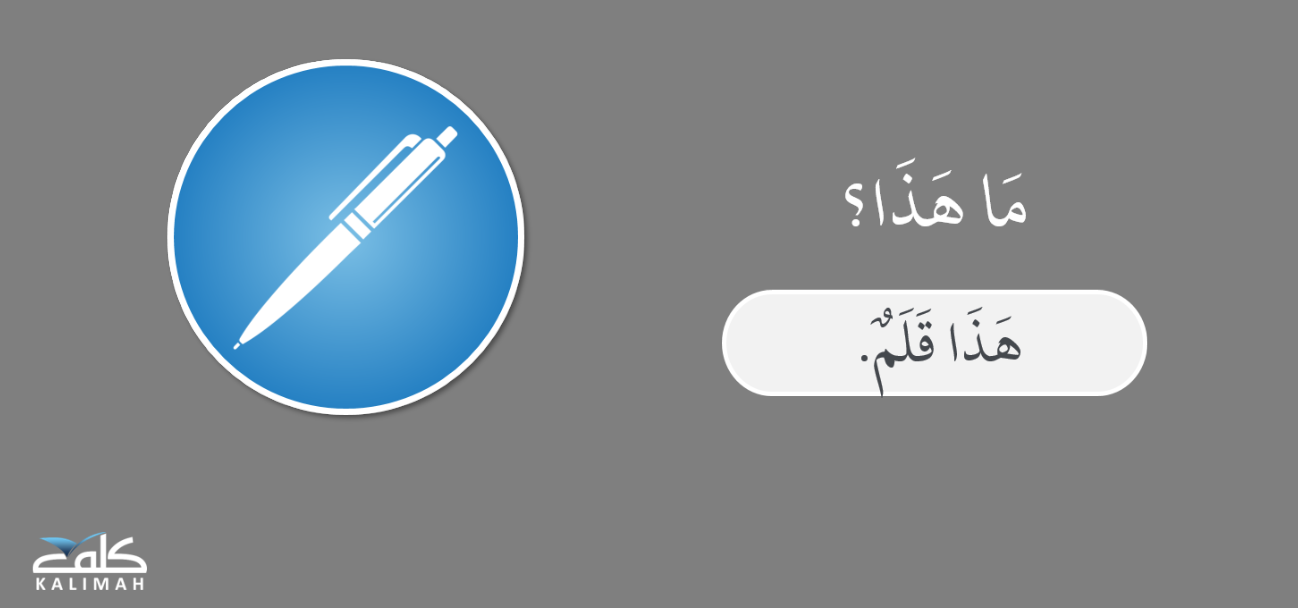
* Excerpted From Kalimah’s online Arabic course curriculum.
Far Arabic Demonstrative Pronouns Chart
| Pronoun | Usage | Example | Translation |
| ذلك (dhaalika) | Singular, masculine | ذلك جبلٌ شاهقٌ. (dhaalika jabalun shaahiq) | That is a towering mountain. |
| تلك (tilka) | Singular, feminine | تلك شجرةٌ بعيدةٌ. (tilka shajaratun ba’eedah) | That is a distant tree. |
| ذانك (dhaanika) | Dual, masculine | ذانك صديقانِ قديمانِ. (dhaanika sadeeqaani qadeemaani) | Those two are old friends. |
| تانك (taanika) | Dual, feminine | تانك مدرستانِ مميزتانِ. (taanika madrasataani mumayyazataani) | Those two are distinguished schools. |
| أولئك (ulaa’ika) | Plural, all genders | أولئك نجومٌ في السماءِ. (ulaa’ika nujoomun fi as-sama’) | Those are stars in the sky. |
Interrogative Pronouns in Arabic
Interrogative pronouns in Arabic, known as أسماء الاستفهام in our Arabic grammar books, are the words that form the basis of questions, which are used to ask about specific details like who, what, when, where, and how.
Here’s a breakdown of the most common interrogative pronouns in Arabic:
| Pronoun | Meaning | Example | Translation | Notes |
| مَنْ (man) | Who? | مَنْ ذهب إلى السوق؟ (man dhahaba ila al-suq?) | Who went to the market? | Used only for people. |
| مَا (ma) / ماذا (maadha) | What? | مَا هذا؟ (ma hadha?) / ماذا تريد؟ (maadha turid?) | What is this? / What do you want? | مَا is often used for short questions, while ماذا is for more detailed ones. |
| متى (mata) | When? | متى ستسافر؟ (mata satusaafir?) | When will you travel? | |
| أين (ayna) | Where? | أين تسكن؟ (ayna taskun?) | Where do you live? | |
| كيف (kayfa) | How? | كيف حالك؟ (kayfa haaluk?) | How are you? | |
| كم (kam) | How many? | كم عدد الطلاب؟ (kam ‘adad al-tullaab?) | How many students are there? | |
| أي (ay) | Which? | أيّ لونٍ تفضل؟ (ayyi lawnin tufaddil?) | Which color do you prefer? | Can be used for both people and things. |
| لماذا (limaadha) | Why? | لماذا تأخرت؟ (limaadha ta’akhkhart?) | Why were you late? |
Arabic Pronouns Worksheet
Want to test your pronoun prowess? Kalimah Center offers a free Arabic pronouns worksheet packed with exercises to solidify your understanding. This worksheet covers various types of pronouns, including:
- Personal Pronouns
- Attached Pronouns
- Demonstrative Pronouns
- Relative Pronouns
Download your free Arabic pronouns worksheet and start practicing!
https://drive.google.com/file/d/16QUmnvx9YXU-5wvWZdUirZWtyXEJ0dUJ/view?usp=drive_link
Master Arabic with Kalimah Center
Join our expert-led online classes and start your journey toward Arabic fluency today.
Book Your Free TrialBeginner’s Learning Path: Which Pronouns to Learn First
Don’t try to memorize all 14+ pronouns at once. Follow this proven progression:
Week 1: Core 6 Pronouns (Survival Level)
Master these first—they cover 70% of basic conversations:
| Priority | Arabic | Transliteration | Meaning | Usage |
|---|---|---|---|---|
| #1 | أنا | ana | I | أنا طالب (I am a student) |
| #2 | أنتَ | anta | You (m) | أنتَ معلم (You are a teacher) |
| #3 | أنتِ | anti | You (f) | أنتِ طالبة (You are a student-f) |
| #4 | هو | huwa | He/It (m) | هو طبيب (He is a doctor) |
| #5 | هي | hiya | She/It (f) | هي معلمة (She is a teacher) |
| #6 | نحن | naḥnu | We | نحن طلاب (We are students) |
Daily practice: Point to yourself → أنا. Point to male friend → هو. Point to female friend → هي. Repeat 10 times daily.
Week 2: Plural Forms (Expand Coverage)
Add these for group conversations:
| Arabic | Transliteration | Meaning | Usage |
|---|---|---|---|
| أنتم | antum | You (m-plural) | أنتم مهندسون (You-all are engineers) |
| أنتنَّ | antunna | You (f-plural) | أنتنَّ طالبات (You-all-f are students) |
| هم | hum | They (m) | هم أطباء (They are doctors) |
| هنَّ | hunna | They (f) | هنَّ معلمات (They are teachers) |
Practice: Describe groups—هم طلاب (they-m students), هنَّ معلمات (they-f teachers).
Week 3: Basic Attached Pronouns
Start with possessives—most common attached use:
| Attached Form | Meaning | Example | Translation |
|---|---|---|---|
| ـي | My | كتابي | My book |
| ـكَ | Your (m) | كتابك | Your book |
| ـكِ | Your (f) | كتابكِ | Your-f book |
| ـه | His/Its | كتابه | His book |
| ـها | Her/Its | كتابها | Her book |
| ـنا | Our | كتابنا | Our book |
Practice: Take 10 nouns you know, add each possessive suffix. Write: بيتي، بيتك، بيته، بيتها، بيتنا (my house, your house, his house, her house, our house).
Week 4+: Dual Forms (Advanced)
Only after mastering above, add dual:
| Arabic | Transliteration | Meaning |
|---|---|---|
| أنتما | antuma | You two |
| هما | huma | They two (m/f) |
Reality check: Dual pronouns are less frequent in daily speech. Prioritize them after mastering singular and plural.
Month 2+: Demonstrative, Relative, Interrogative
Once personal pronouns feel natural, expand to:
- Demonstrative: هذا، هذه، ذلك، تلك (this, that)
- Interrogative: من، ما، أين، كيف (who, what, where, how)
- Relative: الذي، التي (who, which, that)
Study strategy: One type per week, with 20 example sentences each.
Milestone Checklist:
□ Week 1: Can use 6 core pronouns in simple sentences
□ Week 2: Can describe groups with plural pronouns
□ Week 3: Can add possessive suffixes to 20+ nouns
□ Week 4: Can use dual pronouns for pairs
□ Month 2: Can form questions with interrogative pronouns
□ Month 3: Can build complex sentences with relative pronouns
Don’t rush. Solid mastery of basics beats superficial knowledge of everything.
Common Mistakes with Arabic Pronouns (And How to Fix Them)
Even advanced learners make these errors. Recognize and fix them early:
Mistake #1: Wrong Gender for Objects
❌ Wrong: الكتاب الجديد. هي مفيد (The new book-m. She/it-feminine is useful)
✅ Correct: الكتاب الجديد. هو مفيد (The new book. He/it-masculine is useful)
Why: كتاب is masculine, so pronoun must be هو (not هي).
Fix: Always check noun gender before choosing pronoun. Feminine nouns often end in ة (سيارة، شجرة), but not always (شمس – sun is feminine, no ة).
Mistake #2: Using Plural Instead of Dual
❌ Wrong: هم الطالبان (They-plural the-two-students)
✅ Correct: هما الطالبان (They-dual the-two-students)
Why: Dual noun (الطالبان – the two students) requires dual pronoun (هما), not plural (هم).
Fix: Count carefully. Exactly 2 = always use dual pronouns (أنتما، هما). 3 or more = use plural (أنتم، هم).
Mistake #3: Attaching Pronouns to Wrong Word Type
❌ Wrong: أنا ـي (I -my as separate concept)
✅ Correct: كتابي (my book – attached to noun)
Why: Attached pronouns must attach to verbs, nouns, or prepositions—never stand alone.
Fix: Attached pronouns are suffixes. Always write them connected: كتابي, رأيته, معي (never separate).
Mistake #4: Confusing Attached Pronoun Meanings
❌ Wrong: رأيته = “I saw his” (confusing ـه for possessive)
✅ Correct: رأيته = “I saw him” (ـه on verb = object, not possessive)
Why: ـه changes meaning based on what it attaches to:
- On noun: possessive → كتابه (his book)
- On verb: object → رأيته (I saw him)
- On preposition: object of preposition → معه (with him)
Fix: Context determines meaning. Look at the word before the attached pronoun.
Mistake #5: Using Wrong “You” Form
❌ Wrong: أنتَ طالبة (You-masculine are-a-student-feminine)
✅ Correct: أنتِ طالبة (You-feminine are-a-student-feminine)
Why: When addressing a female, use أنتِ (anti), not أنتَ (anta).
Fix: Match pronoun gender to the person you’re addressing, not to what comes after.
Full correction chart:
| Addressing | Pronoun | Example |
|---|---|---|
| Male | أنتَ | أنتَ طالب (You-m are student-m) |
| Female | أنتِ | أنتِ طالبة (You-f are student-f) |
| Two people | أنتما | أنتما طالبان (You-two are students-dual) |
| Men (3+) | أنتم | أنتم طلاب (You-plural-m are students) |
| Women (3+) | أنتنَّ | أنتنَّ طالبات (You-plural-f are students-f) |
Mistake #6: Non-Human Plurals with Wrong Pronoun
❌ Wrong: الكتب هم مفيدة (The books they-masculine-plural are useful)
✅ Correct: الكتب هي مفيدة (The books she/it-feminine-singular are useful)
Why: Non-human plurals are treated as feminine singular in Arabic grammar—even if the singular is masculine.
Rule breakdown:
- كتاب (book) = masculine singular → uses هو
- كتب (books) = non-human plural → uses هي (feminine singular)
Fix: For objects/animals in plural, always use هي and feminine singular adjectives.
Mistake #7: Forgetting Pronoun on Attached Forms
❌ Wrong: معلمي هو جيد (My teacher he is good) [redundant pronoun]
✅ Correct: معلمي جيد (My teacher is good) [no pronoun needed]
Why: Attached pronouns already indicate possession—adding هو creates redundancy.
Exception: When emphasizing: معلمي هو الأفضل (My teacher, he specifically, is the best) [emphasis on “he” vs others].
Fix: After using attached pronouns, usually omit separate pronoun unless emphasizing.
Practical Examples: Arabic Pronouns in Everyday Conversations
Seeing pronouns in context accelerates understanding. Here are realistic dialogues:
Dialogue 1: Meeting Someone (Using Subject Pronouns)
أحمد: مرحبا! أنا أحمد. ما اسمك؟
Ahmad: Hello! I am Ahmad. What is your name?
سارة: أنا سارة. تشرفت بمعرفتك.
Sarah: I am Sarah. Nice to meet you.
أحمد: هل أنتِ طالبة؟
Ahmad: Are you (f) a student?
سارة: نعم، أنا طالبة في الجامعة. و أنتَ؟
Sarah: Yes, I am a student at university. And you (m)?
أحمد: أنا مهندس. أنا أعمل في شركة كبيرة.
Ahmad: I am an engineer. I work at a big company.
Dialogue 2: Talking About Others (Third Person Pronouns)
ليلى: من هو الرجل هناك؟
Layla: Who is he, the man over there?
خالد: هو معلمي. هو يدرّس اللغة العربية.
Khalid: He is my teacher. He teaches Arabic.
ليلى: و من هي المرأة بجانبه؟
Layla: And who is she, the woman beside him?
خالد: هي زوجته. هي أيضاً معلمة.
Khalid: She is his wife. She is also a teacher.
Dialogue 3: Using Attached Pronouns (Possessives)
فاطمة: هل هذا كتابك؟
Fatima: Is this your book?
محمد: لا، هذا كتاب أخي.
Muhammad: No, this is my brother’s book.
فاطمة: أين كتابك؟
Fatima: Where is your book?
محمد: كتابي في حقيبتي.
Muhammad: My book is in my bag.
Dialogue 4: Group Conversation (Plural Pronouns)
المعلم: مرحباً يا طلاب. كيف حالكم؟
Teacher: Hello students. How are you all?
الطلاب: نحن بخير، شكراً.
Students: We are fine, thank you.
المعلم: هل أنتم جاهزون للامتحان؟
Teacher: Are you (plural) ready for the exam?
الطلاب: نعم، نحن جاهزون.
Students: Yes, we are ready.
Dialogue 5: Demonstrative Pronouns
البائع: هذا قلم جيد. تفضل.
Seller: This is a good pen. Here you go.
الزبون: كم سعر هذا؟
Customer: How much is this?
البائع: هذا بخمسة دراهم. و ذلك القلم بعشرة.
Seller: This is five dirhams. And that pen is ten.
الزبون: سآخذ هذا. شكراً.
Customer: I’ll take this. Thank you.
Dialogue 6: Interrogative Pronouns (Questions)
الأم: من أخذ كتابي؟
Mother: Who took my book?
الابن: أنا لم آخذه. ما الذي حدث؟
Son: I didn’t take it. What happened?
الأم: أين وضعته يا ترى؟
Mother: Where did I put it, I wonder?
الابن: كيف يمكنني مساعدتك؟
Son: How can I help you?
Pronoun Density Analysis:
In natural Arabic conversation, pronouns appear every 3-5 words on average. Practice replacing nouns with pronouns in your own sentences to match this natural flow.
Exercise: Take the dialogues above, identify every pronoun (underlined), and explain:
- What type it is (personal/demonstrative/interrogative)
- What it refers to
- Why that specific form was chosen (gender/number match)
Master Arabic with Kalimah Center
Join our expert-led online classes and start your journey toward Arabic fluency today.
Book Your Free TrialInside Kalimah Center: Moments from Our Courses
Get a glimpse into the vibrant learning experience at Kalimah Center. These snapshots capture real moments from our live classes—where students engage deeply, connect with passionate instructors, and grow in a welcoming, supportive environment.
Here Are The Reviews On Our Courses:
Our students frequently commend the excellence of our courses and the commitment shown by our instructors. You can read their complete reviews on Trustpilot.

Kalimah Center Makes Learning Arabic Pronouns Easy
We’ll help you use pronouns correctly, so you can speak and write Arabic with confidence..
. Our online Arabic courses offer:
- We break down complex grammar rules into simple concepts.
- You’ll practice using pronouns in real-life situations.
- Our native Arabic speakers will guide you and answer all your questions.
Sign up for a free trial class!

Looking for an affordable way to learn?
Explore our affordable online group classes and Find your perfect time.
Oue group classes are 4x cheaper than one-on-one sessions.

Conclusion:
Arabic pronouns, or الضمائر (al-ḍamāʾir), are essential for replacing nouns, enhancing clarity, and avoiding repetition. They include personal, demonstrative, relative, and interrogative types, adapting to number, gender, and person. Personal pronouns are divided into detached and attached forms, while demonstrative and relative pronouns add precision and detail. Interrogative pronouns help form questions like “who” and “what,” making them indispensable in communication.
With 14 personal pronouns covering singular, dual, and plural forms, Arabic offers exceptional linguistic flexibility. Learning tools like worksheets and structured courses simplify grammar while focusing on practical usage. These resources empower learners to confidently use pronouns in speech and writing, mastering a key aspect of Arabic grammar.
Frequently Asked Questions About Arabic Pronouns
Q1: What’s the difference between attached and detached pronouns in Arabic?
Detached pronouns (الضمائر المنفصلة) stand alone as separate words: أنا (I), هو (he), نحن (we). They function as sentence subjects or independent objects.
Attached pronouns (الضمائر المتصلة) are suffixes that attach to verbs, nouns, or prepositions: ـي (my), ـه (his), ـنا (our).
Example: أنا كتابي (I – my book) uses both—أنا is detached (subject), ـي is attached (possessive). You cannot say “ـي” alone; it must attach to a word.
Q2: How do I know which gender pronoun to use in Arabic?
Arabic pronouns must match the gender of the person or thing they refer to. For people: Use masculine for males (هو – he), feminine for females (هي – she). For objects: Every Arabic noun has grammatical gender—كتاب (book) is masculine, سيارة (car) is feminine. Use هو for masculine objects, هي for feminine.
Tip: When learning nouns, always memorize their gender.
Non-human plurals take feminine singular pronouns: الكتب (books-plural) → هي (not هم).
Q3: What are dual pronouns and when do I use them?
Arabic has special pronouns for exactly two of something—a feature English lacks. Dual pronouns: أنتما (you two), هما (they two), ـكما (your two-attached).
When to use: Only when referring to precisely two people/things.
Examples: الطالبان (the two students) → هما يدرسان (they-two study). كتاباكما (your-two books).
Common mistake: Using dual for “a few” or “several”—dual means exactly 2, no more, no less. For 3+, use plural forms.
Q4: Why do some Arabic pronouns look the same but have different meanings?
Context determines meaning.
Example: هما (huma) means: (1) They-two masculine, (2) They-two feminine. أنتما (antuma) means: (1) You-two masculine, (2) You-two feminine. Arabic doesn’t distinguish gender in dual/plural “you” forms.
Also: Attached ـه (-hu) means “his” or “him” depending on what it attaches to: كتابه (his book – possessive), رأيته (I saw him – object). Learn to recognize patterns from sentence structure.
Q5: What’s the most common mistake beginners make with Arabic pronouns?
Gender agreement errors, especially with objects. Learners treat all objects as “it” (no gender), but Arabic assigns gender to everything.
Wrong: السيارة… هو (the car-feminine… he).
Correct: السيارة… هي (the car… she/it-feminine).
Fix: When learning nouns, always note gender: سيارة (f), كتاب (m). Use هي for feminine nouns, هو for masculine, regardless of whether they’re alive.
Second most common: Attaching pronouns incorrectly—ـي must attach to a word, never stands alone.
Q6: Do Arabic pronouns change based on case (nominative/accusative/genitive)?
Detached pronouns generally don’t change form based on case—هو (he) remains هو whether subject or object.
Exception: Detached accusative pronouns (إياه, إياك) exist but are rarely used in modern Arabic; attached pronouns on verbs serve this function instead.
Attached pronouns remain the same but the word they attach to changes: كتابُه (his book-nominative), كتابَه (his book-accusative), كتابِه (his book-genitive). The ـه stays; the word ending changes.
Dual pronouns change slightly: هما (nominative) vs هما (accusative/genitive)—but pronunciation differs: humā vs humā (same spelling, context-based).
Q7: How do I practice Arabic pronouns effectively?
Week 1: Memorize 6 core pronouns (أنا، أنتَ، أنتِ، هو، هي، نحن) with flashcards.
Week 2: Practice attached pronouns on nouns—write 20 nouns, add possessive suffixes (كتابي، كتابك، كتابه).
Week 3: Use pronouns in simple sentences: هو طالب. هي معلمة.
Week 4: Practice pronoun replacement: take a paragraph, replace all nouns with appropriate pronouns.
Daily: Label objects at home with possessive forms (كرسيّي on your chair, كتابي on your book).
Apps: Anki for spaced repetition, Quizlet for pronoun drills.
Speaking: Describe your day using only pronouns: أنا استيقظت. ذهبت إلى عملي. رأيت صديقي.