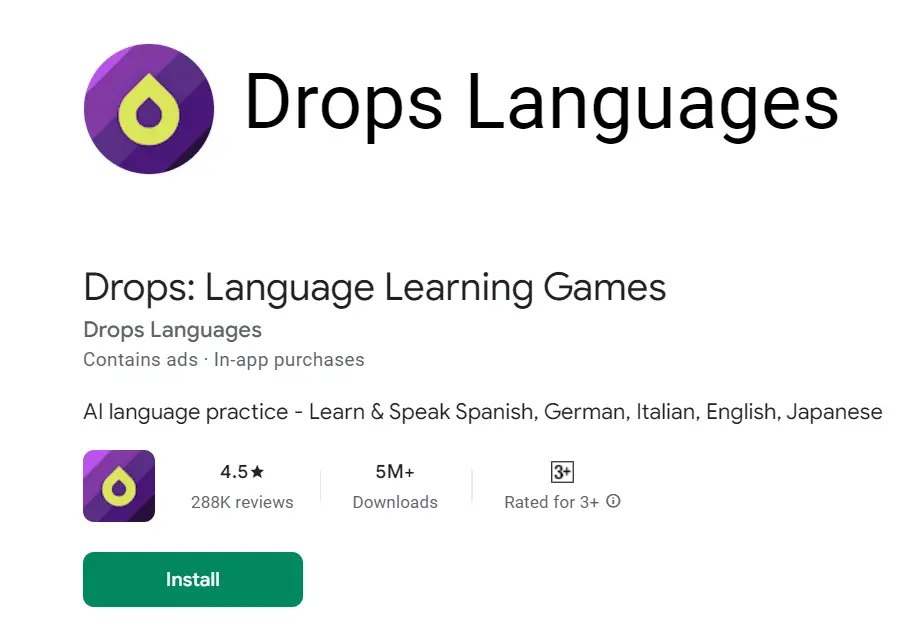
You’ve probably seen Drops in a “best Arabic apps” roundup, or had it recommended by someone who swears by it. So: is the Drops app good for learning Arabic, or is it just good-looking? The app has a 4.7-star rating across millions of users, clean visuals, and an addictive game loop — but ratings don’t tell the whole story.
The honest answer is: it depends entirely on what you mean by “learning Arabic.” Drops does one thing exceptionally well and leaves almost everything else uncovered.
What You’ll Learn in This Article?
- What the Drops app actually teaches — and what it doesn’t.
- Which Arabic dialect Drops uses and why that matters for your goal.
- The specific gap between Drops and real Arabic proficiency.
- How to use Drops correctly as part of a wider learning plan.
Is the Drops App Good for Learning Arabic?
Drops is a vocabulary-first app. It uses hand-drawn illustrations paired with native audio to build direct mental associations between a word and its meaning — bypassing translation and training your brain to think in the target language. This is a genuinely sound method for the narrow thing it sets out to do.
The app covers around 2,500 Arabic words organized into topic-based modules. Free users get 5 minutes of access per day; premium unlocks unlimited sessions at $9.99/month or $69/year.
What Drops Does Well for Arabic Learners?
Drops earns its high rating in specific areas, and it’s worth being precise about what those are before writing the app off entirely.
Three things stand out as genuinely useful for Arabic learners at the beginner and early-intermediate stage.
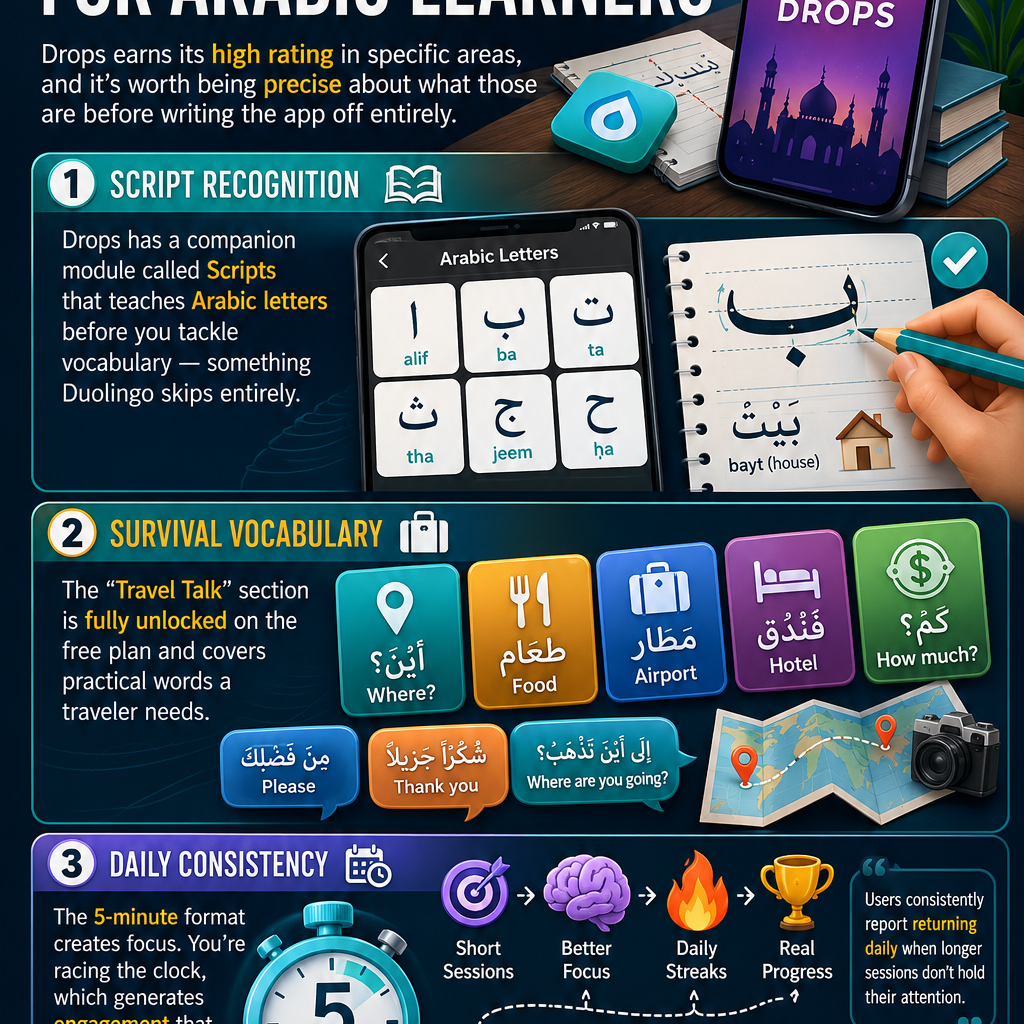
- Script recognition. Drops has a companion module called Scripts that teaches Arabic letters before you tackle vocabulary — something Duolingo skips entirely, throwing learners into Arabic text without preparation.
- Survival vocabulary. The “Travel Talk” section is fully unlocked on the free plan and covers practical words a traveler needs: directions, food, numbers, greetings.
- Daily consistency. The 5-minute format creates focus. You’re racing the clock, which generates engagement that open-ended study often loses. Users consistently report returning daily when longer sessions don’t hold their attention.
Where Drops Falls Short for Arabic Specifically?
Verbs are the real gap, Arabic verbs carry embedded pronoun information, tense, gender, and number inside their conjugated form.
كَتَبَ (kataba) doesn’t mean “write” — it means “he wrote,” with the subject baked in. Drops’ flashcard system teaches root forms in isolation with no sense of how a verb behaves in a sentence.
For Arabic specifically, this is a more serious limitation than it would be in Spanish or French, because Arabic root-pattern morphology means verbs are the key to unlocking the whole language.
No grammar instruction at all. Drops builds word recognition, not sentence construction. You cannot form a single correct Arabic sentence using only what Drops teaches.
Free plan is severely limited. Five minutes per day of vocabulary exposure — even sustained over a full year — will not produce communicative ability in any language, let alone Arabic.
What Arabic Dialect Does Drops Teach?
Drops primarily teaches Modern Standard Arabic (MSA) — the formal register used in news, official documents, and classical texts.
It recently added an Egyptian Arabic track, which is the most widely understood spoken dialect, spoken by over 100 million people and spread globally through Egyptian media and film.
This distinction matters more than most learners realize when they download the app.
| Your Goal | Is Drops’ Arabic Relevant? |
| Read and understand the Quran | Partially — MSA vocabulary overlaps with Quranic Arabic, but classical grammar is absent |
| Have daily conversations with native speakers | Limited — MSA is not spoken colloquially; you need dialect exposure |
| Travel survival phrases | Yes — “Travel Talk” covers this well |
| Build formal written Arabic | Useful as a vocabulary supplement only |
| Reach conversational fluency | No — grammar and speaking practice are both missing |
One recurring criticism from native Arabic speakers who have reviewed the app is that the formal Arabic it prioritizes sounds stilted in everyday speech and won’t transfer directly to real communication.
Is the 5-Minute Limit a Useful Constraint or a Real Problem?
Drops markets its 5-minute daily limit as a feature — and there’s something to it. The time pressure keeps learners consistent in a way that open-ended apps often don’t.
One reviewer described being unable to stop thinking about the app precisely because the constraint made each session feel urgent.
But here’s what the marketing doesn’t say: 5 minutes of vocabulary-only practice per day will not get you to conversational Arabic.
At that rate, you might retain 200–300 words after several months of consistent use. Conversational ability requires vocabulary, grammar, listening comprehension, and speaking practice working together — none of which Drops covers.
The 5-minute limit is a good habit-forming tool. It is not a learning plan.
Read also: Learn Arabic in 3 Minutes a Day – The Daily Routine That Actually Works
Experience Kalimah Center Classes
Watch real excerpts from our live sessions at Kalimah Center and see how we bring learning to life. These clips highlight our interactive, student-centered teaching approach across all our courses—designed to keep learners engaged, motivated, and actively involved every step of the way.
Master Arabic with Kalimah Center
Join our expert-led online classes and start your journey toward Arabic fluency today.
Book Your Free TrialDrops vs. Structured Arabic Learning
Knowing what Drops provides is only half the picture. The other half is understanding what real Arabic proficiency actually demands — and seeing clearly where the gap sits.
The table below maps Drops’ output against what communicative Arabic ability requires, so you can make an informed decision about where it fits in your learning plan.
| What Drops Provides | What Real Arabic Proficiency Requires |
| Vocabulary (nouns, primarily) | Vocabulary + verb conjugation + grammar |
| Visual word-image association | Sentence construction and context |
| Native audio for pronunciation | Speaking practice with real correction |
| Arabic script recognition (via Scripts app) | Reading fluency in connected text |
| 5 minutes/day engagement | Consistent multi-skill daily practice |
| MSA + basic Egyptian Arabic | Grammar-grounded dialect or Quranic Arabic |
Drops fills the vocabulary column well. Everything else in that right column requires instruction that goes beyond what any flashcard app delivers.
If you’re serious about real Arabic proficiency — whether for the Quran, conversation, or both — Kalimah Center’s structured Arabic courses cover grammar, speaking, and Quranic Arabic together, starting from exactly where you are now.
The Moment Drops Stops Being Enough
You know the feeling. The streak is intact. The words are accumulating. And yet — you still cannot form a single sentence you trust.
That gap has a name: it is the distance between recognizing Arabic and actually using it. Drops cannot close it. No vocabulary app can.
What closes it is someone who hears you speak, catches the error before it becomes a habit, and tells you exactly what to build next.
That is what a Kalimah session is.
What Comes After the App?
Drops gave you words. Here is what each word was missing:
1. Drops built vocabulary without verbs — the Online Arabic Course finishes it
16 levels that take every word Drops taught you and put it inside a real sentence, with a specialist tutor correcting you live, and affordable course books reinforcing every session.
2. Drops gave you audio without ever making you speak — the Online Quran with Tajweed changes that
13 levels where you stop listening to Arabic and start producing it — guided by Ijazah-certified instructors who connect every sound directly to Quranic text.
3. Drops gave your child a game — the Online Arabic for Kids gives them a language
24 levels built around how children actually absorb Arabic, taught by instructors trained specifically for young learners — not an algorithm designed to keep them tapping.
And running through all three: a complete digital series based on العربية بين يديك — so what your tutor teaches in session, your materials lock in between sessions.
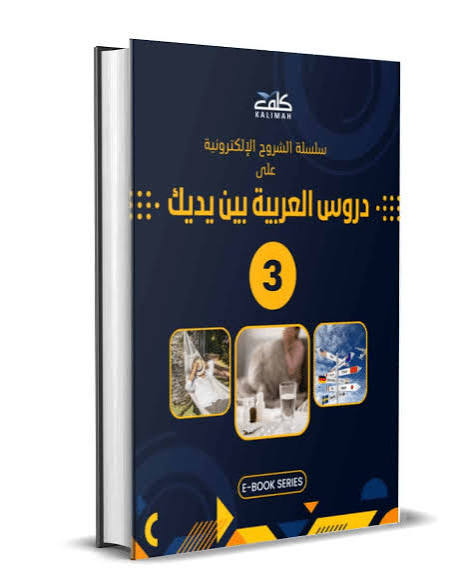
Drops built the habit. Kalimah builds the language.
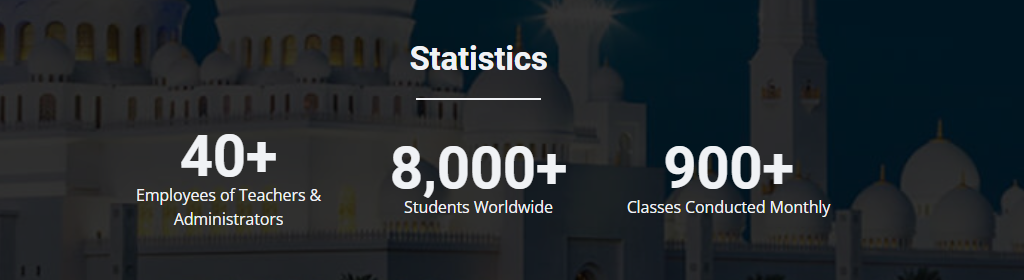
Not Ready for One-on-One? You Don’t Have to Be.
Some learners thrive with a teacher to themselves. Others find their voice when there is a room behind them.
Kalimah’s group classes are built for the second kind — small enough that you actually speak, affordable enough that you show up every week without thinking about the cost, and taught by native Arabic teachers who make the language feel alive, not academic.
Four times cheaper than private lessons. One global community of learners who started exactly where you are.
Find your group Now!

Inside Kalimah Center: Moments from Our Courses
Get a glimpse into the vibrant learning experience at Kalimah Center. These snapshots capture real moments from our live classes—where students engage deeply, connect with passionate instructors, and grow in a welcoming, supportive environment.
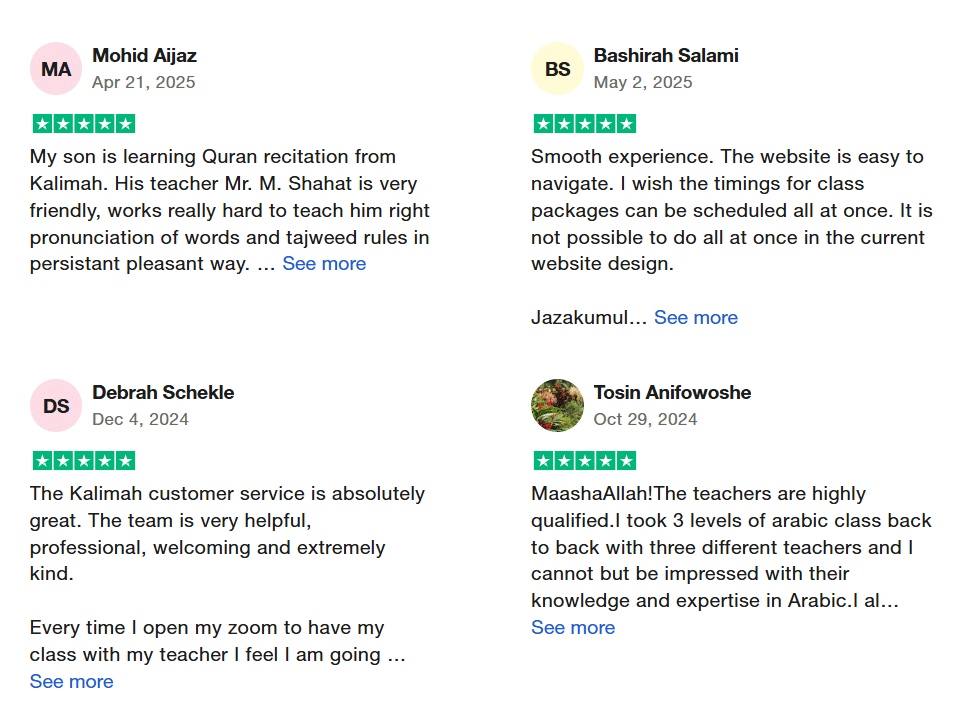
Here Are The Reviews On Our Courses:
Our students frequently commend the excellence of our courses and the commitment shown by our instructors. You can read their complete reviews on Trustpilot.
Read more reviews on Trustpilot
Unlock Your Potential in Arabic and Quran with Kalimah Center!
Ready to deepen your connection with the Quran and enhance your understanding of Arabic? Join Kalimah Center today and embark on a transformative journey of learning and growth! Our professional, handpicked Online Arabic and Quran Tutors are dedicated to helping you master these essential skills with ease and expertise.
📚 Explore Our Courses:
Online Arabic Course: Tailored to your level, our comprehensive Arabic program includes 16 teaching levels and 400+ hours of personalized sessions.
Online Quran With Tajweed Course: Perfect for non-Arabic speakers, our course spans 13 levels and equips you with Tajweed mastery from beginner to advanced.
Online Arabic Course For Kids: Nurture your child’s love for Arabic with our engaging and structured program, available in 24 levels for primary, intermediate, and secondary stages.
🚀 Start Your Free Trial Today! 🚀
Don’t miss out on this life-changing opportunity to deepen your faith and knowledge. Sign up now for your free trial and take the first step towards becoming a better practicing Muslim with Kalimah Center!
Master Arabic with Kalimah Center
Join our expert-led online classes and start your journey toward Arabic fluency today.
Book Your Free TrialConclusion
Is the Drops app good for learning Arabic? Yes — within clear limits. It builds vocabulary effectively, trains script recognition through its Scripts companion, and creates a daily habit through its gamified format. The audio is native-quality and the visual association method is pedagogically sound for word memorization.
Where it falls short: it doesn’t teach verb conjugation meaningfully, its free content prioritizes MSA over spoken dialects, and 5 minutes of vocabulary-only study per day will not produce communicative Arabic ability.
Use Drops for what it is — a vocabulary warm-up — and build your real Arabic skills somewhere else.
FAQs
Is the Drops app good for learning Arabic as a complete beginner?
Drops is useful for beginners who want initial vocabulary and script recognition.
It works best as a supplement to a structured course — not as a primary learning method. Beginners who use only Drops will not learn grammar, sentence structure, or how to speak.
What Arabic dialect does the Drops app teach?
Drops primarily teaches Modern Standard Arabic. It has added an Egyptian Arabic track, which is the most widely understood spoken dialect.
If everyday conversation with native speakers is your goal, you’ll need dialect-specific resources beyond Drops’ core content.
Can you become fluent in Arabic using only Drops?
No. Fluency requires grammar, verb conjugation, listening comprehension, and speaking practice — none of which Drops provides.
The 5-minute daily free limit also caps how much vocabulary input you can receive, making solo Drops use an insufficient path to fluency.
Is Drops better than Duolingo for Arabic?
Drops has one clear advantage: it teaches the Arabic script explicitly through its Scripts module, while Duolingo moves learners into Arabic text without proper letter preparation.
Drops also has higher-quality illustrations and a more focused vocabulary system. Duolingo offers more grammar exposure. Neither replaces qualified instruction.
How much does the Drops premium plan cost?
The premium plan is priced at approximately $9.99 per month or $69 per year, with a lifetime option around $160 — though prices may vary depending on your region and local market rates.
Premium removes the time limit, eliminates ads, unlocks a dedicated word-review bank, and adds a listening game. The free version is enough to evaluate the app — whether premium is worth it depends on how central you make Drops to your overall learning plan.