Hamza in Arabic is the small letter that marks a glottal stop, a quick catch in the throat. Learners meet it at the start, middle, and end of words, so understanding it early prevents many reading and spelling mistakes.
Its shape changes because it often sits on a seat, such as an alif, waw, or yaa. Which seat it takes depends on the vowels around it, which is why Hamza confuses beginners and intermediate students alike.
This guide explains what the Hamza letter is, how to pronounce it, its two types, and every seat rule. You will also find a quick reference table, common mistakes, and a practice drill.
Key Takeaways on Hamza
These points give you the full picture in a few lines before the details begin. Each one is explained step by step in the sections below, with examples you can check yourself.
- Hamza (ء) represents a glottal stop and is a consonant, not a vowel.
- Arabic has two types, Hamzat al-Wasl and Hamzat al-Qat’.
- Hamza sits on alif, waw, yaa, or alone on the line.
- The strongest vowel decides the seat: kasrah first, then dammah, then fathah.
- Two alifs never appear together, so Arabic writes alif madda (آ) instead.
- A missing Hamza can change a word’s meaning, as in سَأَلَ versus سَالَ.
Meaning and Origin of the Hamza Letter
Hamza (ء) is a character in the Arabic script that represents the glottal stop. Its shape is derived from the letter Ayn (ع), and historians trace the small head-like form back to that letter.
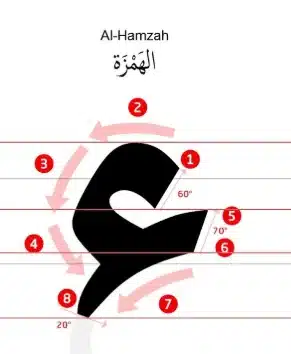
Strictly speaking, Hamza is not one of the 28 basic letters. Many teachers still treat it as the 29th letter of the Arabic alphabet, because it behaves like a consonant in every word where it appears.
The word Hamza comes from the verb هَمَزَ (hamaza), which means to press, prick, or push. The name suits the sound, because the vocal cords press shut and then release.
Hamza often seems to carry an “a” sound because it usually sits on an alif. That is only a seat, though. The letter itself is a consonant, and the alif underneath is just a carrier.
Hamza Pronunciation as a Glottal Stop
Hamza is pronounced from the deepest part of the throat, called Aqsa al-Halq, right at the vocal cords. It is a throat letter in Arabic made by closing the cords to stop the air, then opening them.
A simple English guide is the pause between the two parts of “uh-oh.” English speakers also make this sound before words that start with a vowel, such as “apple” or “egg,” even though English does not write it.
Keep the sound soft and short. Pressing too hard turns it into a harsh cough, while skipping it makes the word sound different or changes its meaning completely.
Listen for the stop in these three words, where it appears at the start, middle, and end:
- أَكَلَ (akala) means he ate, and the stop is at the start.
- سُؤَال (su’āl) means question, and the stop is in the middle.
- سَمَاء (samā’) means sky, and the stop is at the end.
Hamzat al-Wasl and the Connecting Hamza
Arabic has two main types of Hamza, and telling them apart is the first big step. Hamzat al-Wasl (همزة الوصل), the connecting Hamza, is the simpler one to recognize.
It appears only at the start of a word and is pronounced only when you begin speaking with that word. When you connect the word to the one before it, the sound disappears completely.
In writing, it is a plain alif with no Hamza mark. In the Quran, it can carry a small waslah sign (ٱ) that reminds readers it is not pronounced when the words are joined.
Where Hamzat al-Wasl Appears
Hamzat al-Wasl appears in a limited set of words, so you can memorize them. It is found in the following categories:
- The definite article ال, as in الْكِتَاب.
- Imperative verbs of Form I, such as اُكْتُبْ (write) and اِجْلِسْ (sit).
- Past tense verbs of Forms VII to X, such as اِنْطَلَقَ, اِجْتَمَعَ, and اِسْتَخْرَجَ.
- The verbal nouns of those forms, such as اِنْطِلَاق and اِسْتِخْرَاج.
- A short list of nouns: اِسْم (name), اِبْن (son), اِبْنَة (daughter), اِمْرُؤ (man), اِمْرَأَة (woman), اِثْنَان, and اِثْنَتَان (two).
A Quick Test for Hamzat al-Wasl
Say the word after another word. If the first sound disappears, it is Hamzat al-Wasl. In بِسْمِ اللَّهِ, for example, the alif of اِسْم vanishes in both speech and spelling.
Another example is الْحَمْدُ لِلَّهِ. Starting alone, you say “al-hamdu.” After the word قُلْ, you say “qulilhamdu,” and the Hamza vanishes. Our guide on Hamzatul Wasl and Hamzatul Qat adds more practice.
Hamzat al-Qat’ and Where It Appears
Hamzat al-Qat’ (همزة القطع), the cutting Hamza, is the more common type. It is always pronounced, whether you start with the word or connect it to another word.
It is written as أ, إ, or ء, and it can appear at the beginning, middle, or end of a word. The categories below show where you will meet it most often.
Hamzat al-Qat’ in Particles
Hamzat al-Qat’ appears in all Arabic particles (Huruf) except the definite article ال. Common examples include:
- أَنَّ (anna) means that.
- إِنَّ (inna) means indeed.
- أَوْ (aw) means or.
- إِلَى (ilā) means to.
- إِلَّا (illā) means except.
The question Hamza أَ also belongs here, as in أَ تَدْرُسُ؟ (do you study?). Calling someone’s attention with أَيُّهَا follows the same rule.
Hamzat al-Qat’ in Nouns and Pronouns
Nearly all Arabic nouns take Hamzat al-Qat’, except the few Hamzat al-Wasl nouns listed above. Names and common nouns that include it are:
- أَحْمَد (Ahmad).
- أَسَد (Asad), meaning lion.
- إِبْرَاهِيم (Ibrahim).
- إِسْلَام (Islam).
- أَمَل (Amal), meaning hope.
Pronouns use it as well. These are أَنَا (I), أَنْتَ (you, masculine), أَنْتِ (you, feminine), and أَنْتُمْ (you, plural).
Hamzat al-Qat’ in Verbs
Hamzat al-Qat’ appears in several verb patterns. Three-letter verbs in the past tense and their verbal nouns, such as أَكَلَ and أَكْلًا, begin with it. Four-letter verbs, such as أَرْسَلَ (he sent), keep it in the past tense, the verbal noun إِرْسَال, and the command أَرْسِلْ.
Many other verbs follow the same pattern. It also appears in first-person forms of the present tense, such as أَكْتُبُ (I write), أَسْأَلُ (I ask), and أَسْتَعْمِلُ (I use).
See Us in Action!
Curious about what our online classrooms look like? Watch the short clips below to see how our interactive, one-on-one sessions bring learning to life with real-time feedback and engaging teaching methods.
Master Arabic with Kalimah Center
Join our expert-led online classes and start your journey toward Arabic fluency today.
Book Your Free TrialHamza in Arabic Seat Rules by Position
Hamza in Arabic is written on a seat or alone on the line, and its position in the word controls the rules. Start with the beginning of the word, because it is the easiest case.
a. Initial Hamza
An initial Hamza is always written on an alif. With fathah or dammah, it sits above the alif, as in أَكَلَ and أُخْت. With kasrah, it sits under the alif, as in إِسْلَام.
You never see an initial Hamza on the line, on a waw, or on a dotless yaa in standard Arabic.
b. Medial Hamza
A medial Hamza takes a seat based on the vowels around it. The next section explains the full ranking, but these quick cases cover many common words:
- After fathah, the seat is usually alif, as in رَأْس.
- After kasrah, the seat is a dotless yaa called a nabira (ـئـ), as in دَافِئَة.
- After dammah, the seat is waw (ؤ), as in فُؤَاد.
- After a sukoon on a consonant, the vowel on the Hamza decides, as in مَسْأَلَة and مَسْؤُول.
c. Final Hamza
A final Hamza depends on the vowel of the letter before it. The same logic applies at the end of every word:
- After fathah, the seat is alif, as in بَدَأَ.
- After dammah, the seat is waw, as in تَبَاطُؤ.
- After kasrah, the seat is yaa, as in قَارِئ.
- After sukoon or a long vowel, the Hamza stands alone on the line, as in جُزْء and سَمَاء.
Strongest Vowel Rule for Medial Hamza Seats
Medial Hamza is the hardest case, so Arabic uses a ranking system. Compare the short vowel on the Hamza with the short vowel before it, and the stronger vowel chooses the seat.
- Kasrah (i sound) is the strongest, so the Hamza sits on yaa (ئ), as in مِئَة and سُئِلَ.
- Dammah (u sound) comes second, so the Hamza sits on waw (ؤ), as in سُؤَال and يُؤْمِن.
- Fathah (a sound) comes third, so the Hamza sits on alif (أ), as in سَأَلَ and مَسْأَلَة.
- Sukoon is the weakest, so it never decides the seat when another vowel is present.
Take سُئِلَ as a worked example. The dammah before the Hamza ranks second, but the kasrah on the Hamza ranks first, so the seat is yaa and not waw.
Long vowels are ignored in this ranking, with one main exception. If a long alif comes before a Hamza with fathah, the Hamza stands alone on the line, as in تَسَاءَلَ and قِرَاءَة.
Hamza on the Line Without a Seat
Sometimes Hamza needs no carrier at all and stands alone on the line (ء). Arabic calls this a Hamza without a kursi, meaning without a chair. It appears in three clear situations:
- In the middle of a word, after a long alif with fathah on the Hamza, as in تَسَاءَلَ and عَبَاءَة.
- In the middle of a word, after a long waw with fathah on the Hamza, as in مَقْرُوءَة.
- At the end of a word, after sukoon or a long vowel, as in شَيْء, جُزْء, and سَمَاء.
Our Online Arabic Course at Kalimah Center teaches these spelling rules in order, with teachers who correct each mistake live during the lesson.

Alif Madda and Its Link to Hamza
When the rules call for two alifs side by side, Arabic never writes both. It merges them into one alif with a wavy madda sign (آ), which means a Hamza followed by a long ā sound.
That is why Arabic writes آكُلُ for “I eat” and never أاكل. Here are common words with alif madda:
- آمَنَ (āmana) means he believed.
- قُرْآن (qur’ān) means Quran.
- مِرْآة (mir’āh) means mirror.
- آكُلُ (ākulu) means I eat.
Hamza With Tanween
Tanween changes where the mark sits when a word ends in Hamza. For dammah and kasrah, the Tanween goes above or below the Hamza, as in جُزْءٌ and جُزْءٍ.
Fathah tanween has three cases, depending on the letter before the Hamza:
- After an alif, no extra alif is written, as in سَمَاءً.
- After a non-connecting letter, the tanween sits on the Hamza and an independent alif follows, as in جُزْءًا.
- After a connecting letter, the Hamza takes a yaa seat and a connecting alif follows, as in شَيْئًا.
Quick Reference Table for Hamza Seats
This table gathers every rule for Hamza in one place, so you can check any word in seconds before you write it.
| Position | Deciding Factor | Seat | Example |
| Beginning | Fathah or dammah on Hamza | أ | أَكَلَ, أُخْت |
| Beginning | Kasrah on Hamza | إ | إِسْلَام |
| Beginning | Hamza followed by long alif | آ | آمَنَ |
| Middle | Kasrah is strongest | ئ | مِئَة, سُئِلَ |
| Middle | Dammah is strongest | ؤ | سُؤَال, يُؤْمِن |
| Middle | Fathah is strongest | أ | سَأَلَ, مَسْأَلَة |
| Middle | Fathah after long alif | ء | تَسَاءَلَ |
| End | Fathah before it | أ | بَدَأَ |
| End | Dammah before it | ؤ | تَبَاطُؤ |
| End | Kasrah before it | ئ | قَارِئ |
| End | Sukoon or long vowel before it | ء | شَيْء, سَمَاء |
Hamza in the Quran and Tajweed
Hamza matters even more in Quran recitation, because Tajweed rules treat it with great care. Reciters must articulate it clearly from the throat, and several Madd rules depend on it directly.
Hamza and the Rules of Madd
When a long vowel letter (ا، و، ي) meets a Hamza, the reciter stretches the vowel longer than its natural two counts. The two main cases are:
- Madd Muttasil: the long vowel and the Hamza are in the same word, as in جَاءَ and السَّمَاءِ. In Hafs, it is stretched four or five counts.
- Madd Munfasil: the long vowel ends one word and the Hamza starts the next, as in يَا أَيُّهَا. In Hafs, it is also stretched four or five counts.
Quranic Spelling of Hamza
The Quranic text follows its own spelling conventions. As mentioned earlier, Hamzat al-Wasl can carry the waslah sign (ٱ) to show that it is not pronounced when words are joined.
Another example is the plural of “head.” Modern spelling writes رُؤُوس, while the Quranic text writes رُءُوس, which avoids two waws in a row.
How a Missing Hamza Changes the Meaning
Dropping the glottal stop is not a small accent issue. It can turn one Arabic word into a completely different one, which is why reciters and teachers correct it immediately.
- سَأَلَ (sa’ala) means “he asked,” while سَالَ (sāla) means “it flowed.”
- بَدَأَ (bada’a) means “he began,” while بَدَا (badā) means “he appeared.”
- مَاء (mā’) means “water,” while مَا (mā) means “what.”
Students who want to connect these rules to recitation can join the Online Quran Course at Kalimah Center, where Hamza and Madd are practiced with live correction.

Hamza vs Ayn and Hamza vs Alif Compared
Hamza is often confused with two other letters. Ayn shares the same throat region, while alif shares the same seat. Separating these three removes a major source of errors.
a. Hamza vs Ayn
Both letters come from the throat, and Hamza was even derived from the shape of Ayn. Still, they sound very different, and many students who know the rules still swap them.
Hamza is a clean, sudden stop at the vocal cords with no friction. Ayn comes from the middle of the throat, where the muscles squeeze to produce a deep, voiced sound that continues for a moment.
Train your ear with pairs of words that differ only in these two letters:
- أَلِمَ (alima) means “he felt pain,” and عَلِمَ (‘alima) means “he knew.”
- سَأَلَ (sa’ala) means “he asked,” and سَعَلَ (sa’ala) means “he coughed.”
- أَمَل (amal) means “hope,” and عَمَل (‘amal) means “work.”
b. Hamza vs Alif
Alif is a vowel letter that gives a long ā sound, as in كِتَاب (kitāb). Hamza is a consonant that represents a glottal stop. They are different sounds, even though they often appear together.
At the start of a word, alif only acts as a seat for Hamza. You can see a vowel mark on Hamza, but you never see one on a long alif.
Common Hamza Spelling Mistakes
Most Hamza errors come from applying one rule and forgetting the others. Spotting these mistakes early saves you from habits that are hard to break later.
- Adding a Hamza to Hamzat al-Wasl words: writing إسم or إبن instead of اسم and ابن.
- Checking only the letter before the Hamza: writing سؤل instead of سُئِلَ, ignoring that the kasrah on the Hamza is stronger.
- Writing two alifs in a row: writing أاكل instead of آكل.
- Adding an extra alif after tanween fathah: writing سماءًا instead of سماءً.
- Putting a final Hamza on a seat after sukoon: writing جزأ instead of جزء.
Practice Exercise for Hamza Seats
Test what you have learned. Read each word with its vowels, decide where the Hamza sits, then check your answers below the list.
- su’āl, meaning “question.”
- bi’r, meaning “well.”
- ya’s, meaning “despair.”
- mi’ah, meaning “hundred.”
- tafā’ul, meaning “optimism.”
- qara’a, meaning “he read.”
- shay’, meaning “thing.”
Answers:
- سُؤَال, because dammah is stronger than fathah.
- بِئْر, because kasrah is the strongest vowel.
- يَأْس, because fathah comes before a sukoon.
- مِئَة, because kasrah is the strongest vowel.
- تَفَاؤُل, because dammah is stronger than the long alif.
- قَرَأَ, because fathah comes before a final Hamza.
- شَيْء, because sukoon comes before a final Hamza.
How to Type Hamza on an Arabic Keyboard
First, install an Arabic keyboard layout on your device. On an Arabic keyboard, the Hamza forms are printed on the keys, so you can find them directly.
On an English keyboard with the standard Arabic layout, ء sits on the X key, ئ on the Z key, and ؤ on the C key. Check your own device, because layouts can differ.
Inside Our Virtual Classrooms
We believe in full transparency and proven quality. Take a look at these actual snippets from our live classes to experience our modern learning platform, patient instructors, and interactive student participation.
Master Arabic with Kalimah Center
Join our expert-led online classes and start your journey toward Arabic fluency today.
Book Your Free TrialWhat Our Students Say About Our Courses
Our students frequently commend the excellence of our courses and the commitment shown by our instructors.

Master Hamza With Kalimah Center Expert Teachers
At Kalimah Center, our courses train students step by step on Arabic sounds like Hamzat al-Qat’, covering pronunciation, forms, and spelling. Teachers correct every mistake during live lessons.
Through structured lessons and practical exercises, you improve both your speaking and your writing. You also build a strong foundation in the alphabet and basic grammar, so each new rule feels easier.
Book your FREE trial lesson and meet a teacher who can guide you through every Hamza rule.
Our Courses
Conclusion
Hamza in Arabic is a small mark with a big job. It marks a true consonant, the glottal stop, and its seat changes from alif to waw to yaa or the line, depending on the strongest surrounding vowel.
Once you separate Hamzat al-Wasl from Hamzat al-Qat’, learn the seat table, and train your ear to tell Hamza from Ayn, both reading and recitation become clearer. Spelling mistakes start to disappear.
Keep practicing with real words, check each seat against the ranking, and use the quick table whenever you are unsure. With steady practice, writing Hamza correctly becomes automatic.
FAQs
Where Is Hamza Written in an Arabic Word?
What Are the Two Types of Hamza in Arabic?
Hamzatul Wasl has no Hamza mark. It is pronounced only when you start with the word and dropped when joining, as in الْحمد لله (Alhamdulillah) versus قل الْحمد لله (Qulilhamdulillah).
How Do You Write Hamza on an Arabic Keyboard?
If you have an English keyboard, you will find ء on the letter (X), ئ on the letter (Z), and ؤ on the letter (C). Please take care, as the layout may differ from one keyboard to another.