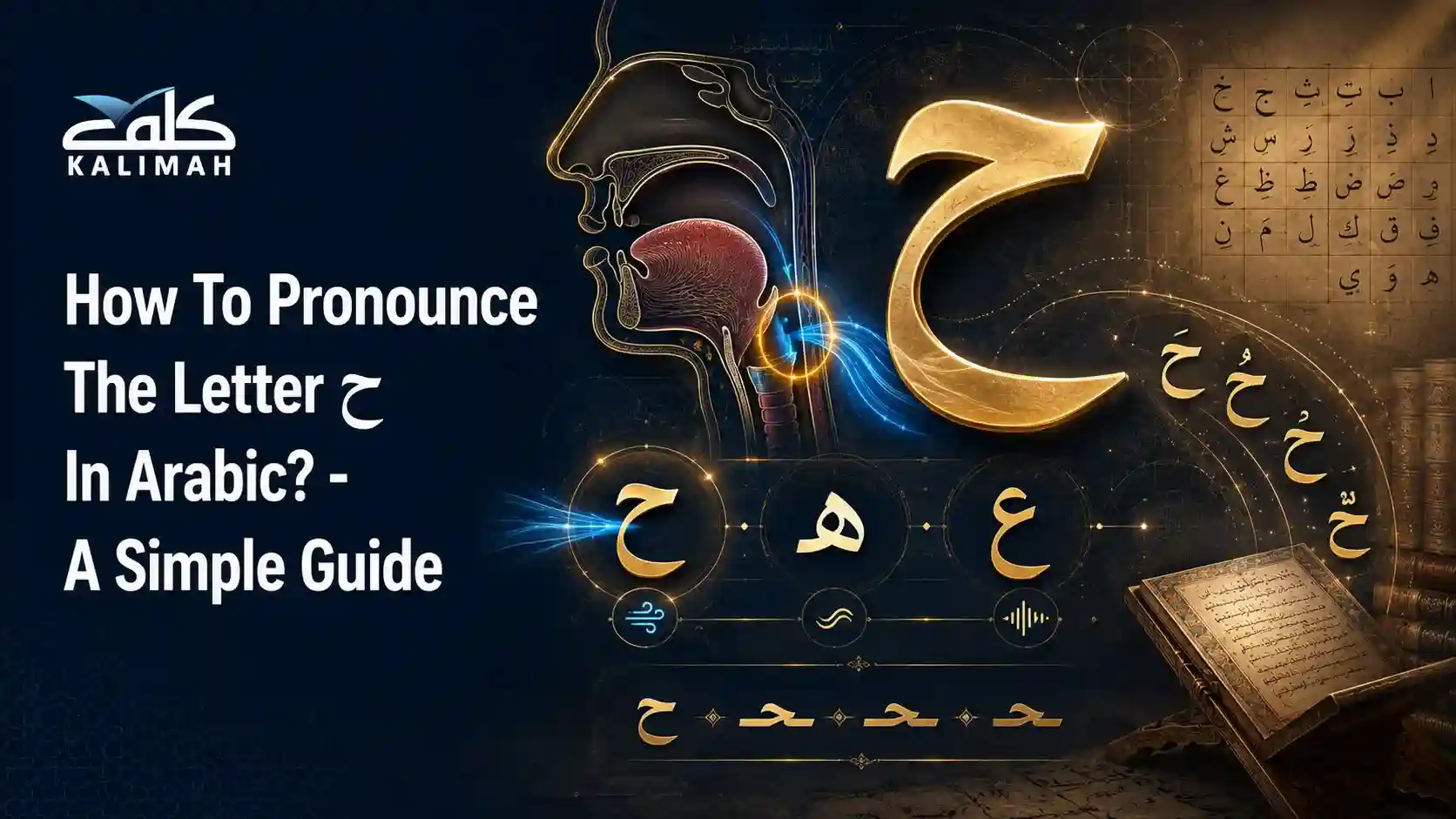
If you’ve ever tried to say a word like حَبِيب (ḥabīb) and felt like your throat just wasn’t cooperating, you’re not alone.
Learning how to pronounce ح in Arabic is one of the first real hurdles for English speakers, because this letter has no true equivalent in English. Once you understand where the sound comes from and how to shape your throat, it becomes a repeatable skill rather than a guessing game.
This guide breaks the sound down step by step, using the mouth and throat positions taught in structured Arabic phonetics, so you can practice with confidence from your first attempt.
What You’ll Learn in This Article
- A complete breakdown of how to pronounce ح in Arabic, from throat position to full words
- Where the letter ح is articulated in the throat and why that matters
- The exact difference between ح and the similar-looking letter ه
- How to pronounce ح with each of the Arabic harakat (vowel marks)
- Common mistakes learners make and how to fix them
- Practice words to build muscle memory
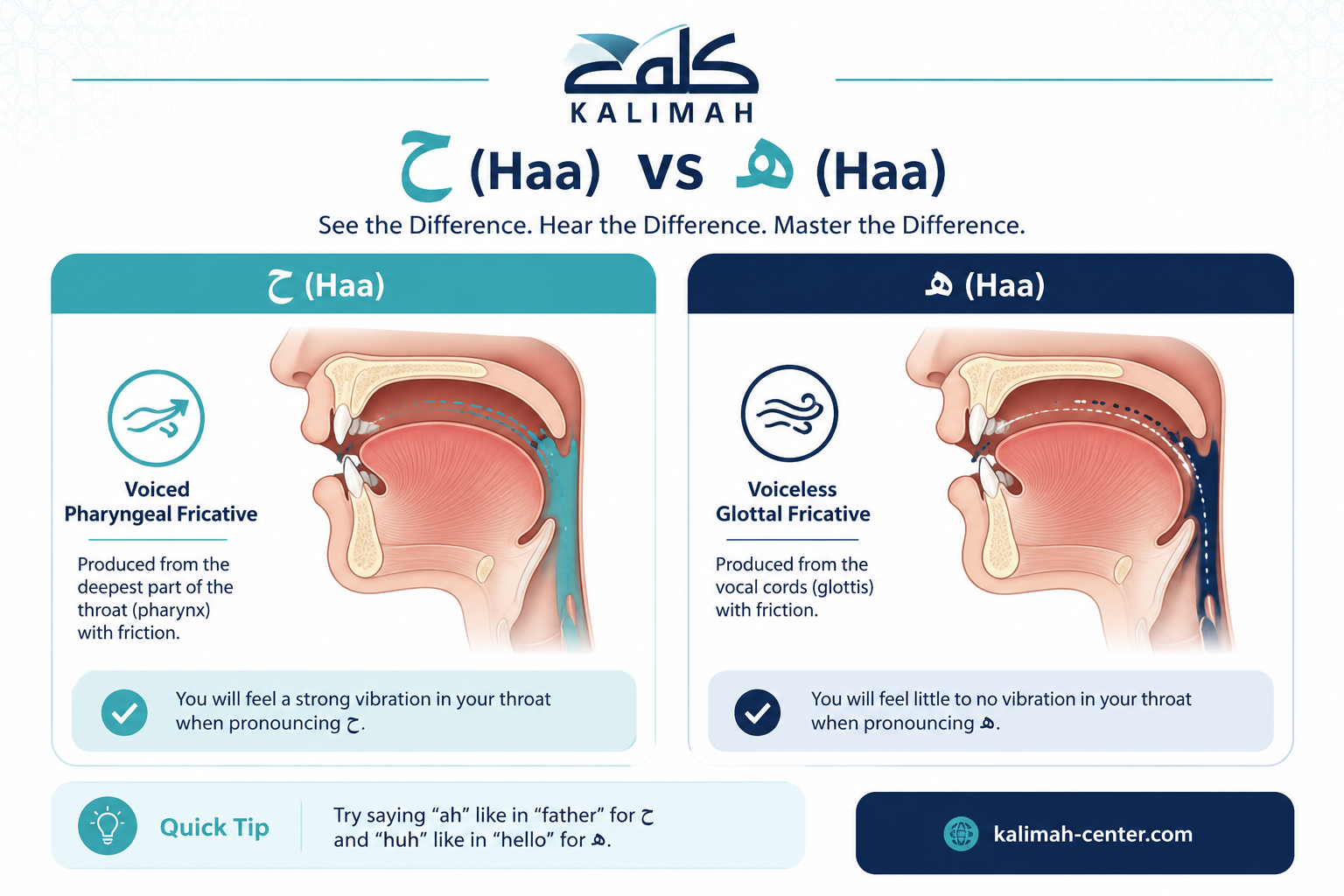
ح (ḥāʾ) is the sixth letter of the Arabic alphabet. It is a voiceless pharyngeal fricative, which means the sound is produced by narrowing the airflow in the pharynx without vibrating the vocal cords.
Before practicing the sound itself, it helps to know exactly where in the throat it comes from, since Arabic phonetics divides the throat into three distinct zones that produce different letters.
Arabic pronunciation teaching divides the throat into three regions: أقصى الحلق (the deepest part, near the chest), وسط الحلق (the middle of the throat), and أدنى الحلق (the part closest to the mouth). The letter ح is produced from وسط الحلق, the middle of the throat.
To locate this spot, try swallowing and notice the muscles that tighten in the middle of your throat, roughly where your Adam’s apple sits. That tightening point is where ح originates, and it’s a noticeably different location than where other throat letters are formed.
A. Step-By-Step Guide To Pronouncing ح
Mastering how to pronounce ح in Arabic comes down to three coordinated actions: mouth position, throat tension, and airflow. Each step below builds on the last, so work through them in order rather than skipping ahead.
1. Mouth Position And Throat Focus
Open your mouth slightly, as if you were about to say “aah.” Instead of pushing air from your chest or shaping the sound with your tongue and lips the way English “H” works, redirect the effort to the middle of your throat.
Your tongue should stay relaxed and low, since ح does not involve any tongue contact with the roof of the mouth.
2. The Squeeze And The Cough Method
Tighten the muscles in the middle of your throat so the air has to squeeze through a narrow gap, creating friction rather than a smooth breath.
A practical trick that many learners find effective is to imagine you are gently fogging up a piece of glass or coughing softly. Because the vocal cords stay silent throughout, the result is a breathy, raspy “h” that is noticeably harsher than the English version.
Once you can produce the isolated sound consistently, the next step is layering it with vowels, since Arabic letters are almost never pronounced in isolation in real speech.
Read Also: How To Pronounce The Arabic Letter Daad (ض)?
B. Practicing ح With Arabic Vowels (Harakat)
Arabic vowel marks, called harakat, change how a consonant like ح is voiced. Getting comfortable with ح under each haraka is what makes the letter usable in actual words rather than just as an isolated sound.
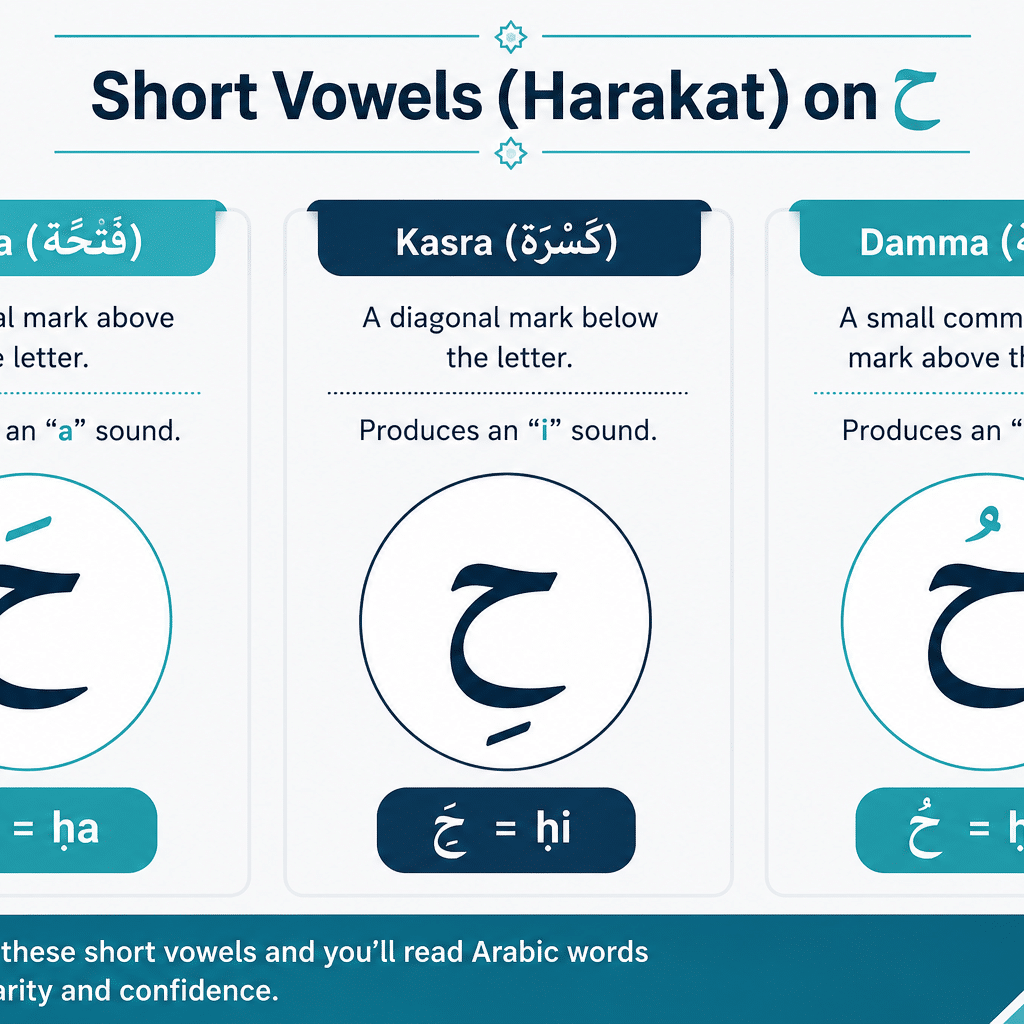
1. Fatha, Kasra, And Damma
The fatḥa (فَتْحَة) is a diagonal mark above the letter and produces an “a” sound, so حَ is read as “ḥa.” The kasra (كَسْرَة) is a diagonal mark below the letter and produces an “i” sound, so حِ is read as “ḥi.”
The damma (ضَمَّة) is a small comma-shaped mark above the letter and produces a “u” sound, so حُ is read as “ḥu.”
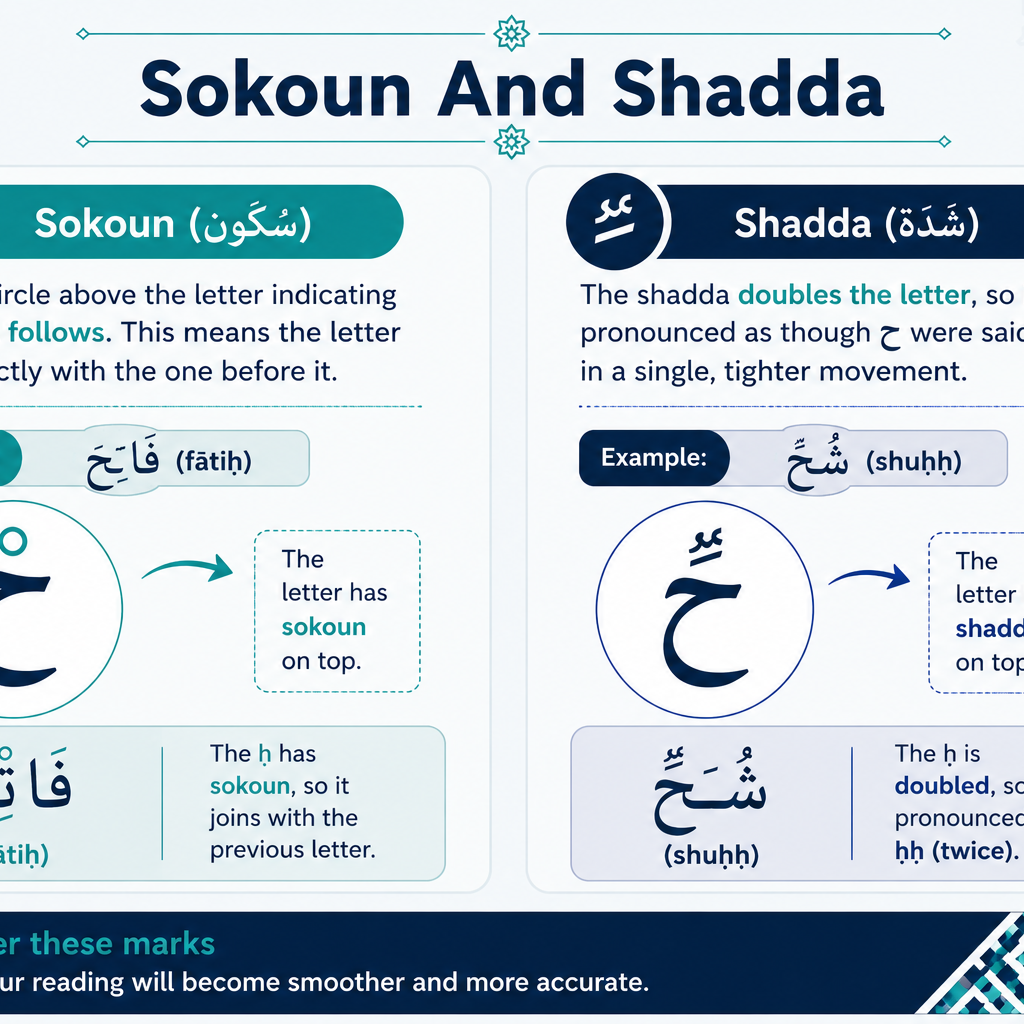
2. Sokoun And Shadda
The sokoun (سُكُون) is a small circle above the letter indicating no vowel follows, meaning the letter joins directly with the one before it, as in فَاتِح (fātiḥ).
The shadda (شَدَّة) doubles the letter, so it is pronounced as though ح were said twice in a single, tighter movement, as in شُحّ (shuḥḥ).
Practicing all five haraka combinations daily, even for five minutes, builds the muscle memory that turns a conscious effort into an automatic reflex. This is the same progression used in the Best Online Arabic Classes For Adults, where pronunciation drills are paired with live correction from a native-speaking teacher.
Read Also: Is Refold Good for Learning Arabic?
Experience Kalimah Center Classes
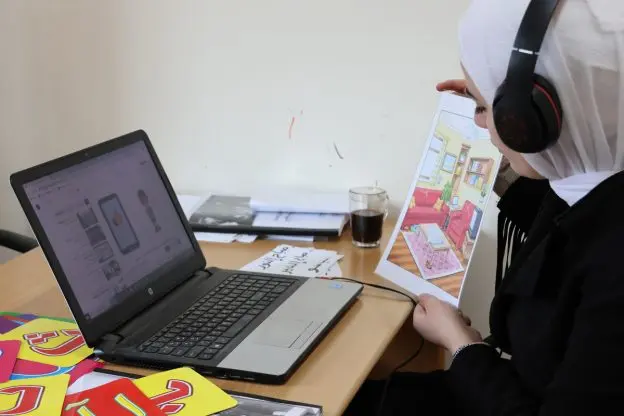
Watch real excerpts from our live sessions at Kalimah Center and see how we bring learning to life. These clips highlight our interactive, student-centered teaching approach across all our courses—designed to keep learners engaged, motivated, and actively involved every step of the way.
Master Arabic with Kalimah Center
Join our expert-led online classes and start your journey toward Arabic fluency today.
Book Your Free TrialC. Common Mistakes When Pronouncing ح
Most learners make one of two errors when first attempting ح, and both are easy to correct once you know what to listen for.
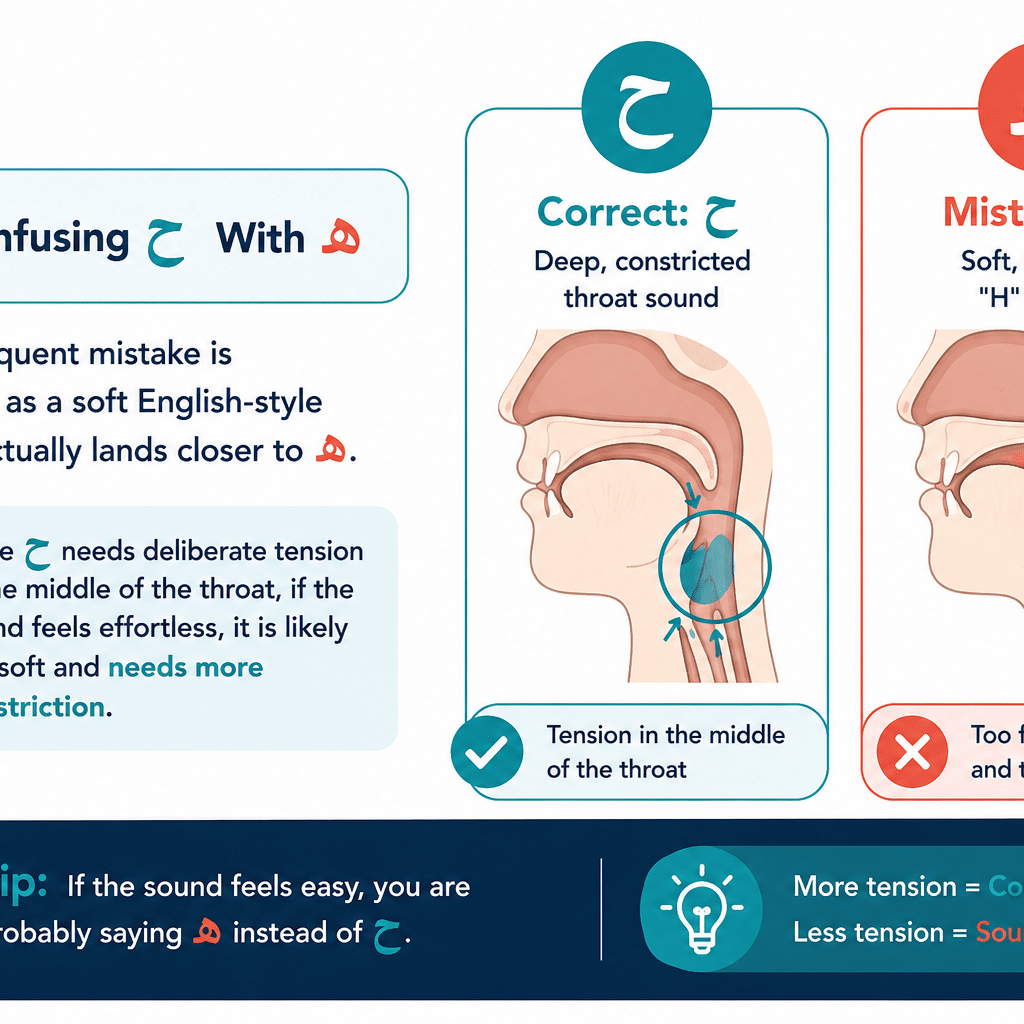
1. Confusing ح With ه
The most frequent mistake is producing ح as a soft English-style “H,” which actually lands closer to ه.
Since ح needs deliberate tension in the middle of the throat, if the sound feels effortless, it is likely too soft and needs more constriction.
2. Using Vocal Cord Vibration
The second common error is letting the vocal cords vibrate, which shifts the sound toward ع (ʿayn) instead.
ح must stay completely voiceless: place two fingers lightly on your throat while producing the sound, and if you feel vibration, the vocal cords are engaged and need to relax.
Read Also: Tongue Letters In Arabic
D. Practice Words to Master ح
Repetition with real vocabulary is what moves this sound from theory into habit. Try these words slowly at first, then at natural speaking speed:
- حَقًّا (ḥaqqan) – truly, indeed
- حَمَامَة (ḥamāma) – pigeon
- أَحْمَر (aḥmar) – red
- حَبْل (ḥabl) – rope
- حِصَان (ḥiṣān) – horse
- حُوت (ḥūt) – whale
- حُزْن (ḥuzn) – sadness
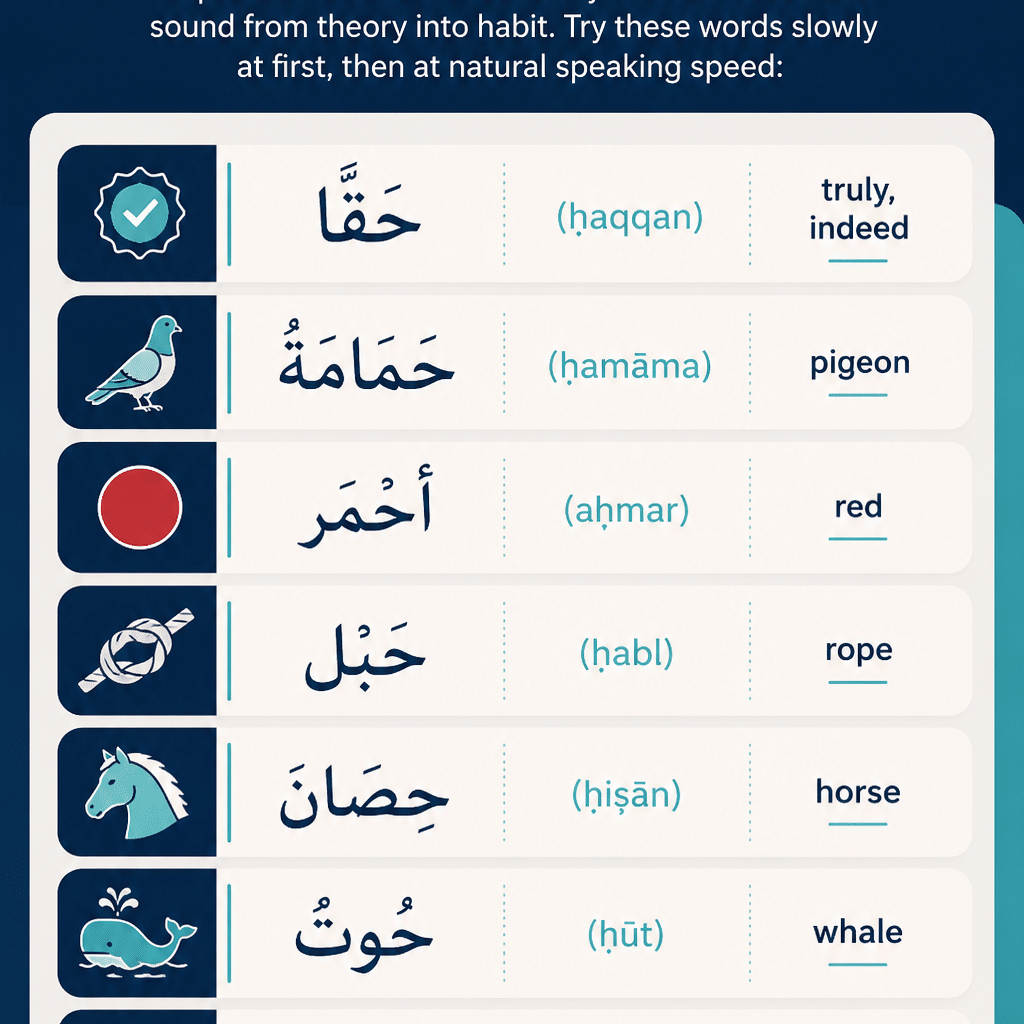
Reading these aloud daily, and ideally recording yourself to compare against a native speaker, is one of the fastest ways to catch small errors before they become fixed habits.
Read Also: Is Glossika good for Arabic?
Master Your Pronunciation With Kalimah Center
Self-study can only take pronunciation so far, because throat sounds like ح are hard to self-correct without direct feedback.
Kalimah Center‘s live classes pair you with native-speaking teachers who catch these small articulation errors in real time and correct them before they become permanent habits.

Whether you’re an adult starting from scratch or looking for a more social way to practice, Kalimah Center’s Intensive Arabic Group Classes With Cheap Fees give you consistent, affordable practice with real conversation partners.
Parents looking to start their children early can also explore Learn Arabic Online For Kids, designed around age-appropriate pronunciation drills.

Inside Kalimah Center: Moments from Our Courses
Get a glimpse into the vibrant learning experience at Kalimah Center. These snapshots capture real moments from our live classes—where students engage deeply, connect with passionate instructors, and grow in a welcoming, supportive environment.
Here Are The Reviews On Our Courses:
Our students frequently commend the excellence of our courses and the commitment shown by our instructors. You can read their complete reviews on Trustpilot.
Read more reviews on Trustpilot

📚 Explore Our Courses:
Online Arabic Course: Tailored to your level, our comprehensive Arabic program includes 16 teaching levels and 400+ hours of personalized sessions.
Online Quran With Tajweed Course: Perfect for non-Arabic speakers, our course spans 13 levels and equips you with Tajweed mastery from beginner to advanced.
Online Arabic Course For Kids: Nurture your child’s love for Arabic with our engaging and structured program, available in 24 levels for primary, intermediate, and secondary stages.
🚀 Start Your Free Trial Today! 🚀
Don’t miss out on this life-changing opportunity to deepen your faith and knowledge. Sign up now for your free trial and take the first step towards becoming a better practicing Muslim with Kalimah Center!
Master Arabic with Kalimah Center
Join our expert-led online classes and start your journey toward Arabic fluency today.
Book Your Free TrialConclusion
Learning how to pronounce ح in Arabic comes down to locating the middle of the throat, keeping the vocal cords silent, and building enough muscle memory through repetition that the sound becomes automatic.
The clearest way to check your progress is comparing ح against ه in paired words like حِمَار and فَهْد, since the contrast makes the correct throat position obvious.
With daily practice on the haraka combinations and the common practice words above, most learners notice a real difference within a few weeks.If you want that progress to happen faster and with fewer bad habits to unlearn later, structured feedback from a native speaker at Kalimah Center remains the most reliable shortcut.
Frequently Asked Questions
Here are direct answers to the questions learners most often ask about pronouncing ح correctly.
1. What part of the throat is used to pronounce ح?
ح is pronounced from وسط الحلق, the middle part of the throat, distinguishing it from ه, which comes from the deepest part of the throat closer to the chest.
2. Is ح a voiced or voiceless sound?
ح is a voiceless sound, meaning your vocal cords should not vibrate at all while producing it. If you feel vibration in your throat, the sound has shifted toward ع instead.
3. What is the easiest way to practice the ح sound?
The cough or fogging-the-glass method is the easiest starting point: gently constrict your throat as if fogging up glass, keeping the sound breathy rather than vocal, then repeat it with each haraka.
4. How is ح different from ه?
ح is produced from the middle of the throat and sounds thicker and rougher, while ه comes from the deepest part of the throat and sounds softer and thinner, as heard in the contrast between حِمَار and فَهْد.
5. Can I learn correct Arabic pronunciation on my own?
Self-practice helps you learn the mechanics, but throat sounds like ح are difficult to self-correct without a native speaker’s feedback, which is why live classes with real-time correction speed up progress significantly.