No, you do not have to be fluent in Arabic to be a Muslim. Islam is a universal religion for all people regardless of language. However, every Muslim must learn minimal Arabic — specifically the Shahada, Surah Al-Fatiha, and basic prayer phrases — as these cannot be substituted in the five daily prayers (Salah).
Key Takeaway Summary Table
| Question | Answer |
|---|---|
| 🕌 Must you speak Arabic to be Muslim? | No — Islam is for all languages and peoples |
| 🙏 Is some Arabic required? | Yes — Shahada, Al-Fatiha, and prayer phrases |
| 📖 Can you understand the Quran without Arabic? | Yes — through translations, but depth is lost |
| 🗣️ Can you make Dua in your own language? | Yes — personal supplications can be in any language |
| 🕋 Can you pray Salah in English? | No — the five daily prayers must be in Arabic |
| 🌟 Is learning Arabic Sunnah? | Yes — highly recommended but not obligatory beyond basics |
| 🏡 Can you enter Jannah without knowing Arabic? | Yes — Paradise is earned through faith and deeds |
| 📚 Scholar position | Imam Shafi’i: Learn enough Arabic to fulfill obligations |
The short answer is: no, you do not need to be fluent in Arabic to be a Muslim. Islam was revealed as a universal religion for all of humanity — Arab and non-Arab alike. The Prophet Muhammad (peace be upon him) was sent to all people, not only to Arabic speakers.
However, a basic level of Arabic is required — specifically enough to recite the Shahada and perform the five daily prayers correctly. Beyond this minimum, how much Arabic you learn is a matter of personal devotion, not religious obligation.
This article explores exactly what is required, what is recommended, and why Arabic holds such a profound place in Islam — even for those who will never become fluent in it.
Why Is Arabic the Language of the Quran? (And What That Means for You)
Arabic, my dear brothers and sisters, is not just any language; it’s the very vessel chosen by Allah (SWT) to hold His final message to humanity. Every word, every letter, carries a weight and a depth that cannot be fully grasped in any other tongue.
As Muslims, we hold the Quran close to our hearts, and its Arabic words resonate deep within our souls.
In the Quran, Allah says:
(وَكَذَٰلِكَ أَوْحَيْنَا إِلَيْكَ قُرْآنًا عَرَبِيًّا لِّتُنذِرَ أُمَّ الْقُرَىٰ وَمَنْ حَوْلَهَا وَتُنذِرَ يَوْمَ الْجَمْعِ لَا رَيْبَ فِيهِ ۚ فَرِيقٌ فِي الْجَنَّةِ وَفَرِيقٌ فِي السَّعِيرِ)
“And thus We have revealed to you an Arabic Qur’an that you may warn the Mother of Cities [Makkah] and those around it and warn of the Day of Assembly, about which there is no doubt. A party will be in Paradise and a party in the Blaze.” (Ash-Shura, 42:7)
In this verse, Allah reminds us that the Quran was revealed in Arabic for a specific purpose – to warn the people of Makkah and everyone else about the Day of Judgment. On that day, some people will go to Paradise (Jannah), and others will go to the Blaze (Hellfire).
Islam Is for All People: Faith Beyond Language
Knowing Arabic is important to fully understand the Quran. However, even if you don’t know Arabic, you can still be a Muslim. Islam is for everyone, regardless of their language or background. Allah says in the Quran:
(وَمَا أَرْسَلْنَاكَ إِلَّا كَافَّةً لِّلنَّاسِ بَشِيرًا وَنَذِيرًا وَلَكِنَّ أَكْثَرَ النَّاسِ لَا يَعْلَمُونَ)
“And We have not sent you, [O Muhammad], except as a comprehensive warner and bearer of good tidings to all mankind, but most of the people do not know.” (Saba, 34:28)
This verse tells us that Prophet Muhammad was sent as a messenger to all people, not just Arabs. The message of Islam is universal, and everyone is invited to believe in it.
What Is the Difference Between Arab and Muslim?
One of the most common misconceptions addressed by this question is the assumed link between Arab identity and Muslim faith. These are two entirely separate things:
| # | Arab | Muslim |
|---|---|---|
| Definition | Ethnic and cultural identity | Religious identity |
| Language | Arabic is native language | No specific language required |
| Religion | Arabs can be Muslim, Christian, Jewish, or secular | Muslims can be any ethnicity |
| Population | ~450 million people worldwide | ~1.9 billion people worldwide |
The numbers tell the story clearly: Approximately 80% of the world’s Muslims are not Arab. The countries with the largest Muslim populations are Indonesia (231 million), Pakistan (212 million), Bangladesh (153 million), and Nigeria (105 million) — none of which are Arab countries, and none of which speak Arabic as a native language.
Islam began in Arabia and Arabic is the language of its scripture — but the religion itself belongs to every nation, every ethnicity, and every language on earth. As Allah says:
“And We have not sent you except as a mercy to the worlds.” (Al-Anbiya 21:107)
How Many Muslims in the World Don’t Speak Arabic?
This single fact is perhaps the most powerful answer to the question of whether Arabic is required to be Muslim:
Approximately 1.57 billion of the world’s 1.9 billion Muslims — roughly 83% — do not speak Arabic as a native language.
Muslims pray in Arabic in Jakarta, Karachi, Lagos, London, São Paulo, and Kuala Lumpur. They recite the same Surah Al-Fatiha, in the same Arabic words, five times a day — yet the overwhelming majority have never held a conversation in Arabic.
This global reality itself testifies to what Islam requires: not linguistic mastery, but sincerity of faith expressed through the universal form of prayer Allah ordained.
The Arabic of prayer is a unifying thread — when Muslims from 195 countries stand together in Hajj and recite “Labbayk Allahumma Labbayk” (Here I am, O Allah, here I am), they speak one voice. That unity does not require anyone to abandon their native language or culture. It requires only that they learn the language of worship — and that is within reach of every sincere believer.
What Arabic Are Muslims Actually Required to Learn? (Scholar-Backed Answer)
Let’s start with the basics. There is a consensus that a basic level of Arabic is required for every Muslim to fulfill their religious obligations (fard ain).
Imam Shafi’i, a prominent Islamic scholar, stated: “It is obligatory upon every Muslim to learn from the Arabic language what allows him to make effort in fulfilling his obligations.” This implies that every Muslim must know enough Arabic to understand and perform their religious duties.
But what does this mean practically? At a minimum, every Muslim should strive to learn the following:
- The Declaration of Faith (Shahada): لَا إِلَٰهَ إِلَّا ٱللَّٰهُ مُحَمَّدٌ رَسُولُ ٱللَّٰهِ (La ilaha illallah, Muhammadur rasulullah) – There is no god but Allah, and Muhammad is the messenger of Allah.
- Surah Al-Fatiha: The opening chapter of the Quran, recited in every prayer.
- Some Additional Verses for Prayer: such as Surah Al-Ikhlas 112.
Knowing these basics allows a Muslim to pray and understand the core tenets of their faith. However, the pursuit of deeper knowledge of Arabic is highly encouraged. A deeper understanding of Arabic not only facilitates a more profound connection with the Quran and the Sunnah, but also fosters khushu’ (humility and presence) in prayer.
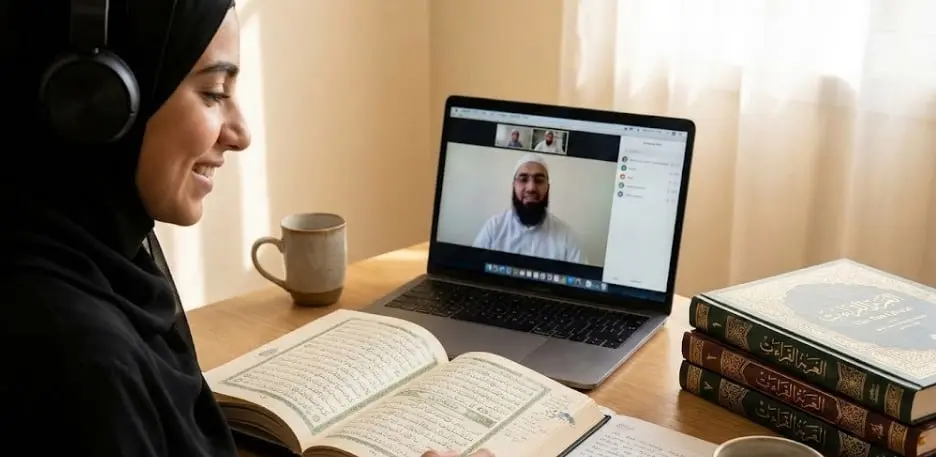
At Kalimah Center, we cater to all levels of learners, from beginners who simply want to understand their prayers to those who aspire to become scholars of the Arabic language. Whether your goal is to deepen your faith, connect with the rich cultural heritage of the Arab world, or simply enjoy the beauty of the language, we have a course that’s right for you.
Experience Kalimah Center Classes
Watch real excerpts from our live sessions at Kalimah Center and see how we bring learning to life. These clips highlight our interactive, student-centered teaching approach across all our courses—designed to keep learners engaged, motivated, and actively involved every step of the way.
Master Arabic with Kalimah Center
Join our expert-led online classes and start your journey toward Arabic fluency today.
Book Your Free TrialIs Learning Arabic Mandatory in Islam?
YES, every Muslim must learn enough Arabic in some level to recite the Shahada (declaration of faith), Surah Al-Fatiha (the first chapter of the Quran), and some additional verses for prayer. And it’s just it.
BUT…
Complete fluency isn’t required. It’s not necessary for every Muslim to become a scholar of the Arabic language. The depth of learning depends on individual circumstances and aspirations.
So, do you have to speak Arabic to be Muslim? The answer remains no, you don’t have to speak Arabic to be Muslim. Basic Arabic is necessary for performing religious duties only, but it is not required for all aspects of faith.
Can You Pray in Your Own Language?
NO, you cannot pray the five prayers in your own language. For the five daily prayers (Salah), Muslims are required to recite specific verses from the Quran in Arabic. This includes Surah Al-Fatihah and other Quranic passages.
However, personal supplications (dua) can be made in any language. This distinction ensures that the ritual prayers maintain their universal form while allowing personal prayers to be intimate and heartfelt.
How to Pray in Islam If You Don’t Know Arabic Yet
For new Muslims or those still learning Arabic, the path to correct prayer is gradual and merciful. Islamic scholars agree that a new Muslim should begin praying immediately and learn the required Arabic progressively. Here is a practical starting framework:
Step 1 — Learn the Shahada first
لَا إِلَٰهَ إِلَّا ٱللَّٰهُ مُحَمَّدٌ رَسُولُ ٱللَّٰهِ
La ilaha illallah, Muhammadun rasulullah
“There is no god but Allah, and Muhammad is the messenger of Allah.”
Step 2 — Learn Surah Al-Fatiha
This is the opening chapter of the Quran and is recited in every unit of every prayer. It contains only 7 verses and 29 unique words. Memorizing it with meaning takes most beginners 1–2 weeks with daily practice.
Step 3 — Learn the Tasbeeh and Takbeer phrases
Key phrases used throughout prayer:
- Allahu Akbar — Allah is the Greatest (said when moving between positions)
- Subhana Rabbiyal Adheem — Glory be to my Lord, the Magnificent (said in Ruku)
- Subhana Rabbiyal A’la — Glory be to my Lord, the Most High (said in Sujood)
- Assalamu alaykum wa rahmatullah — Peace and mercy of Allah be upon you (to end prayer)
Step 4 — Add short Surahs
Surah Al-Ikhlas (4 verses), Surah Al-Falaq (5 verses), and Surah An-Nas (6 verses) are the most commonly learned and recited after Al-Fatiha.
The key principle: Start praying now, learn as you go. Allah is Al-Wadud (the Most Loving) and Ar-Raheem (the Most Merciful) — He honors sincere effort over perfect execution.
Read more about: Learn Arabic Prayer
Why Did Allah Reveal the Quran in Arabic Specifically?
Allah chose Arabic for the final revelation for reasons that scholars have reflected on for centuries. Arabic is among the most grammatically precise and semantically rich languages ever developed — a single Arabic root word can carry layers of meaning that require entire paragraphs to convey in English. The Quran’s linguistic perfection, known as I’jaz Al-Quran (the inimitability of the Quran), is itself considered one of its greatest miracles — and it is inseparable from the Arabic language.
Beyond linguistic richness, the Quran was revealed in the language of the community that would first carry the message — the Arabs of 7th-century Makkah. This was not a limitation but a starting point: a message delivered in the living language of its first audience, then carried by those people to the rest of the world.
As Ibn Taymiyyah wrote: “The Arabic language is part of Islam, and knowing it is an obligation.” The language was not chosen arbitrarily — it was chosen to preserve the precision of Divine guidance across all generations.
Allah (God) could have chosen any language, but He chose Arabic. Why? Well, think of it this way:
- The Quran is a message for all time: It needs to be preserved in its original form so that its meaning doesn’t change as languages evolve.
- Arabic is a rich and precise language: It has the power to express complex ideas and emotions with beautiful clarity.
- The Prophet’s mission was natural: The Prophet Muhammad was a human being, just like us. He spoke the language of his people, not a miraculous mix of all languages. This makes his example one we can follow.
So, Arabic is the language of Islam because it’s the language the Quran was revealed in. It’s part of the natural way Allah chose to guide us.
Does that mean you have to be an Arabic expert to be a good Muslim? Absolutely not! The most important thing is your beliefs and your actions. But learning Arabic can definitely help you understand Islam better.
Does Allah Only Hear Arabic? What the Quran Actually Says
Allah (SWT) is not bound or defined by any human language. He is Al-Aleem (the All-Knowing) and As-Sami’ (the All-Hearing) — He hears and understands every prayer, in every language, from every corner of the earth. When a mother in Indonesia cries to Allah in Bahasa, when a new Muslim in France makes dua in French, when a grandmother in Nigeria whispers her prayers in Hausa — Allah hears them all with complete understanding.
Arabic is the chosen language of the Quran, not a limitation on Allah’s comprehension. As the Quran itself says, the diversity of human languages is one of Allah’s signs (Ar-Rum 30:22) — something to be celebrated, not treated as a barrier to faith.
As for the language of Jannah itself, no Quran verse or universally authenticated hadith definitively states what language will be spoken in Paradise. Some scholars have discussed this topic, but the agreed-upon Islamic position remains: entry into Jannah depends entirely on faith, deeds, and Allah’s mercy — not on which language you spoke in this world.
Allah mentions in the Quran:
(وَمِنْ آيَاتِهِ خَلْقُ السَّمَاوَاتِ وَالْأَرْضِ وَاخْتِلَافُ أَلْسِنَتِكُمْ وَأَلْوَانِكُمْ ۚ إِنَّ فِي ذَٰلِكَ لَآيَاتٍ لِّلْعَالِمِينَ)
“And of His signs are the creation of the heavens and the earth and the diversity of your tongues and your complexions. In all that there are signs for those who are endowed with knowledge.” (Ar-Rum 30:22)
This verse highlights the diversity of languages as one of Allah’s signs. Arabic, as the chosen language for the final revelation, carries a profound significance, but it does not diminish the value of other languages.
So, while Arabic is the language of the Quran, it’s not meant to be a barrier. It’s a bridge to understanding the heart of Islam. And as we learn Arabic basics, we connect not only with the Quran but also with the rich history and culture of the Muslim world. It’s a beautiful journey of discovery, open to anyone who seeks it.
Can You Go to Jannah Without Knowing Arabic?
Absolutely. Paradise is attained through faith, good deeds, and Allah’s mercy, not linguistic skills.
Islam is a universal religion that transcends linguistic boundaries. The essence of being a Muslim lies in the belief in Allah, the angels, the Books, the Messengers, and the Last Day, and in practicing the five pillars of Islam: the declaration of faith, prayer, fasting, zakah, and Hajj.
Allah says in the Quran:
(بَلَىٰ مَنْ أَسْلَمَ وَجْهَهُ لِلَّهِ وَهُوَ مُحْسِنٌ فَلَهُ أَجْرُهُ عِندَ رَبِّهِ وَلَا خَوْفٌ عَلَيْهِمْ وَلَا هُمْ يَحْزَنُونَ)
“Whoever surrenders his purpose to Allah while doing good works, they will surely have their rewards with their Lord, and they will have no reason to fear or grieve.” (Al-Baqarah 2:112)
This verse reassures us that faith and good deeds are what matter most. However, let’s delve deeper into why Arabic holds a special place in Islam.
However, learning Arabic can enrich one’s understanding and practice of Islam.
Is it Sunnah to learn Arabic?
Yes, learning Arabic is considered a sunnah (recommended act) in Islam. It is not mandatory for every Muslim to become fluent, but it is highly encouraged for several reasons:
- Understanding the Quran: The Quran was revealed in Arabic, and learning the language allows for a deeper and more nuanced understanding of Allah’s message.
- Connecting with Islamic Heritage: Arabic is the language of Islamic scholarship, literature, and culture. Learning it opens up a vast world of knowledge and history.
- Following the Example of the Prophet and Companions: The Prophet Muhammad (peace be upon him) was a master of Arabic language. Learning Arabic is a way to follow in the footsteps of the Prophet and to gain a deeper understanding of his teachings.
And as Umar ibn Al-Khattab (may Allah be pleased with him) said, “تعلَّموا العربيةَ؛ فإنها من دينِكم” (Learn Arabic, for it is part of your religion).
Even learning 50–100 key Arabic words can transform your experience of Salah. Suddenly, when you say “Allahu Akbar” (Allah is the Greatest), you’re not reciting a sound — you’re making a declaration. When you recite “Al-hamdu lillahi rabb il-aalameen” (All praise is for Allah, Lord of all worlds), you understand the magnitude of what you’re saying.
This is the gift of even basic Arabic: it converts prayer from ritual recitation into conscious conversation with Allah. Scholars call this khushu’ — the presence of heart in prayer — and it is one of the most sought-after qualities in Islamic worship.
You don’t need years of study to experience this. Starting with the vocabulary of Surah Al-Fatiha alone — 29 unique words — can fundamentally change your connection to every prayer you make for the rest of your life.
If you are able, I encourage you to embark on this linguistic journey. You might be surprised at how quickly you can understand the language of the Quran and how it illuminates your faith. Kalimah Center offers a range of online Arabic courses tailored to different levels, making it accessible for everyone to learn.
Master Arabic with Kalimah Center
Join our expert-led online classes and start your journey toward Arabic fluency today.
Book Your Free TrialInside Kalimah Center: Moments from Our Courses
Get a glimpse into the vibrant learning experience at Kalimah Center. These snapshots capture real moments from our live classes—where students engage deeply, connect with passionate instructors, and grow in a welcoming, supportive environment.
Here Are The Reviews On Our Courses:
Our students frequently commend the excellence of our courses and the commitment shown by our instructors. You can read their complete reviews on Trustpilot.

Your Arabic and Quran Journey Begins Here
Kalimah Center is your gateway to this enriching world. Our online Arabic courses cater to all levels, from absolute beginners to those seeking advanced proficiency. Our experienced teachers are passionate about sharing the beauty of the Arabic language and the wisdom of Islam.
Our comprehensive Arabic program is designed to guide you through every stage of your language acquisition, from the very first letter to engaging in deep conversations on complex topics.
Phase 1: Building Blocks
- Arabic Alphabet & Writing: Master the Arabic script and basic writing skills in just a few months.
- Essentials of Arabic: Lay the groundwork for communication with basic vocabulary and grammar.
Phase 2: Conversation Starter
- Everyday Arabic: Gain confidence in handling daily conversations with ease.
Phase 3: Advanced Speaker
- Deepening Conversations: Discuss complex societal topics and refine your grammar knowledge.
Beyond the Basics
- Specialized Courses: For those who wish to dive deeper, explore our specialized courses in MSA, Classical Arabic, and Fusha.
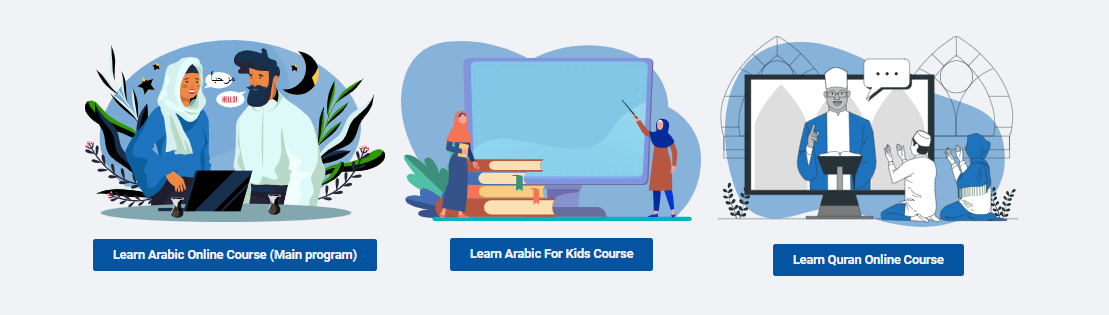
- Learn Arabic Online Course (Main program): Immerse yourself in the Arabic language and culture, gain fluency, and confidently communicate in Arabic.
- Learn Arabic For Kids Course: Ignite your child’s passion for Arabic with interactive and engaging lessons designed for young learners.
- Learn Quran Online Course: Master Quranic recitation, understand Tajweed rules, and connect with Allah’s divine words under the guidance of experienced teachers.
Conclusion:
The question “Do you have to learn Arabic to be Muslim?” often arises, and while Arabic is the language of the Quran, knowing it isn’t mandatory to be a devout Muslim. The essence of Islam lies in faith and practice, not linguistic ability. Basic Arabic is necessary for performing religious duties, such as reciting prayers, but complete fluency is not required.
However, learning Arabic can deepen your connection with the Quran and enrich your spiritual experience. It’s a beautiful journey that enhances understanding of Islamic texts and fosters a closer relationship with the faith. At Kalimah Center, we offer courses for all levels to help you embark on this enriching path, making Arabic accessible and enjoyable for everyone.
FAQs about Do You Have To Learn Arabic To Be Muslim?
Q1: Do you have to speak Arabic to be a Muslim?
No. Speaking Arabic is not a requirement for being a Muslim. Islam is a universal religion sent to all of humanity, regardless of their language or ethnic background. What is required is belief in the core tenets of Islam and the practice of its five pillars. A minimal level of Arabic — enough to recite the Shahada and perform the five daily prayers — is necessary, but conversational fluency is not.
Q2: Can you pray Salah in English or your own language?
No. The five obligatory daily prayers (Salah) must be performed in Arabic, as they involve the recitation of specific Quranic verses — most importantly Surah Al-Fatiha — which cannot be substituted with translations during formal prayer. However, personal supplications (Dua) made outside of or during prayer can be made in any language Allah has made, and He hears them all.
Q3: What is the difference between being Arab and being Muslim?
Being Arab refers to an ethnicity and cultural identity — people from Arab countries who speak Arabic as their native language. Being Muslim refers to a person who follows the religion of Islam. These are entirely separate categories. The majority of the world’s Muslims — over 80% — are not Arab. Countries like Indonesia, Pakistan, Bangladesh, Nigeria, and Turkey have massive Muslim populations where Arabic is not a native language.
Q4: What language will we speak in Jannah (Paradise)?
There is no definitive Quranic or Sahih hadith that specifies the language of Jannah. Some scholars have discussed Arabic as the language of Paradise based on certain narrations, but these are not universally authenticated. What is universally agreed upon is that entry into Jannah depends on faith, good deeds, and Allah’s mercy — not on knowledge of any specific language.
Q5: Is it mandatory to learn Arabic in Islam beyond the basics?
Beyond the minimum required for prayer, learning Arabic is considered a Sunnah (recommended act) rather than a strict obligation for every Muslim. The Islamic scholar Umar ibn Al-Khattab (RA) encouraged Muslims to learn Arabic as part of their faith. The deeper your Arabic, the richer your understanding of the Quran, Hadith, and Islamic scholarship — but your standing as a Muslim is not diminished by limited Arabic knowledge.