5 minutes of Arabic study daily is not enough to become fluent — but it is enough to build the habit that leads to fluency. The 5-minute rule works because consistency, not session length, is the primary predictor of language learning success.
A learner who studies Arabic for 5 minutes every day for one year accumulates 30 hours of focused practice — more than most people manage with irregular “marathon” study sessions. This guide shows exactly what to study in those 5 minutes, how to expand sessions gradually, and how to stay consistent long enough for results to appear.
Example of Arabic Learning Schedule: 5 Minutes a Day
Here is an example of a daily routine:
| Time | Activity |
|---|---|
| Morning (7:00 AM – 7:05 AM) | Review 5 new Arabic words |
| Midday (12:00 PM – 12:05 PM) | Listen to an Arabic audio clip or song |
| Afternoon (3:00 PM – 3:05 PM) | Practice writing one new letter or sound |
| Evening (7:00 PM – 7:05 PM) | Learn one simple grammar rule |
| Night (9:00 PM – 9:05 PM) | Reflect on what you’ve learned and track progress |
Can You Learn Arabic In 5 Minutes A Day?
Learning a language in just 5 minutes a day might seem impossible, but the 5-minute rule makes learning easy and accessible. The 5-minute rule is a powerful concept in language learning. Imagine learning Arabic by dedicating just 5 minutes a day to your studies.
At first, you might wonder, “How can I possibly learn a language fluently in such a short time each day?” While fluency doesn’t come overnight, the 5-minute rule is about setting a routine that’s easy to follow. This method makes language learning less intimidating and ensures you stay on the path to progress without feeling overwhelmed.
Why Just 5 Minutes?
Spending only 5 minutes a day creates a low-pressure environment for learning. While an hour-long language study session might sound exhausting after a busy day, spending 5 minutes on something productive feels simple.
Though 5 minutes won’t make you fluent, it’s enough to get started and gradually build a learning habit. Once you consistently complete your 5-minute sessions, you’ll realize how easy it is to keep going, and over time, you’ll naturally increase the amount of time you spend learning Arabic.
Creating a Consistent Learning Routine with the 5-Minute Rule
One of the biggest reasons language learners struggle is inconsistency. Many learners start with a burst of motivation, study intensely for hours, and then lose steam within days. The 5-minute rule combats this by creating a routine that’s easy to follow daily.
Committing to just 5 minutes of Arabic each day builds consistency and momentum, which are key to language learning success. Over time, this routine becomes second nature, and soon you’ll find yourself investing more time in your studies without even noticing.
How to Make the 5-Minute Rule Work for You In Arabic
To ensure success with the 5-minute rule, follow these steps:
1. Set a Timer for 5 Minutes
Open the clock app on your phone and set a timer for 5 minutes. This will ensure that you stay focused and avoid distractions.
2. Choose a Specific Time and Place
Decide when and where you’ll study Arabic. For example, you could commit to spending 5 minutes after dinner or before bed, while sitting at your desk or on the couch. Establishing a routine makes it easier to stick to your daily practice.
3. Start with Simple Learning Tasks
During your 5 minutes, focus on one specific learning activity. It could be listening to an audio lesson, reviewing vocabulary, or practicing phrases. Avoid multitasking and dedicate this time solely to Arabic learning.
What To Learn In Arabic In 5 Minutes A Day?
In a 5-minute Arabic learning session, focusing on a single task is crucial to maximize productivity. Whether you’re a beginner or intermediate learner, the key is to break down language learning into small, manageable components that you can effectively absorb in such a short amount of time.
Here are specific tasks you can focus on each day, ensuring consistent progress in your Arabic language learning journey:
1. Arabic Vocabulary:
One of the best ways to use 5 minutes is to focus on expanding your Arabic vocabulary. In each session, learn 3-5 new words. By learning a small number of words, you can spend time really focusing on their pronunciation, spelling, and usage.
- Write Them Down: Start by writing down each word in Arabic script. If you’re unfamiliar with the script, write it in both Arabic and transliteration (e.g., “kalb” for “dog”).
- Pronounce Them Repeatedly: Say each word multiple times out loud. This will help you commit the correct pronunciation to memory. You could also record yourself to compare your pronunciation with native speakers.
- Form Simple Sentences: Use these words in basic sentences. For example, if you’re learning the word for “house” (بَيْت – bayt), form a sentence like “This is a house” (هَذَا بَيْت – hādhā bayt). Practicing sentences helps reinforce the new vocabulary in context.
Pro Tip: You can use apps like Anki or Quizlet to create flashcards with these words to review them later.
2. Arabic Grammar:
In a short session, concentrate on mastering one small Arabic grammar rule or concept. Avoid overwhelming yourself with complicated rules; instead, choose something specific that you can focus on during the session.
- Conjugate a Verb: Pick one verb and conjugate it across different tenses or pronouns. For example, take the verb “to write” (كَتَبَ – kataba), and conjugate it in the present tense:
- I write: أَكْتُبُ (aktubu)
- You (m) write: تَكْتُبُ (taktubu)
- You (f) write: تَكْتُبِينَ (taktubeena)
- He writes: يَكْتُبُ (yaktubu)
- Focus on Gender Agreement: Arabic nouns and adjectives must agree in gender. Spend the 5 minutes practicing how to match adjectives with feminine and masculine nouns. For example, practice using “beautiful” (جميل – jameel) for masculine nouns and (جميلة – jameelah) for feminine nouns.
Kalimah Center “Droos nahwiyah mena Al Moqaddemah Al AAjourromiyah (PDF) – دروس نحوية من المقدمة الآجرومية” book will help you learn Arabic grammar effectively.

You can also use our grammar exercise books or online quizzes to practice specific rules. This keeps your learning focused and reinforces your understanding.
3. Arabic Pronunciation:
Arabic pronunciation can be challenging for non-native speakers, especially because of its unique sounds, like the guttural sounds (ح – ḥ, ع – ʿayn) and emphatic consonants (ط – ṭ, ص – ṣ). In your 5-minute session, focus on one or two difficult sounds, listen to how native speakers pronounce them, and mimic their pronunciation.
- Listen to Native Speakers: Use apps like YouTube or language learning platforms that offer native Arabic speakers’ audio. Focus on how they pronounce specific sounds.
- Repeat Aloud: Spend your 5 minutes mimicking their pronunciation. For example, practice the Arabic letter “ع” (ʿayn), which can be hard for beginners. Say a few words containing this letter, such as عَيْن (ʿayn – eye) and عَرَبِي (ʿarabī – Arabic).
- Record Yourself: Compare your pronunciation to a native speaker. This feedback is essential for refining your pronunciation over time.
Focus on pronouncing commonly used words and sounds, as this will directly benefit your conversational abilities.
4. Arabic Alphabet and Writing:
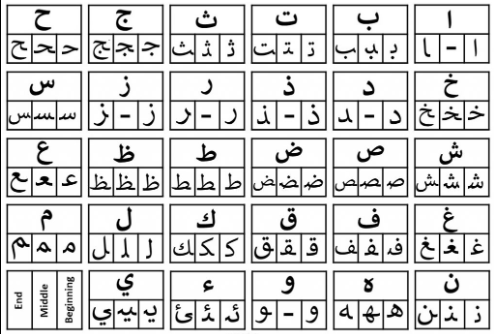
If you’re new to Arabic, spend your 5-minute sessions mastering the Arabic alphabet and writing system. The Arabic script is cursive, meaning the shape of the letters changes depending on whether they are at the beginning, middle, or end of a word. In these short bursts, you can learn to recognize, write, and pronounce 2-3 letters per session.
- Recognize Letters: Start by learning the isolated form of a letter. For example, the letter “ب” (bā) looks different depending on its position in a word:
- Beginning: بـ
- Middle: ـبـ
- End: ـب
Here is a complete chart that illustrates all Arabic connecting letters in their different positions within a word.
- Practice Writing: Use a notebook or an app with handwriting features to practice writing each letter in its various forms. Write a few words containing these letters to solidify their shape and pronunciation.
- Letter Pronunciation: Spend a minute or two repeating the letter’s sound and memorizing its name. For example, say the letter “ب” aloud several times to internalize its sound.
Check this YouTube video to help you Learn Arabic pronunciation.
Read Also: How To Learn Arabic In 10 Days
How to Stay Consistent When Learning Arabic
Consistency is the variable that separates successful Arabic learners from those who quit. Here is what the research on habit formation and what experienced Arabic teachers observe about long-term learners:
1. Attach Arabic to an Existing Habit
Do not create a new time slot for Arabic — attach it to something you already do every day. Examples:
- Morning coffee → review 5 Anki vocabulary cards while drinking it
- Commute → listen to one ArabicPod101 audio clip
- Before bed → write one Arabic word or phrase in a notebook
This approach uses “habit stacking” — the most reliably effective consistency technique from behavioural psychology research.
2. Make Missing One Day Painful — Not Two
The most dangerous Arabic learning pattern: missing one day, feeling guilty, missing another day, abandoning the habit. The rule: never miss twice. One missed day is a normal human occurrence. Two missed days is the beginning of quitting.
3. Track Your Streak Visually
A paper calendar on your wall with an X on each day you study is more motivating than any app. When you have a 21-day streak, you will not want to break it. This is not a technique — it is psychology. Make your progress visible.
4. Set the Minimum Ridiculously Low
Your daily Arabic minimum should be so small it feels embarrassing to skip. Not “30 minutes of Arabic vocabulary” — “say 3 Arabic words out loud.” On hard days, you do the minimum. On good days, you do more. The minimum exists so you never have an excuse to skip entirely.
5. Review What You Have Learned — Not Just New Material
The biggest consistency killer is the feeling that you have forgotten everything. Weekly review sessions (spend 5 minutes reviewing the week’s learning on Sunday) prevent this and give you visible proof of progress.
6. Connect Arabic to Your Motivation
Why are you learning Arabic? Write this answer down and put it somewhere visible. When motivation drops (and it will), this anchor prevents abandonment. The motivation to understand the Quran, connect with family, or work in the Arab world is more durable than general “self-improvement” motivation.
The Fastest Way to Accelerate Your 5-Minute Progress
Five minutes of self-study daily works. One weekly session with a qualified native Arabic teacher works even faster — because a teacher identifies the specific errors your self-study is producing and corrects them before they become habits.
Kalimah Center’s free trial lesson pairs your 5-minute daily habit with expert guidance.
Master Arabic with Kalimah Center
Join our expert-led online classes and start your journey toward Arabic fluency today.
Book Your Free TrialHow to Stay Motivated While Learning Arabic Online
Online Arabic learning presents specific motivation challenges that in-person learning does not. Here is how to address each:
Challenge 1: No social accountability
Solution: Find one accountability partner — a friend, family member, or HelloTalk language exchange partner — who knows your daily Arabic goal. Text them when you complete your session. This simple social accountability check dramatically reduces dropout rates.
Challenge 2: Progress feels invisible
Solution: Record yourself speaking Arabic every two weeks. Play back the oldest recording after two months. The improvement is always more than you feel while studying — and hearing it directly restores motivation.
Challenge 3: The material feels repetitive
Solution: Rotate your learning activities. Use the 5-activity rotation in this article (vocabulary → grammar → pronunciation → alphabet → listening) so no two consecutive days feel identical.
Challenge 4: Comparison with faster learners
Solution: Only compare your Arabic to your own Arabic from one month ago — never to other learners. Language acquisition rates vary enormously based on prior language experience, study time, and method. Another learner’s speed is irrelevant to your trajectory.
Challenge 5: Lack of visible real-world use
Solution: Create an early win. Within your first month, find one Arabic phrase that you can use in a real context — a greeting with a Muslim friend, a phrase from a Quranic verse you are memorising, or a word from an Arabic food label. Real-world use, even tiny, is the most powerful motivator available.
How Do I Learn Arabic on My Own in 5 Minutes?
Learning Arabic on your own can be a rewarding experience, and dedicating just 5 minutes a day can lead to significant progress. Here are some effective strategies to make the most of your self-study journey:
1. Utilize Language Learning Apps
Language learning apps like Duolingo and Memrise offer bite-sized lessons perfect for short study sessions. These apps gamify learning, making vocabulary, grammar, and pronunciation practice engaging and interactive.
2. Incorporate Flashcards for Vocabulary Expansion
Flashcards are great for building vocabulary. Focus on 3-5 new terms daily, and use digital flashcard apps with spaced repetition to reinforce memory retention over time.
3. Practice Listening and Speaking
Listening to Arabic audio clips or music for a few minutes daily helps with pronunciation and comprehension. Try repeating what you hear, and engage with native speakers through language exchange platforms for Arabic speaking practice.
4. Learn Grammar in Manageable Portions
Tackle one simple grammar rule each day, like basic noun-adjective agreement or verb conjugations. This gradual approach will strengthen both writing and communication skills.
5. Focus on a Schedule and Gradual Development
The key to success with a 5-minute-a-day approach is creating a daily routine that works with your schedule. Here’s how to stay consistent and develop your learning:
Stick to the Same Time
Choose a specific time each day to study Arabic. This could be during breakfast, on your commute, or before bed. Consistency is crucial.
Set Small Goals
Focus on tiny goals such as learning 5 new words or practicing a specific sound each day. Achieving these mini-goals keeps you motivated.
Track Progress
Keep a record of what you learn each day. This helps you stay motivated and see how much you’ve progressed over time.
Increase Time Gradually
Once you feel comfortable with 5 minutes a day, increase your study time by 5-minute increments each week until you can dedicate 20-30 minutes a day to Arabic.
6. Set a Gradual Development Plan
As you develop a habit, aim to gradually increase your study time to 20-30 minutes daily. Here’s an example of how to develop a gradual plan:
Weeks 1-2:
Stick to the 5-minute sessions for each activity, focusing on consistency and familiarity.
Weeks 3-4:
Increase your daily study time by 5 minutes. Combine morning vocabulary learning with evening writing practice (total: 10 minutes).
Weeks 5-6:
Aim for 15-20 minutes daily by extending your audio practice and incorporating a short grammar review.
Weeks 7-8:
Target 20-30 minutes by adding additional vocabulary and conversation practice, gradually increasing complexity.
By following this structured schedule, you can ensure steady progress while building a solid foundation in Arabic.
In summary, by dedicating small daily sessions, using language apps, practicing vocabulary, listening, and focusing on manageable grammar portions, you can steadily improve your Arabic skills. Stay consistent and enjoy the learning process!
How Long Should I Study Arabic a Day?
Starting with just 5 minutes a day is a great way to develop a consistent language learning habit.While it may seem short, this manageable approach helps prevent overwhelm and improves retention. Daily exposure, even in small doses, is more effective than infrequent longer sessions.
After 2-3 weeks, aim to increase your sessions to 10 minutes a day. This small jump allows you to cover a bit more material while still keeping your sessions manageable.
By the second month, you may feel ready to study for 15-20 minutes daily, allowing you to incorporate more complex tasks like sentence-building, listening comprehension, or short reading exercises. For steady progress, 30 minutes a day is ideal, but consistency is key.
How Long Does It Take to Learn Arabic at Kalimah Center?
At Kalimah Center, the time needed to learn Arabic varies based on your course selection, current skill level, and pace of learning. Our comprehensive 16-level program offers over 400 hours of one-on-one sessions.
Course durations range from 1-2 months for standard levels, while beginners may need 3-4 months for foundational courses like the Arabic alphabet. Kalimah Center’s tailored approach ensures you receive a personalized estimate based on your individual learning needs and goals.
Master Arabic with Kalimah Center
Join our expert-led online classes and start your journey toward Arabic fluency today.
Book Your Free TrialInside Kalimah Center: Moments from Our Courses
Get a glimpse into the vibrant learning experience at Kalimah Center. These snapshots capture real moments from our live classes—where students engage deeply, connect with passionate instructors, and grow in a welcoming, supportive environment.
Here Are The Reviews On Our Courses:
Our students frequently commend the excellence of our courses and the commitment shown by our instructors. You can read their complete reviews on Trustpilot.
Read more reviews on Trustpilot

Begin Your Journey to Master Arabic with Kalimah Center Today!
Ready to start learning Arabic and unlock a deeper understanding of the Quran? At Kalimah Center, we offer personalized, interactive online courses designed for every level, from beginners to advanced learners.
With over 400 hours of one-on-one lessons and certified tutors, our structured program ensures you achieve your language goals at your own pace.
Start your free trial now and experience the power of learning Arabic with expert guidance, interactive materials, and a supportive community. Take your first step with Kalimah and become proficient in Arabic today!
📚 Explore Our Courses:
Online Arabic Course: Tailored to your level, our comprehensive Arabic program includes 16 teaching levels and 400+ hours of personalized sessions.
Online Quran With Tajweed Course: Perfect for non-Arabic speakers, our course spans 13 levels and equips you with Tajweed mastery from beginner to advanced.
Online Arabic Course For Kids: Nurture your child’s love for Arabic with our engaging and structured program, available in 24 levels for primary, intermediate, and secondary stages.
🚀 Start Your Free Trial Today! 🚀
Don’t miss out on this life-changing opportunity to deepen your faith and knowledge. Sign up now for your free trial and take the first step towards becoming a better practicing Muslim with Kalimah Center!
Conclusion
The 5-minute rule is not a shortcut to Arabic fluency. It is the minimum viable daily commitment that builds the habit that eventually leads to fluency.
Every fluent Arabic speaker who started as a non-native learner had a first week, a first month, a first year. Most of them, at some point, studied for 5 minutes on a hard day because that was all they could manage — and they showed up anyway.
That showing up — the discipline of the minimum — is what separates learners who succeed from learners who quit.
Start with 5 minutes. Use the daily schedule above. Follow the 8-week expansion plan. Stay consistent using the habit strategies in this article.
The Arabic will come. The habit is the work.
If you’re ready to deepen your Arabic skills and understanding, consider joining a program like Kalimah Center. With expert guidance and a supportive community, you can enhance your learning experience. Enroll today in the Best Online Arabic Learning Courses and discover the richness of the Arabic language!
FAQs about Learn Arabic 5 Minutes a Day
Q1: Can you really learn Arabic in just 5 minutes a day?
Not to fluency — but 5 minutes daily is genuinely productive for specific things: reviewing vocabulary with spaced repetition (Anki), listening to one short Arabic audio clip, practicing one pronunciation sound, or writing one Arabic letter. The real power of 5 minutes is habit formation — a consistent 5-minute session daily builds the routine that eventually becomes 15, then 30 minutes. No serious linguist claims 5 minutes produces fluency. But 5 minutes is infinitely more than 0 minutes, and consistency always beats intensity in language learning.
Q2: What should I study in a 5-minute Arabic session?
The most effective 5-minute Arabic activities: (1) Vocabulary review — review 10–15 Anki cards (spaced repetition is most effective in short bursts). (2) Pronunciation practice — repeat one difficult Arabic sound (ع، ح، غ) after a native speaker audio clip. (3) Alphabet practice — write one letter in all four positional forms. (4) Phrase review — say one Arabic phrase aloud 10 times with correct pronunciation. (5) Listening — listen to one 5-minute Arabic podcast episode without stopping. Rotate these activities across the week rather than doing the same task every day.
Q3: How do I build a daily Arabic habit that sticks?
The most reliable method: attach Arabic practice to an existing daily habit (morning coffee, commute, pre-sleep routine). Set a minimum so small it is impossible to skip — even “say 3 Arabic words aloud” counts as completing your Arabic session. Track your streak visually (paper calendar with daily X marks). Never miss two days in a row — one missed day is human, two is the beginning of abandonment. See the consistency section above for the full habit-formation framework.
Q4: How long should I study Arabic each day for real progress?
30 minutes of daily focused Arabic study (vocabulary review + one skill practice + short conversation or listening) produces meaningful progress — intermediate level in 18–24 months. However, the journey from 5 minutes to 30 minutes is the real goal, not starting at 30 minutes. Use the 8-week gradual development plan in this article: start with 5 minutes, add 5 minutes every two weeks, and reach 30 minutes by week 8. Consistency at 5 minutes beats inconsistency at 30 minutes every time.
Q5: What is the best free resource for 5-minute Arabic study sessions?
Anki (free on Android/web) with a pre-made Arabic frequency deck is the ideal 5-minute daily tool — spaced repetition is specifically designed for short daily review sessions and produces more retention per minute than any other vocabulary method. For listening in 5-minute bursts, Coffee Break Arabic (podcast) and ArabicPod101 YouTube both produce episodes in the 5–15 minute range. For pronunciation, individual YouTube videos targeting specific Arabic sounds work well for single 5-minute sessions.