In a nutshell: An Arabic nominal sentence consists of a subject (مبتدأ) and a predicate (خبر) without a verb, where the subject can be a noun or pronoun. The predicate provides information about the subject, and both must agree in gender and number. The Nominal sentence structure typically follows the pattern: subject first, then predicate, and is essential for understanding Arabic grammar.
In a previous article, we discussed al-Zamakhshari‘s definition of the Arabic sentence as a combination of two or more words related to each other to form meaningful and beneficial speech. We also mentioned the two fundamental pillars of a sentence: the “musnad” (predicate) and the “musnad ilayhi” (subject).
Sibawayh defined them as two inseparable elements that a speaker must use together, such as the “mubtada'” (subject) and the “khabar” (predicate), or the verb and its subject.
In this article, we will explore the nominal sentence al-jumla al-ismiyya (الجملة الاسمية), composed of a subject and predicate, without a verb.
What is an Arabic Nominal Sentence?
Arabic nominal sentence (al-jumla al-ismiyya الجملة الاسمية) is a sentence that starts with a noun (اسم, ism) or something acting as a noun, like a pronoun ضمير. It doesn’t need a verb to express a complete thought. Instead, the focus is on a state or a description of the subject.
الطفل نحيف
The kid is thin.
Here, “the kid” (الطفل) is the subject of our statement, and “thin” (نحيف) describes him. This simple structure forms the basis of the nominal sentence.
The Two Pillars of the Arabic Nominal Sentence: Mubtada and Khabar (المبتدأ والخبر)
Every nominal sentence in Arabic is built on two essential components:
1. Mubtada (المبتدأ) – The Subject
Mubtada (المبتدأ) is the subject of the sentence, the noun or pronoun we’re talking about. It’s like the foundation upon which the sentence rests.
2. Khabar (الخبر) – The Predicate
Khabar (الخبر) is the predicate, the part that provides information about the mubtada. It completes the meaning of the sentence.
Let’s break down our previous example:
- الطفل: This is the mubtada, our subject (the kid).
- نحيف: This is the khabar, our predicate (thin). It tells us something about the boy.
| Predicate (خبر) | Subject (مبتدأ) |
| نحيف | الطفل |
| (thin) | (the kid) |

* From Kalimah’s online Arabic courses curriculum.
Types of Mubtada in Arabic
The mubtada can actually take on several different forms in Arabic.
1. Mubtada as a Noun (اسم)
This is the most common form of mubtada. It can be any noun, from a person’s name to an object or concept.
خالد معلم
Khalid is a teacher.
الكتابُ مفيدٌ
The book is useful.
al-kitab (the book) is the mubtada, a definite noun.
2. Mubtada as a Pronoun (ضمير)
Sometimes, we use pronouns to replace nouns, making our sentences more concise. These pronouns can also act as the mubtada.
أنا محمد
I am Mohamed
ana (I) is a pronoun functioning as the mubtada.

3. Mubtada as a Demonstrative Pronoun (اسم إشارة)
Arabic demonstrative pronouns can also function as the mubtada.
هذا ولدٌ
This is a boy.
4. Mubtada as a Relative Pronoun (الاسم الموصول)
Words like الذي (who/that) or التي (who/that, feminine) can also function as the mubtada.
الذي كتب الرسالةَ طالبٌ
The one who wrote the letter is a student.
Master Arabic with Kalimah Center
Join our expert-led online classes and start your journey toward Arabic fluency today.
Book Your Free TrialTypes of Khabar in Arabic
Just like the mubtada, the khabar also comes in various forms, allowing for a wide range of expressions in Arabic. Let’s take a look:
1. Khabar as a Noun (اسم)
The khabar can be a noun, providing a simple and direct description of the mubtada.
الأب فلاح
The father is a farmer.
2. Khabar as an Adjective (صفة)
Adjectives are perfect for adding descriptive details to our mubtada.
القهوة ساخنة
The coffee is hot.
3. Khabar as an Prepositional Phrase (جار ومجرور)
Sometimes, we need to provide information about location or relationship. This is where prepositional phrases come as khabar.
الكتابُ في الحقيبةِ
The book is in the bag.
4. Khabar as a Verb Sentence (جملة فعلية)
Yes, you read that right! An entire verb sentence can act as the khabar, adding a dynamic element to our nominal sentence.
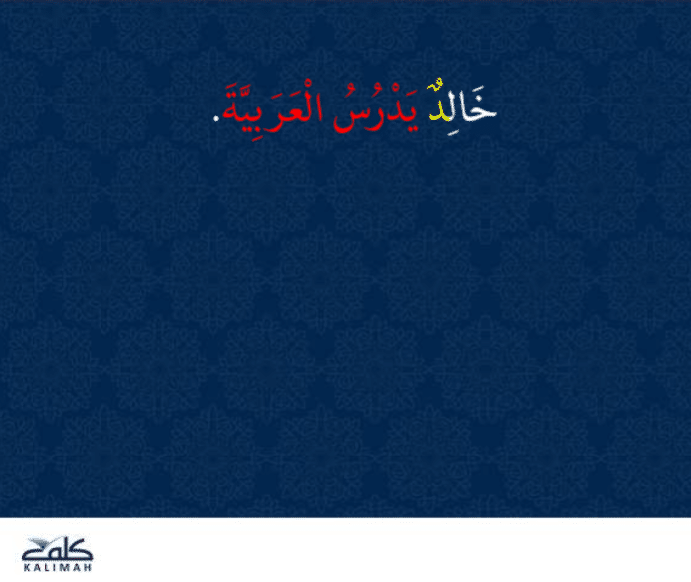
خالد يدرس العربية
Khalid studies Arabic.
Understanding the Arabic nominal sentence is your first step toward mastering the Arabic grammar. At Kalimah Center, we specialize in teaching Arabic in a structured, engaging way.
Former students praise our methods for making complex topics like grammar feel easy and enjoyable.

Experience Kalimah Center Classes
Watch real excerpts from our live sessions at Kalimah Center and see how we bring learning to life. These clips highlight our interactive, student-centered teaching approach across all our courses—designed to keep learners engaged, motivated, and actively involved every step of the way.
Master Arabic with Kalimah Center
Join our expert-led online classes and start your journey toward Arabic fluency today.
Book Your Free TrialThe Rules of Nominal Sentence in Arabic
The nominal sentence in Arabic is simple but follows precise rules that ensure the sentence is meaningful and grammatically correct.
1. The Nominal Sentence Must Begin with a Noun
A nominal sentence always starts with a noun or a pronoun, called the mubtada.
البحرُ جميلٌ
The sea is beautiful.
al-baḥr (the sea) is the noun (mubtada) introducing the sentence.
2. The Mubtada Must Be Definite
The subject (mubtada) in a nominal sentence is usually definite, meaning it refers to something specific or known. This can be achieved using:
- A definite article (like “the” in English): ال (al-)
- A proper noun: “Zayd” or “Fatima.”
- A possessive structure: كتاب المعلم (kitab al-mu‘allim – the teacher’s book).
3. Mubtada first, then Khabar
The usual order in a nominal sentence is: Mubtada first, then Khabar.
الشاي ساخن
The tea is hot.
But sometimes we can switch this order! This is done for emphasis, like when a poet wants to create a certain effect.
4. Subject-Verb Agreement
Even though our nominal sentence starts with a noun, sometimes the khabar includes a verb. When this happens, remember this important rule: the verb must agree with the mubtada. This means the verb should match the mubtada in gender (masculine or feminine) and number (singular, dual, or plural).
البنت تقرأ
The girl is reading.
Here, “taqra’u” (تقرأ) is feminine singular to match “al-bint” (البنت).
الرجال يعملون
The men are working.
Here, “ya’malun” (يعملون) is masculine plural to match “al-rijal” (الرجال).
10 Examples of Nominal Sentences in Arabic
To help you fully understand how nominal sentences (jumla ismiyya) work in real-life contexts, let us look at more ten Arabic nominal sentences examples. These jumla ismia examples in arabic are connected to everyday Arabic life and culture.
1. The Nile is long. (النيل طويل – Al-Nil tawil)
Notice how “Al-Nil” (النيل) is the definite mubtada, while “tawil” (طويل) is the indefinite khabar.
2. Ramadan is a holy month. (رمضان شهرٌ مُبارك – Ramadan shahrun mubarak)
“Ramadan” (رمضان) is the definite mubtada, and “shahrun mubarak” (شهرٌ مُبارك) is the indefinite khabar, describing Ramadan in a general way.
3. The Kaaba is in Mecca. (الكعبةُ في مكةَ – Al-Ka’bah fi Makkah)
Here, we have a prepositional phrase as the khabar. “Al-Ka’bah” (الكعبةُ) is the definite mubtada, and “fi Makkah” (في مكةَ) tells us its location.
4. Arabic coffee is delicious. (القهوةُ العربيةُ لذيذةٌ – Al-qahwah al-‘arabiyyah ladhidhatun)
The mubtada is القهوة and khabar is لذيذة.
5. The dates are sweet. (التمرُ حُلوٌ – Al-tamr hulwun)
“Al-tamr” (التمرُ) is the definite mubtada, and “hulwun” (حُلوٌ) is the indefinite khabar.
6. The desert is vast. (الصحراءُ واسعةٌ – Al-sahra’ wasi’atun)
Both “Al-sahra'” (الصحراءُ) and “wasi’atun” (واسعةٌ) are feminine singular, demonstrating agreement between mubtada and khabar.
7. The falcon is a symbol of courage. (الصقرُ رمزُ الشجاعةِ – Al-saqr ramz al-shaja’ah)
8. Hospitality is a virtue. (الكرمُ فضيلةٌ – Al-karam fadilah)
9. The oud is a beautiful instrument. (العودُ آلةٌ جميلةٌ – Al-‘ud alatun jamilah)
10. The mosque is a place of worship. (المسجدُ مكانُ عبادةٍ – Al-masjid makan ‘ibadah)
Nominal vs. Verbal Sentences in Arabic: A Quick Comparison
While we’ve focused on the nominal sentence, it’s important to understand how it differs from its counterpart, the verbal sentence. Here’s a simple comparison:
| Nominal Sentence (جملة اسمية) | Verbal Sentence (جملة فعلية) | |
| Starts with | Noun or pronoun (اسم أو ضمير) | Verb (فعل) |
| Structure | Mubtada + Khabar (مبتدأ + خبر) | Verb + Subject + Object (فعل + فاعل + مفعول به) |
| Example | The man is tall. (الرجل طويل – Al-rajul tawil) | The man ate an apple. (أكل الرجل تفاحة – Akala al-rajul tuffahan) |
Nominal Sentence Exercises
We at Kalimah center believe that you must practice to truly learn the Arabic nominal sentence. so it’s time to put your newfound knowledge to the test. Here are some exercises designed to challenge and strengthen your understanding:
Exercise 1: Spot the Mubtada and Khabar
Carefully examine these sentences and identify the mubtada and khabar. Remember what you’ve learned about their characteristics!
- The door is closed. (الباب مغلق – Al-bab mughlaq)
- The camel is patient. (الجمل صبور – Al-jamal saboor)
- This is a beautiful garden. (هذه حديقة جميلة – Hadhihi hadiqa jamila)
Exercise 2: Arabic Nominal Sentence Construction
Construct your own nominal sentences in Arabic using the following words. Remember to follow the rules of agreement and word order.
- قهوة (qahwa) – coffee, ساخن (sakhin) – hot
- كتاب (kitab) – book, مفيد (mufid) – useful
- طالب (talib) – student, مجتهد (mujtahid) – diligent
- مدينة (madina) – city, كبير (kabir) – big
Exercise 3: Translate into Arabic Nominal Sentences
Translate the following sentences into Arabic.
- The house is old.
- That is a new car.
- The children are happy.
- The moon is bright.
Nominal vs. Verbal Sentences (الجملة الاسمية والجملة الفعلية)
Now, let’s compare verbal sentences with their close cousins, nominal sentences (الجملة الاسمية – al-jumla al-ismiyya). Here’s a handy table to highlight the key differences:
| Verbal Sentence (الجملة الفعلية) | Nominal Sentence (الجملة الاسمية) | |
| Starts with | Verb (فعل) | Noun or pronoun (اسم أو ضمير) |
| Focus | Action | State of being |
| Example | ذهب الولد (The boy went.) | الولدُ سعيدٌ (The boy is happy.) |
Master Arabic with Kalimah Center
Join our expert-led online classes and start your journey toward Arabic fluency today.
Book Your Free TrialInside Kalimah Center: Moments from Our Courses
Get a glimpse into the vibrant learning experience at Kalimah Center. These snapshots capture real moments from our live classes—where students engage deeply, connect with passionate instructors, and grow in a welcoming, supportive environment.
Here Are The Reviews On Our Courses:
Our students frequently commend the excellence of our courses and the commitment shown by our instructors. You can read their complete reviews on Trustpilot.

Learn Nominal Sentences and More at Kalimah Center
At Kalimah Center, we can help you understand this important part of Arabic grammar. We’ll break down the different components, types, and examples in a way that’s easy to understand. Plus, we’ll give you plenty of exercises to practice what you’ve learned.
Our courses progressively build your understanding of Arabic grammar, from basic concepts to complex structures like nominal sentences.
Engage in lively discussions and exercises that solidify your grasp of sentence construction.
📚 Explore Our Courses:
Online Arabic Course: Tailored to your level, our comprehensive Arabic program includes 16 teaching levels and 400+ hours of personalized sessions.
Online Quran With Tajweed Course: Perfect for non-Arabic speakers, our course spans 13 levels and equips you with Tajweed mastery from beginner to advanced.
Online Arabic Course For Kids: Nurture your child’s love for Arabic with our engaging and structured program, available in 24 levels for primary, intermediate, and secondary stages.
🚀 Start Your Free Trial Today! 🚀
Don’t miss out on this life-changing opportunity to deepen your faith and knowledge. Sign up now for your free trial and take the first step towards becoming a better practicing Muslim with Kalimah Center!
Let’s keep learning together. Join us for a FREE trial class.

Conclusion:
an Arabic nominal sentence (الجملة الاسمية) consists of two main parts: the subject (المبتدأ) and the predicate (الخبر), with no verb needed. The subject can be a noun, pronoun, demonstrative pronoun, or relative pronoun, while the predicate provides more information, which could be a noun, adjective, prepositional phrase, or even a verb sentence.
Nominal sentences follow certain rules, such as beginning with a noun or pronoun and often requiring the subject to be definite. The predicate can vary in form and provides details about the subject.
Unlike verbal sentences that start with a verb, nominal sentences focus on describing or identifying the subject. Mastery of nominal sentences is essential in learning Arabic grammar, with exercises available to reinforce understanding and practice sentence construction.
FAQs about Nominal Sentences in Arabic
Q1: What is a nominal sentence (Al-Jumla Al-Ismiyya) in Arabic grammar?
A: An Arabic nominal sentence (al-jumla al-ismiyya) is a sentence that begins with a noun or pronoun and expresses a complete thought without requiring a verb. It focuses on a state of being or description and consists of two primary pillars: the subject (mubtada) and the predicate (khabar).
Q2: What is the difference between Mubtada and Khabar in Arabic?
A: The mubtada is the subject of the sentence (the noun or pronoun being spoken about) and is typically definite. The khabar is the predicate, which provides essential information or a description about the mubtada to complete the sentence’s meaning. Both must agree in gender and number.
Q3: Can a nominal sentence in Arabic contain a verb?
A: Yes, a nominal sentence can contain a verb if the predicate (khabar) takes the form of a verbal sentence (jumla fi’liyya). For example, in “Khalid yadrusu al-‘arabiyyah” (Khalid studies Arabic), the sentence is still nominal because it begins with the noun Khalid, but the khabar is a dynamic action.
Q4: What are the main types of Khabar (predicate) in Arabic?
A: The khabar in an Arabic nominal sentence can take four distinct forms:
Noun/Adjective: A simple direct description (e.g., The coffee is hot).
Prepositional Phrase: Indicating location or relationship (Shibh Jumla).
Verbal Sentence: A complete verb phrase (Jumla Fi’liyya).
Nominal Sentence: A nested subject and predicate.
Q5: How do nominal and verbal sentences differ in Arabic?
A: The primary difference lies in the starting word and the core focus. A nominal sentence (jumla ismiyya) starts with a noun or pronoun and describes a state of being. A verbal sentence (jumla fi’liyya) starts with a verb and focuses entirely on an action being performed by a subject.