In a nutshell: Arabic verbal sentences start with a verb, followed by a subject and sometimes an object, depending on whether the verb is transitive or intransitive. The sentence’s structure also varies with tense—past, present, or command—while the subject can be a visible noun, an attached pronoun, or implied. Understanding these components helps form clear and meaningful sentences, crucial for mastering Arabic grammar.
Building on our previous exploration of al-Zamakhshari‘s definition of the Arabic sentence, we now turn our attention to one of its key classifications: the verbal sentence (الجملة الفعلية – al-jumla al-fi’liyyah). Recall that an Arabic sentence hinges on the interplay between the subject and predicate or subject and verb, two elements Sibawayh considered indispensable to meaningful expression.
Let’s explore verbal sentences in Arabic with examples.
What Is a Verbal Sentence in Arabic?
An Arabic verbal sentence (الجملة الفعلية – al-jumla al-fi’liyyah) starts with a verb (فعل) and is followed by other parts, like the subject (فاعل) and sometimes the object (مفعول به). Arabic verbal sentence always begins with an action.
Now, let’s get down to the building blocks of our verbal sentences. What are the essential components of these sentences?
What Are the Components of Verbal Sentences Structure in Arabic?
The essential components of a verbal sentence in Arabic are the verb (الفعل – al-fi’l) and the subject (الفاعل – al-fā’il):
1. The Verb (الفعل – al-fi’l)
The verb is the heart of the Arabic sentence, the action that drives everything forward.
2. The Subject (الفاعل – al-fā’il)
The subject is the doer of the action, the one who performs the verb.
Now, sometimes, our Arabic verb needs a helper to complete its meaning. That’s where the third component comes in:
3. The Object (المفعول به – al-maf’ūl bih)
The object المفعول به is the receiver of the action in the Arabic sentence, the one who is affected by the verb.
Important note: The Arabic object is only present if the verb is transitive (متعدّي – muta’addi). We will discuss this in the following section
Let’s see these components in action:
قرأَ الطالبُ القرآنَ
The student recited the Quran.
Here, “قرأَ” (qara’a – recited) is our verb, “الطالبُ” (al-ṭālibu – the student) is the subject doing the reciting, and “القرآنَ” (al-Qur’āna – the Quran) is the object being recited.
Now, we will focus on how these sentences are shaped by the verb’s relationship with its object. This is what we call “verb transitivity” (التعدّي واللزوم). Don’t worry, it’s not as complicated as it sounds!
Types of Arabic Verbal Sentences Based on the Verb’s Transitivity
Arabic verbs can be classified as either intransitive (لازم – lazim) or transitive (متعدّي – muta’addi). This classification affects how we construct our Arabic verbal sentences. Let’s explore each type with examples:
1. Arabic Verbal Sentences Begin with Intransitive Verbs (الأفعال اللازمة)
An intransitive verb does not require an object to complete its meaning. It only needs a subject to form a meaningful sentence. These verbs are “self-sufficient” because the action does not transfer to another noun.
نامَ الطفلُ
The child slept
The verb نامَ (naama), meaning “slept,” only requires the subject الطفلُ (the child) to convey a full idea.
2. Arabic Verbal Sentences Begin with Transitive Verbs (الأفعال المتعدّية)
Arabic transitive verbs need an object to complete their meaning. Without the object, the sentence feels incomplete. These verbs “transfer” the action from the subject to the object.
قرأَ خالدٌ القرآنَ
Khalid recited the Quran.
Here, the verb “قرأَ” (qara’a – recited) needs an object to make sense. What did Khalid recite? The Quran (القرآنَ – al-Qur’āna).
Teacher’s Tip: To identify if a verb is transitive, ask yourself “What?” or “Whom?” after the verb. If you can answer this question with a noun, then it’s likely a transitive verb. For example, “Khalid recited what?” – The Quran.
Understanding the types of verbal sentences based on transitivity is important for learing Arabic. Whether the verb is intransitive or transitive, its role shapes the sentence structure. To dive deeper into such concepts, join our online Arabic class, where experienced teachers simplify complex rules and guide you through the Arabic grammar.
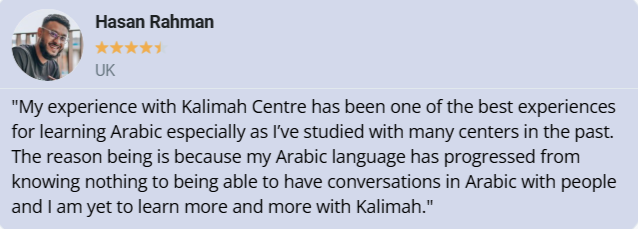
Don’t just take our word for it! Hear what othe students say:
Experience Kalimah Center Classes
Watch real excerpts from our live sessions at Kalimah Center and see how we bring learning to life. These clips highlight our interactive, student-centered teaching approach across all our courses—designed to keep learners engaged, motivated, and actively involved every step of the way.
Master Arabic with Kalimah Center
Join our expert-led online classes and start your journey toward Arabic fluency today.
Book Your Free TrialTypes of Verbal Sentences in Arabic Based on the Verb’s Tense
In Arabic, the verb’s tense (زمن الفعل) plays an important role in determining the structure of the verbal sentence. Arabic verbs are divided into three main tenses: Past (الماضي), Present (المضارع), and Command (الأمر).
1. Past Tense Verbal Sentences in Arabic
The past tense (الفعل الماضي) indicates actions that happened and were completed in the past. The past tense in Arabic is always fixed in form (مبني), and its endings change depending on the pronouns attached.
سافرَ خالدٌ إلى مكة
Khalid traveled to Mecca.
The verb سافرَ (Safara – He traveled) is in the past tense, and it is followed by the subject خالدٌ (Khalid) and the prepositional phrase إلى مكة (to Mecca).
2. Present Tense Verbal Sentences in Arabic
The present tense (الفعل المضارع) expresses actions that are happening now or will happen in the near future. Unlike the past tense, the present tense is flexible in form (معرب) and changes depending on the case markers.
يدرسُ أحمدُ اللغةَ العربيةَ
Ahmed is studying the Arabic language.
3. Command Verbal Sentences in Arabic
The command tense (فعل الأمر) is used to give instructions or requests. It is always fixed in form (مبني) and requires the subject to be implied rather than explicitly stated.
افعلْ الخيرَ دائماً
Do good always.
The verb افعلْ (If’al – Do) encourages action with the hidden subject implied.
Types of the Subject (الفاعل – al-fā’il) in Arabic Verbal Sentences
There are three main forms of the subject (الفاعل – al-fā’il) in Arabic:
1. The Subject as an Explicit Noun (اسم ظاهر)
This is when the subject is a clear, visible noun in the sentence. It is easy to recognize and typically marked with a ḍamma (ـُ) when singular.
كتبَ المعلمُ الدرسَ
(The teacher wrote the lesson)
The subject المعلمُ (al-mu’allimu) is clear and carries the visible ḍamma, showing it is the one who did the action.
2. The Subject as an Attached Pronoun (ضمير متصل)
Sometimes, the subject is not a visible noun but an attached pronoun directly linked to the verb. These pronouns are part of the verb form and show who performed the action.
Types of Attached Pronouns:
التاء المتحركة (al-Tā’ al-Mutaharrika)
قرأتُ القرآنَ
(I recited Quran)
Here, تُ (tu) is the attached pronoun, meaning “I,” and it acts as the subject.

نون النسوة (Nūn an-Niswah)
يَطبُخنَ الطّعامَ
(They (females) cook food)
نون النسوة (na) is the subject referring to a group of women.

نا الفاعلية (Nā al-Fā’iliyyah)
سمعنا وأطعنا
(We hear and we obey)
The pronoun نا (nā) means “we” and serves as the subject.

ياء المخاطبة (Yā’ al-Mukhāṭabah)
اكتبي درسكِ
(Write your lesson)
The pronoun ياء (yā) indicates “you” (feminine singular) as the subject.
3. The Subject as a Hidden Pronoun (ضمير مستتر)
In some cases, the subject is not visible but implied within the verb. This is called a hidden pronoun (ضمير مستتر). We infer its presence based on the verb and the context of the sentence.
أدرسُ العربية
(I study Arabic)
The subject here is I (أنا), but it is not written. It is understood from the verb أدرسُ (Adrusu).

Types of the Object (المفعول به – al-maf’ūl bih) in Arabic Verbal Sentences
Objects in Arabic take different forms, and understanding them helps in both reading and creating sentences. Let’s look at the main types.
1. The Object as an Explicit Noun (اسم ظاهر)
This is when the object is a clear and visible noun in the sentence, separate from the verb.
شربَ الرجلُ القهوةَ
(The man drank the coffee)
Here, القهوةَ (al-qahwah) is the object because it is the thing being drunk. It is an explicit noun in the accusative case, marked by the fatha (ـَ).
2. The Object as an Attached Pronoun (ضمير متصل)
Sometimes, the object is not a full noun but a pronoun attached to the verb. These pronouns simplify the sentence and make it more natural in daily speech.
Types of Attached Pronouns:
- الهاء (Hā’)
جعلتُهُ يدخل المسابقة
(I made him enter the competition)
Here, هُ (hu) is the object pronoun, meaning “him,” and it is attached to the verb جعلتُ (ja‘altu).
- الكاف (Kāf)
كافأك المديرُ على مجهودك
(The manager rewarded you for your efforts)
The pronoun ك (ka), meaning “you,” is the object here.
- نا المفعوليّة (Nā al-maf‘ūliyyah)
أدخلنا الأستاذ
(The professor let us in)
The pronoun نا (nā), meaning “us,” serves as the object.

- ياء المتكلم (Yā’ al-mutakallim)
علّمني والدي السباحة
(My father taught me swimming)
ياء (yā), meaning “me,” is the object here.
Nominal vs. Verbal Sentences (الجملة الاسمية والجملة الفعلية)
Now, let’s compare verbal sentences with their close cousins, nominal sentences (الجملة الاسمية – al-jumla al-ismiyya). Here’s a handy table to highlight the key differences:
| Verbal Sentence (الجملة الفعلية) | Nominal Sentence (الجملة الاسمية) | |
| Starts with | Verb (فعل) | Noun or pronoun (اسم أو ضمير) |
| Focus | Action | State of being |
| Example | ذهب الولد (The boy went.) | الولدُ سعيدٌ (The boy is happy.) |
Master Arabic with Kalimah Center
Join our expert-led online classes and start your journey toward Arabic fluency today.
Book Your Free TrialInside Kalimah Center: Moments from Our Courses
Get a glimpse into the vibrant learning experience at Kalimah Center. These snapshots capture real moments from our live classes—where students engage deeply, connect with passionate instructors, and grow in a welcoming, supportive environment.
Here Are The Reviews On Our Courses:
Our students frequently commend the excellence of our courses and the commitment shown by our instructors. You can read their complete reviews on Trustpilot.

Why Learn About Verbal Sentences at Kalimah Center?
To truly understand how verbal sentences work, you need to hear them, use them, and get feedback from experts.
Our online Arabic courses offer a unique blend of theory and practice, taking you from basic concepts to confident communication:
- Our curriculum guides you through the details of Arabic grammar, including verb conjugation, sentence structure, and different sentence types.
- Engage with dynamic activities that reinforce your understanding of verbal sentences and help you apply your knowledge.
- Our experienced instructors provide personalized guidance and feedback, ensuring you grasp the nuances of Arabic grammar.

And consider joining our group Arabic classes
- Speak more confidently: Get plenty of speaking practice in a supportive environment.
- Learn from the best: Our teachers are native Arabic speakers with a passion for teaching.
- Save money: Group classes are 4x cheaper than private lessons.
- Connect with others: Meet fellow learners from around the world.
📚 Explore Our Courses:
Online Arabic Course: Tailored to your level, our comprehensive Arabic program includes 16 teaching levels and 400+ hours of personalized sessions.
Online Quran With Tajweed Course: Perfect for non-Arabic speakers, our course spans 13 levels and equips you with Tajweed mastery from beginner to advanced.
Online Arabic Course For Kids: Nurture your child’s love for Arabic with our engaging and structured program, available in 24 levels for primary, intermediate, and secondary stages.
🚀 Start Your Free Trial Today! 🚀
Don’t miss out on this life-changing opportunity to deepen your faith and knowledge. Sign up now for your free trial and take the first step towards becoming a better practicing Muslim with Kalimah Center!
Conclusion:
In Arabic, a verbal sentence (الجملة الفعلية) begins with a verb (فعل) and is followed by a subject (فاعل), and sometimes an object (مفعول به) if the verb is transitive. The verb is the core of the sentence, driving the action, while the subject is the doer.
A key distinction in Arabic is whether the verb is intransitive (لازم), requiring only a subject, or transitive (متعدّي), which needs both a subject and an object to complete its meaning. For example, “نامَ الطفلُ” (The child slept) uses an intransitive verb, while “قرأَ الطالبُ الكتابَ” (The student read the book) uses a transitive verb.
Arabic verbal sentences also differ based on the verb’s tense (past, present, or command). The past tense (الماضي) denotes completed actions, the present tense (المضارع) describes ongoing or future actions, and the command form (فعل الأمر) gives instructions or requests.
The subject can be an explicit noun (اسم ظاهر), an attached pronoun (ضمير متصل), or a hidden pronoun (ضمير مستتر) depending on the context. Similarly, objects may appear as explicit nouns or attached pronouns, adding layers of meaning to the sentence. These structures are crucial for mastering Arabic sentence construction, offering flexibility in expressing actions and relationships.
FAQs about Verbal Sentences in Arabic
Q1: What is a verbal sentence in Arabic?
An Arabic verbal sentence (الجملة الفعلية – al-jumla al-fi’liyyah) is a sentence structure that always begins with a verb (fi’l). It is fundamentally driven by an action and is followed by a subject (fā’il) and occasionally an object (maf’ūl bih) depending on the verb’s transitivity.
Q2: What are the main components of an Arabic verbal sentence?
The core components of an Arabic verbal sentence are the verb (الفعل – al-fi’l), which drives the action, and the subject (الفاعل – al-fā’il), which is the doer of the action. A third component, the object (المفعول به – al-maf’ūl bih), is only required if the verb is transitive.
Q3: What is the difference between transitive and intransitive verbs in Arabic?
In Arabic grammar, an intransitive verb (لازم – lazim) requires only a subject to form a complete meaning (e.g., “نامَ الطفلُ” – The child slept). A transitive verb (متعدّي – muta’addi) must transfer its action to an object to complete its meaning (e.g., “قرأَ خالدٌ القرآنَ” – Khalid recited the Quran).
Q4: What are the three types of subjects (Fā’il) in Arabic grammar?
The subject (الفاعل – al-fā’il) in an Arabic verbal sentence can take three distinct forms:
Explicit Noun (ism ẓāhir): A visible noun, usually marked with a ḍamma.
Attached Pronoun (ḍamīr muttaṣil): A pronoun directly linked to the verb suffix.
Hidden Pronoun (ḍamīr mustatir): An unwritten pronoun implied by the verb’s context.
Q5: How do Arabic verbal sentences change based on verb tense?
Arabic verbal sentences alter their structure across three tenses: the Past Tense (al-māḍī), representing completed actions with a fixed form; the Present Tense (al-muḍāri’), showing ongoing or future actions with flexible case markers; and the Command Tense (fi’l al-amr), used for requests, which features an implied hidden subject.