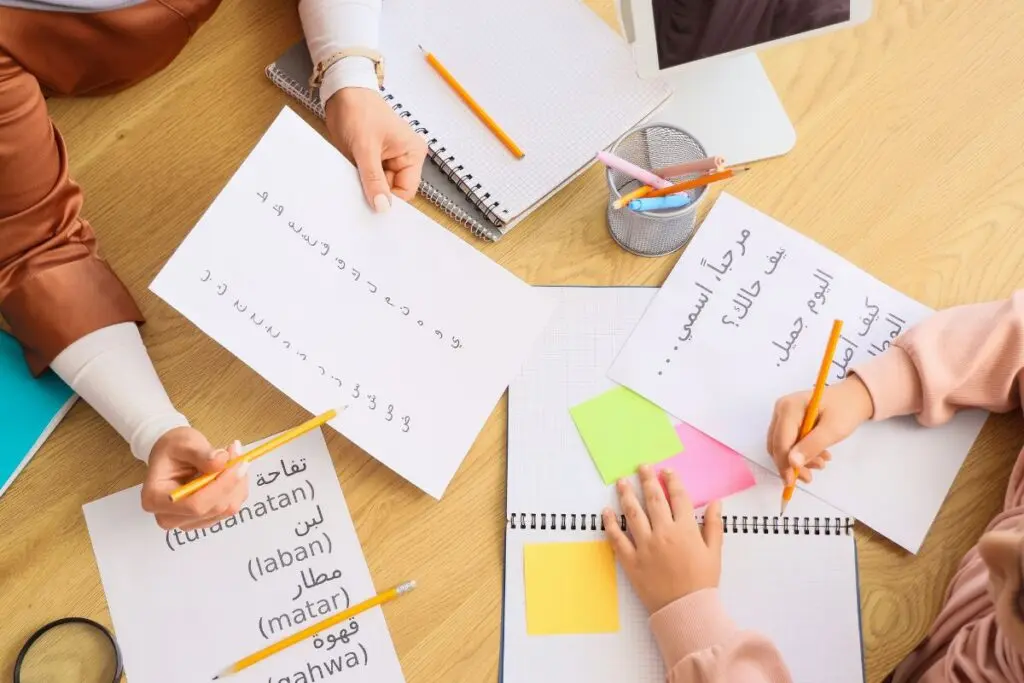
Mastering the Arabic alphabet requires three types of practice tools: charts (to understand letter shapes and positional forms), worksheets (to practice writing and connecting letters), and test sheets (to assess retention). All free downloadable PDFs for each category are linked below.
The 28 Arabic letters each have up to four positional forms (isolated, initial, medial, final) — which is why alphabet exercise materials need to cover all four positions, not just isolated letter recognition.
✅ Free Resource Quick Reference Table:
📍 Placement: Immediately after AI Overview — this is the article’s most important addition.
| Resource | Type | Level | PDF? | Best For |
|---|---|---|---|---|
| Arabic Alphabet Chart — All 28 Letters | Chart | All | Quick letter reference | |
| Arabic Alphabet Positional Forms Chart | Chart | Beginner | Beginning/middle/end forms | |
| Arabic Alphabet Pronunciation Chart | Chart | Beginner | Letter sounds | |
| Arabic Letter Tracing Worksheets | Worksheet | Absolute beginner | First letter writing | |
| Connecting Letters Practice Sheets | Worksheet | Beginner | Joining letters in words | |
| Arabic Alphabet Test Sheet | Test | Beginner | Self-assessment | |
| Kindergarten Arabic Worksheets | Worksheet | Kids 4–6 | Young learners | |
| Grade 1 Arabic Worksheets | Worksheet | Kids 6–7 | School-level practice | |
| Grade 2 Arabic Worksheets | Worksheet | Kids 7–8 | Advanced letter practice | |
| Missing Letters Worksheets | Exercise | Beginner | Fill-in-the-blank | |
| Arabic Alphabet Matching Exercises | Exercise | Beginner | Letter recognition |
When you start learning Arabic, the first step is the alphabet. We at Kalimah have seen many students struggle at the beginning. But don’t worry! With the right exercises, worksheets, and charts, you can learn the Arabic alphabet easily.
In this article, I will share with you some exercises, worksheets, and charts that can help you master the Arabic alphabet. These tools are like the keys to unlocking the door to the beautiful Arabic language. Let’s start this journey together!
How to Practice the Arabic Alphabet: A Step-by-Step Method
Here, I will help you exercise the Arabic alphabet, step by step. We will start with the letters chart, then practice writing them. Soon, you will be connecting letters to make words! Ready? Yalla, let’s begin!
Step 1: Start with the Basics—The Alphabet Chart
The first step in learning the Arabic alphabet is familiarizing yourself with the letters and their pronunciations. An Arabic alphabet chart is an excellent tool for this. These charts typically display each letter along with its different forms and provide pronunciation guides.
For instance, take a look at the letter “ج” (jeem). On the chart, you’ll see:
- Beginning: جـ
- Middle: ـجـ
- End: ـج
Tip: As you review the chart, try to say the sound of each letter out loud. This will help reinforce your memory and improve your pronunciation.

Step 2: Practice with Arabic Letter Worksheets—Forming Letters
Once you’re comfortable with the alphabet chart, it’s time to start writing. Arabic alphabet worksheets are designed to help you practice forming each letter correctly. These worksheets usually feature dotted lines that guide you in tracing the letters.
For example, a worksheet might have the letter “س” (seen) repeated several times, with dotted outlines for you to trace. As you trace, focus on the direction of your strokes and the shape of the letter. Practice makes perfect, so don’t be discouraged if it takes time to get the letters just right.

Step 3: Writing Words—Connecting the Dots
Now that you know how to form individual letters, the next step is to practice connecting them to form words. This is where Arabic alphabet practice sheets come in. These sheets often provide simple words or phrases for you to practice writing.
Let’s try the word “كتاب” (kitaab), which means “book.” Notice how the letters connect:
- كـ (kaaf) at the beginning
- تـ (taa) in the middle
- ا (alif)
- and بـ (baa) at the end
As you write, pay attention to how each letter changes its form depending on its position. Practice writing the word multiple times until you feel comfortable with the flow of the script.
Step 4: Test Your Knowledge—Arabic Alphabet Test Sheets
After practicing for a while, it’s important to test your knowledge. Arabic alphabet test sheets are designed to assess how well you’ve learned the letters and their different forms. These test sheets might ask you to identify letters in different positions or to write out entire words from memory.
For example, a test sheet might show you the letter “ن” (noon) and ask you to write it in the beginning, middle, and end positions. This helps reinforce your understanding and highlights areas where you might need more practice.

Experience Kalimah Center Classes
Watch real excerpts from our live sessions at Kalimah Center and see how we bring learning to life. These clips highlight our interactive, student-centered teaching approach across all our courses—designed to keep learners engaged, motivated, and actively involved every step of the way.
Arabic Alphabet Charts: Pronunciation, Positional Forms, and All 28 Letters
An Arabic alphabet chart is like a map of the alphabet. It shows you each letter in all its forms—isolated, beginning, middle, and end. This visual guide is essential for learners who are new to the script.
Some charts also include pronunciation guides. For example, next to the letter ق (Qaf), you might see /q/ to remind you of its sound. A good chart will help you quickly recognize letters and their positions in words.
Arabic Alphabet Chart with Pronunciation
An Arabic alphabet chart with pronunciation is particularly useful for beginners. It helps you associate each letter with its correct sound, which is crucial for developing good pronunciation habits from the start.
This is very helpful because some Arabic sounds don’t exist in English. For example, the letter خ (Khaa) sounds like /kh/, which is not common in English. A pronunciation guide will help you learn these sounds correctly from the start.
Example Chart:
- د (Dal) – /d/
- ذ (Dhal) – /dh/
- ر (Raa) – /r/
Use this chart to practice saying the letters aloud, focusing on the correct pronunciation.

Arabic Alphabet Beginning, Middle, and End: Complete Positional Forms
Every Arabic letter has up to four forms depending on its position in a word. Understanding these forms is the key to reading connected Arabic text. Six letters (ا، د، ذ، ر، ز، و) only have two forms — they do not connect to the following letter.
Complete Positional Forms — All 28 Letters:
| Letter | Name | Isolated | Initial | Medial | Final | Connects to Next? |
|---|---|---|---|---|---|---|
| ا | Alif | ا | ا | ـا | ـا | ❌ No |
| ب | Baa | ب | بـ | ـبـ | ـب | ✅ Yes |
| ت | Taa | ت | تـ | ـتـ | ـت | ✅ Yes |
| ث | Thaa | ث | ثـ | ـثـ | ـث | ✅ Yes |
| ج | Jeem | ج | جـ | ـجـ | ـج | ✅ Yes |
| ح | Haa | ح | حـ | ـحـ | ـح | ✅ Yes |
| خ | Khaa | خ | خـ | ـخـ | ـخ | ✅ Yes |
| د | Daal | د | د | ـد | ـد | ❌ No |
| ذ | Dhaal | ذ | ذ | ـذ | ـذ | ❌ No |
| ر | Raa | ر | ر | ـر | ـر | ❌ No |
| ز | Zaay | ز | ز | ـز | ـز | ❌ No |
| س | Seen | س | سـ | ـسـ | ـس | ✅ Yes |
| ش | Sheen | ش | شـ | ـشـ | ـش | ✅ Yes |
| ص | Saad | ص | صـ | ـصـ | ـص | ✅ Yes |
| ض | Daad | ض | ضـ | ـضـ | ـض | ✅ Yes |
| ط | Taa | ط | طـ | ـطـ | ـط | ✅ Yes |
| ظ | Dhaa | ظ | ظـ | ـظـ | ـظ | ✅ Yes |
| ع | Ayn | ع | عـ | ـعـ | ـع | ✅ Yes |
| غ | Ghayn | غ | غـ | ـغـ | ـغ | ✅ Yes |
| ف | Faa | ف | فـ | ـفـ | ـف | ✅ Yes |
| ق | Qaaf | ق | قـ | ـقـ | ـق | ✅ Yes |
| ك | Kaaf | ك | كـ | ـكـ | ـك | ✅ Yes |
| ل | Laam | ل | لـ | ـلـ | ـل | ✅ Yes |
| م | Meem | م | مـ | ـمـ | ـم | ✅ Yes |
| ن | Noon | ن | نـ | ـنـ | ـن | ✅ Yes |
| هـ | Haa | هـ | هـ | ـهـ | ـه | ✅ Yes |
| و | Waw | و | و | ـو | ـو | ❌ No |
| ي | Yaa | ي | يـ | ـيـ | ـي | ✅ Yes |
🔗 [Download Positional Forms Chart PDF →]

Read Also: Arabic Alphabet for Kids
Arabic Connecting Letters Worksheets: Practice Joining Arabic Letters
Learning to connect Arabic letters is the bridge between knowing the alphabet and reading actual Arabic. This is where most beginners face their biggest challenge — letters change shape when connected, and six letters (ا، د، ذ، ر، ز، و) break the flow by not connecting to the following letter.
The 6 Non-Connecting Letters:
| Letter | Name | Why It Matters |
|---|---|---|
| ا | Alif | Most common letter — every time it appears, it breaks the connection |
| د | Daal | Appears frequently in everyday Arabic words |
| ذ | Dhaal | Same shape as Daal + dot |
| ر | Raa | Appears in nearly every Arabic text |
| ز | Zaay | Same shape as Raa + dot |
| و | Waw | Also functions as a long vowel |
Connecting Letters Practice — Progressive Exercises:
Level 1 — Two Connected Letters:
بَا (ba + alif) → ما (ma + alif) → سَا (sa + alif)
Level 2 — Three Letter Words:
بَاب (bab — door) → كتب (kataba — he wrote) → سلم (salim — safe)
Level 3 — With Non-Connecting Letters:
وَلَد (walad — boy) → كِتَاب (kitaab — book) → مَدرَسَة (madrasa — school)
Level 4 — Short Sentences:
هَذَا كِتَاب (hadha kitaab — this is a book)
أَنَا طَالِب (ana taalib — I am a student)
Practice These Exercises With a Native Arabic Teacher — First Lesson Free
Worksheets and exercises give you the practice framework. A qualified native Arabic teacher gives you the feedback that tells you whether your letter forms are correct, your connections are smooth, and your pronunciation is accurate.
Kalimah Center’s free trial lesson uses the same structured approach — moving from individual letters to connected words to simple sentences — with a teacher who sees your writing in real time.
Master Arabic with Kalimah Center
Join our expert-led online classes and start your journey toward Arabic fluency today.
Book Your Free TrialFree Arabic Alphabet Worksheets: Tracing, Writing, and Connecting Letters
Arabic alphabet learners come from different backgrounds and have varying levels of experience with the Arabic language. That’s why Arabic alphabet worksheets should be tailored to meet the needs of all learners—from beginners to advanced.
For example, we are going to focus here on the worksheets for kindergarten.
Worksheets for Kindergarten
For our youngest learners, we offer Arabic letters worksheets for kindergarten. These worksheets are simple and fun, with colorful illustrations and large, easy-to-trace letters. They’re designed to make learning the Arabic alphabet an enjoyable experience for children.
Imagine your little one tracing the letter “م” (meem) on a worksheet with a picture of a “موز” (mawz), which means “banana.” This combination of visual aids and hands-on practice helps children associate the letters with words and objects, making the learning process more engaging.
I want to tell you about some great worksheets for teaching Arabic letters to your young students. They are full of colors and fun activities to help children learn their letters.
1. Coloring and Writing Practice Worksheet
These FREE worksheets have all the letters from Alif to Yaa, and each one has a picture to color. This helps children remember the letter and connect it to a word they know. They can also practice writing the letter, which is important for early literacy skills.
- Give each child a worksheet and some crayons.
- Talk about the letter on the worksheet and the picture that goes with it.
- Encourage them to color the picture neatly and then trace and write the letter.
- You can use these worksheets for individual work, group activities, or even homework.

2. “I’m Looking for the Letter Worksheet”
This activity is super fun and helps children connect letters to words and pictures. Here’s how it works:
- Each page has a big picture and lots of little circles with letters inside.
- Children look at the picture and think about the letter that makes its first sound.
- They find that letter in the circles and color it in.
- They can also count how many times they find the letter and cross out the other letters that aren’t the right one.
This worksheet is great because:
- It helps children recognize letters and their sounds.
- It makes them think about the beginning sounds of words.
- It’s interactive and keeps them engaged.
- It helps them practice fine motor skills like coloring and crossing out.

Arabic Alphabet Worksheets for Grade 1 and Grade 2
As children move beyond basic letter recognition into formal reading and writing, worksheet complexity should increase progressively.
Grade 1 Arabic Worksheets (Ages 6–7):
At Grade 1 level, children are ready to:
- Recognise all 28 letters in all four positional forms
- Write letters in connected words
- Read simple 2–3 letter words with harakat
- Begin filling in missing letters in familiar words
Grade 1 Practice Activities:
| Activity | Description |
|---|---|
| Missing letter fill-in | كـ_اب (kitaab) — fill in the missing ت |
| Letter ordering | Rearrange letters to form a word |
| Word matching | Match Arabic word to its English meaning |
| Short sentence copying | Copy simple sentences correctly |
Grade 2 Arabic Worksheets (Ages 7–8):
At Grade 2 level, children are ready to:
- Read short vowelled sentences fluently
- Write words from dictation
- Identify letters in context (middle of words, non-connecting positions)
- Begin working with simple unvowelled text
Grade 2 Practice Activities:
| Activity | Description |
|---|---|
| Sentence dictation | Teacher says word, child writes it |
| Letter grouping | Sort letters by connecting/non-connecting |
| Word classification | Group words by first letter |
| Short reading comprehension | Read 2–3 sentences, answer questions |
Beyond the Basics: Advanced Exercises and Practice Sheets
As you progress in your Arabic studies, you’ll want to challenge yourself with more advanced exercises. This is where our Arabic alphabet practice sheets come into play. These sheets are designed to push you beyond the basics, encouraging you to write more complex words and even short paragraphs.
Practicing Sentences
One of the best ways to solidify your knowledge is by practicing full sentences. For example, try writing the sentence: “أحب اللغة العربية” (uhibbu al-lughah al-arabiyyah), which means “I love the Arabic language.” As you write, focus on the flow of the script and the connection between the letters.
Arabic Alphabet Practice Sheets
Practice makes perfect, they say. Arabic alphabet practice sheets are great for this. These sheets focus on drilling each letter until you’re comfortable with its shape, sound, and connection to other letters.
For example, practice sheets for beginners might focus on tracing the letter ك (Kaf) and then gradually move on to writing it independently and in words like كتاب (kitaab), which means “book.” The more you practice, the more natural it will become.
Example Practice Sheet:
- Trace the letter س (Seen).
- Then write it in a word: سلام (salaam), which means “peace.”
- س – سل – سلام
Here, I recommend these FREE “Arabic Alphabet Tracing & Write Worksheets” by My Resouce Startion.
These worksheets are very good for beginners. They have tracing lines for each letter, so you can learn the shape slowly. Then, there is space to write the letter by yourself, with lines to help you make it look nice.
This is like training wheels for your hand! You start with help, and then you can write alone.
These worksheets are perfect for practice. You can practice each letter many times until you know it well – its shape, its sound, and how it connects to other letters.

Arabic Alphabet Test Sheets: Assess Your Knowledge
Once you’ve practiced, it’s time to test your knowledge. Test sheets help you see how much you’ve learned and what areas you need to focus on. They can include a mix of exercises, such as identifying letters, filling in the blanks, or writing words from memory.
A good test might ask you to write all the forms of a specific letter in different words. For example, the letter م (Meem) looks different in the beginning of a word (مــ), in the middle (ــمــ), and at the end (ــم). Testing your ability to use these forms correctly is key to mastering the alphabet.
Example Test Question:
- Write the letter ع (Ain) in the following words:
- ع_مال (Answer: عمال – ummal, meaning “workers”).
- م_لم (Answer: معلم – mu’allim, meaning “teacher”).
And here are some test sheets, such as writing the missing letter:

Or arranging the letters:

Or matching letters to their correct forms:

Master Arabic with Kalimah Center
Join our expert-led online classes and start your journey toward Arabic fluency today.
Book Your Free TrialInside Kalimah Center: Moments from Our Courses
Get a glimpse into the vibrant learning experience at Kalimah Center. These snapshots capture real moments from our live classes—where students engage deeply, connect with passionate instructors, and grow in a welcoming, supportive environment.
Here Are The Reviews On Our Arabic Courses:
Our students frequently commend the excellence of our courses and the commitment shown by our instructors. You can read their complete reviews on Trustpilot.

Finished the exercises? Feeling good, but maybe a little unsure? That’s normal!
Practice makes perfect, but practice needs to be smart practice.
That’s where our online Arabic course for adults and our Arabic course for kids come in. We don’t just give you more worksheets. We build your confidence from the ground up, just like the ‘Iqraa’ book teaches.
You will be able to:
- Read Arabic words smoothly, even with the trickiest vowel marks
- Write those letters beautifully, without needing to look them up every time
- Understand your teacher’s instructions easily, like you’ve known Arabic for years!
Sound impossible? It’s not. our course takes you through Levels 1 & 2, step-by-step. You’ll even learn key words to use in class, so you can participate actively.
Ready to turn those exercises into real Arabic skills? Get your FREE lesson now and let’s get started!

And consider Kalimah’s Intensive Group Classes
Connect, collaborate, and learn Arabic with expert teachers, dynamic materials, and fellow learners worldwide. Join Now for Faster Progress, Affordable Learning, & a Global Community.
Conclusion
Mastering the Arabic alphabet requires four distinct practice tools working together:
| Tool | Purpose | When to Use |
|---|---|---|
| Chart | Learn the letter and its forms | Before writing practice |
| Tracing worksheet | Develop muscle memory | First 1–2 weeks |
| Connecting letters sheet | Build word-level reading | Weeks 2–4 |
| Test sheet | Identify gaps and measure progress | End of each week |
The free PDFs in this article cover all four types — for beginners, kindergarten learners, Grade 1 and Grade 2 students, and adults. Download the ones that match your level and practice daily.
Fifteen minutes of structured worksheet practice daily produces measurable improvement within two weeks. Thirty minutes with a qualified teacher once per week produces fluency.
FAQs about Arabic Alphabet Worksheets
Q1: Where can I find free Arabic alphabet worksheets PDF to download?
Free Arabic alphabet worksheets in PDF format are available directly from this article — see the download links in the “Free Arabic Alphabet Worksheets PDF” section above. Resources include tracing worksheets for all 28 letters, positional forms charts, connecting letters practice sheets, test sheets, and kindergarten and Grade 1 specific worksheets. All are free to download and print without registration.
Q2: What is the difference between Arabic alphabet charts and worksheets?
Charts are reference tools — they show you what each letter looks like in all its forms (isolated, initial, medial, final), what sounds they make, and how they compare to each other. You read a chart but you practise with it passively. Worksheets are practice tools — they require active writing, tracing, or filling-in-blanks. The most effective alphabet learning combines both: use the chart to learn the letter, use the worksheet to practise it. See the step-by-step method above.
Q3: What Arabic alphabet worksheets are best for Grade 1 students?
Grade 1 students (ages 6–7) are typically ready for: missing letter fill-in worksheets (write the letter that completes the word), letter ordering exercises (rearrange letters to form words), word-to-meaning matching, and simple sentence copying. They should be comfortable with isolated letter recognition before moving to positional forms, and positional forms before attempting word formation. See the Grade 1 worksheet section above for specific activities and downloadable PDFs.
Q4: How do I practice Arabic letters in their beginning, middle, and end forms?
The most effective practice method is: (1) study the positional forms chart above to see all four forms of each letter, (2) write each letter in all four positions in your notebook — isolated, initial, medial, final, (3) find one example word for each position, (4) practice the connecting letters worksheet to see how positional forms work in real words. The complete positional forms table is in this article — download the PDF version for offline practice.
Q5: What is the best Arabic alphabet chart for beginners?
For absolute beginners, the most useful chart is the Arabic alphabet pronunciation chart — showing all 28 letters with their English sound equivalents. This allows you to associate each letter’s written form with its sound simultaneously. Once pronunciation is understood, the positional forms chart (showing initial/medial/final forms) becomes the most important reference. Both charts are available as free downloadable PDFs from this article.