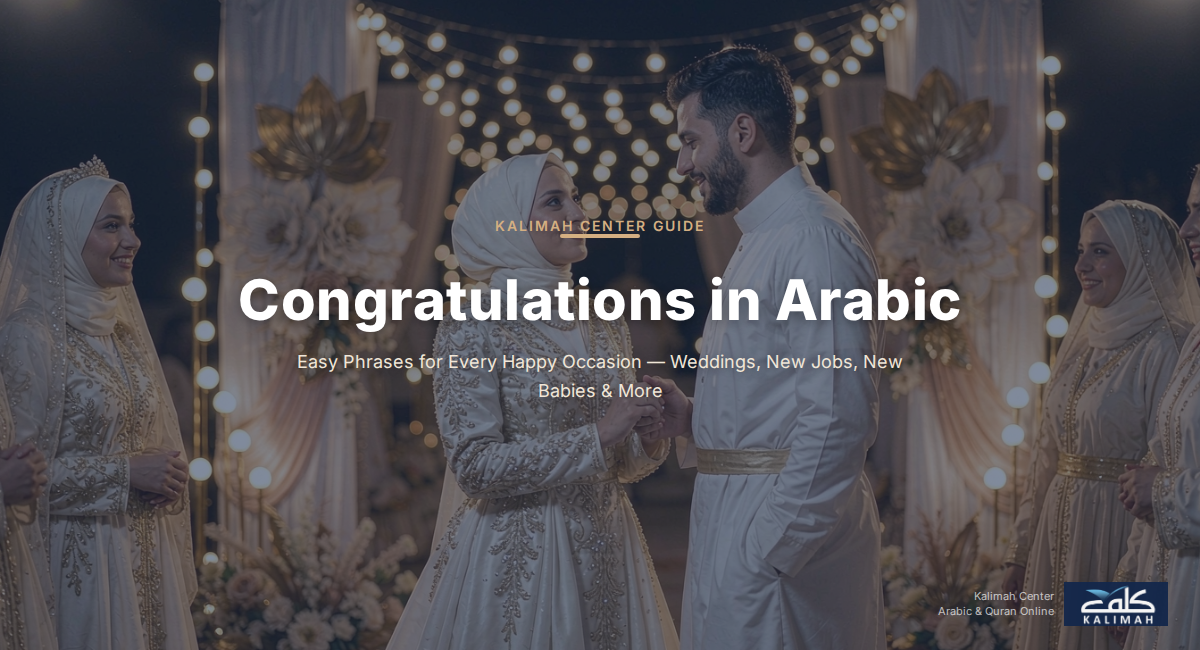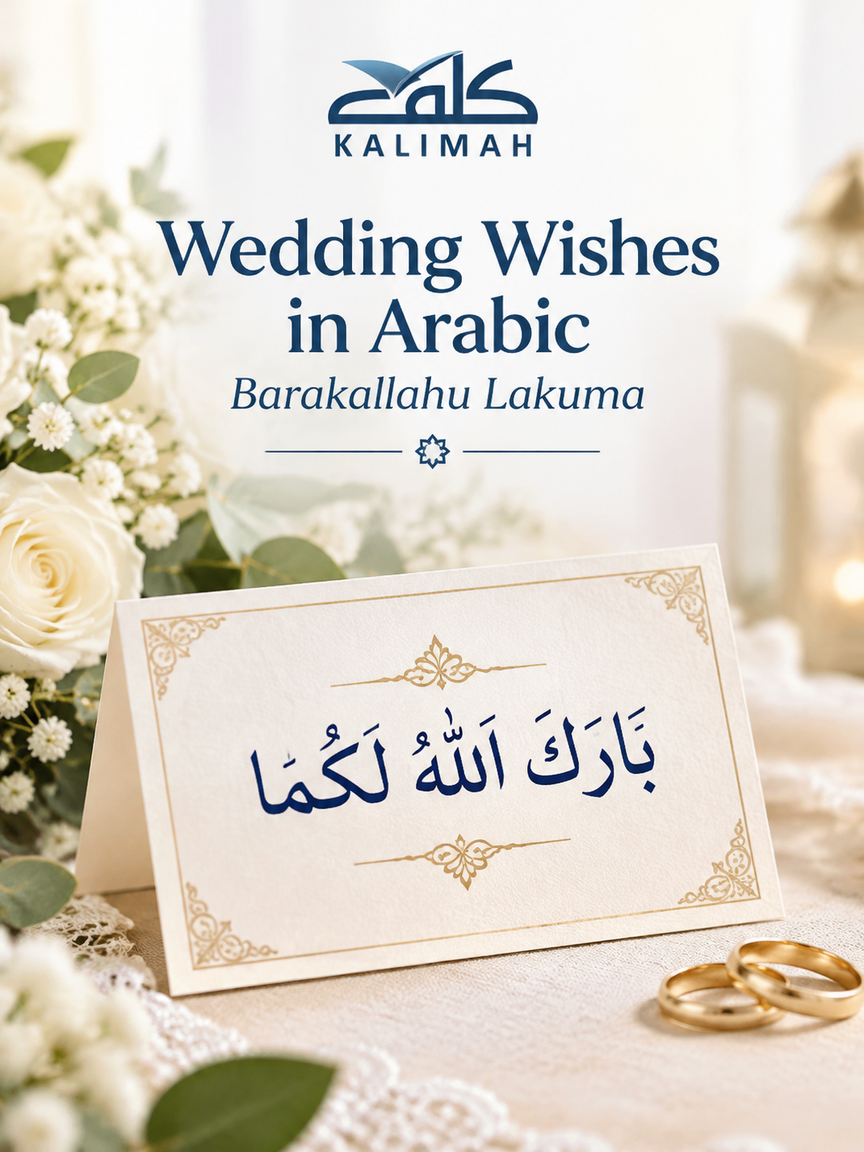
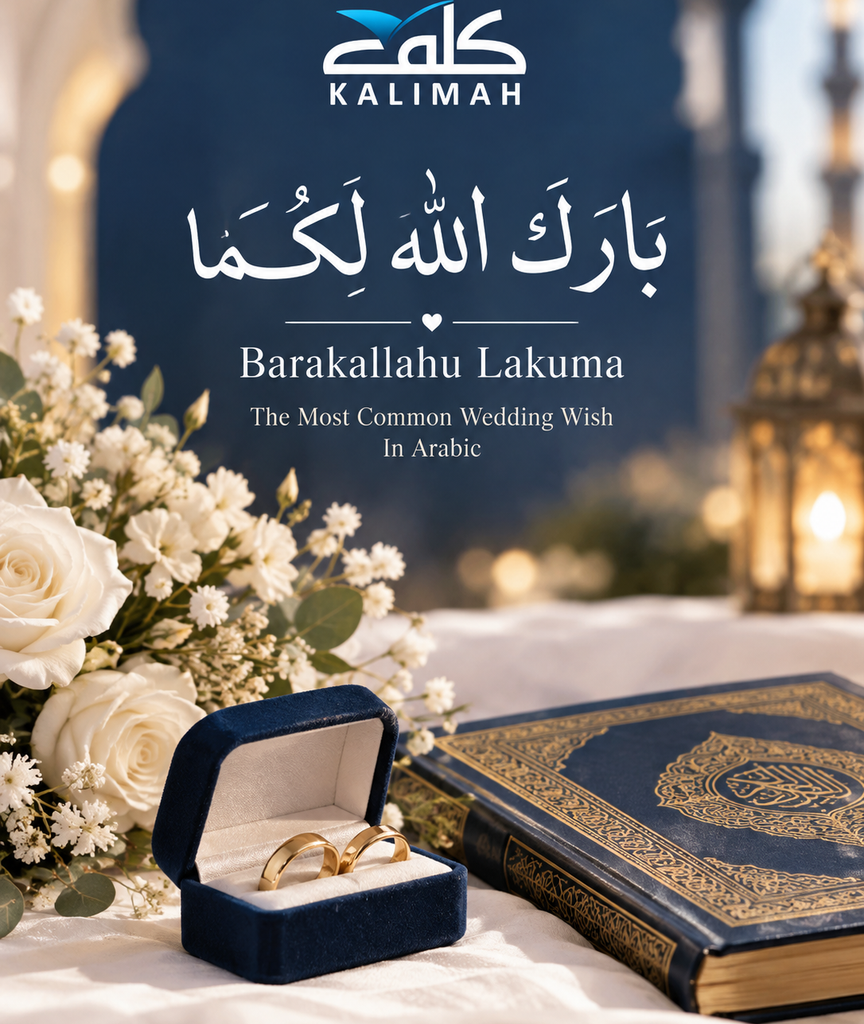
You’re at the wedding, the couple walks over, and you want to say more than “congrats.” In Arabic, the words most people reach for are بَارَكَ اللهُ لَكُمَا وَبَارَكَ عَلَيْكُمَا وَجَمَعَ بَيْنَكُمَا فِي خَيْرٍ (Bārakallāhu lakumā wa bāraka ʿalaykumā wa jamaʿa baynakumā fī khayr).
It means “May Allah bless you both, send His blessings upon you both, and bring you both together in goodness.”
This is the dua the Prophet ﷺ said to a man who had just married. More than 1,400 years later, it’s still the first thing many people say to a new couple, from Cairo to London.
The tricky part is that the words change slightly depending on who you’re talking to. A groom, a bride, and a couple each get their own form.
Below, you’ll find the right form for each one, along with messages you can copy, dialect greetings, and what to say back when the wishes come to you.
What you’ll learn in this article
- The meaning of Barakallahu lakumā, one word at a time.
- How the dua changes for a groom, a bride, a couple, or a group.
- Which wish fits a WhatsApp message, a card, a speech, or an email.
- Ready messages you can copy for friends, family, and coworkers.
- Kind wishes for every couple, plus how to reply when people congratulate you.
Barakallahu Lakuma: The Most Common Wedding Wish In Arabic
Barakallahu lakumā is a dua. A dua is a short prayer you say for someone else. Below, you will learn what it means, how to change it for different people, and where it comes from.
What Does Barakallahu Lakuma Mean, Word By Word?
The dua has five small parts. Each part asks for something different, so it means more than a simple “congrats.”
| Arabic | How to Say It | Meaning |
| بَارَكَ اللهُ | Bārakallāhu | May Allah bless |
| لَكُمَا | lakumā | for you both |
| وَبَارَكَ عَلَيْكُمَا | wa bāraka ʿalaykumā | and send blessings upon you both |
| وَجَمَعَ بَيْنَكُمَا | wa jamaʿa baynakumā | and bring you both together |
| فِي خَيْرٍ | fī khayr | in goodness |
First, what is baraka? It means good that grows and stays. When you ask Allah to bless a marriage, you ask for good that lasts.
Now look at lakumā and ʿalaykumā. They sound close, but they are not the same. Lakumā asks for good things for you. ʿAlaykumā asks for blessing to come down upon you.
Scholars explain it this way. The first part blesses the happy days. The second part keeps the blessing with you on hard days too.
The last part, jamaʿa baynakumā fī khayr, asks Allah to keep the two of you close. It also asks that your time together be full of good.
Laka, Laki, Lakuma, Or Lakum: Which One Should You Say?
All four forms are correct. The right one depends on who you are talking to.
Arabic changes the end of a word for a man, a woman, two people, or a group. It even has a special form for exactly two people, called the dual. You can learn more in The Dual Nouns in Arabic (Al-Muthanna).
The table below shows each form with the full dua. Pick the row that matches the person in front of you.
| Who You Are Talking To | Ending | Full Dua |
| The groom | laka / ʿalayka | بارك الله لكَ وبارك عليكَ وجمع بينكما في خير |
| The bride | laki / ʿalayki | بارك الله لكِ وبارك عليكِ وجمع بينكما في خير |
| The couple | lakumā / ʿalaykumā | بارك الله لكما وبارك عليكما وجمع بينكما في خير |
| A group, like the whole family | lakum / ʿalaykum | بارك الله لكم وبارك عليكم |
| Parents, talking about the couple | lahumā / ʿalayhimā | بارك الله لهما وبارك عليهما وجمع بينهما في خير |
Notice one thing. Baynakumā (“between you both”) never changes when you speak to the groom or bride alone. That is because marriage always joins two people.
Be careful not to mix forms. Barakallahu lakumā wa bāraka ʿalayka starts with “you both” and ends with “you, one man.” Pick one form and use it all the way through.
These little endings are hard to catch from a list. In the online Arabic course at Kalimah Center, a native tutor listens as you speak and fixes each ending on the spot. That way, your dua sounds right the first time you say it.
Master Arabic with Kalimah Center
Join our expert-led online classes and start your journey toward Arabic fluency today.
Book Your Free TrialWhere Does This Wedding Dua Come From?
This dua comes from the Sunnah. The Sunnah is what the Prophet ﷺ said and did. Abu Hurairah said that when a man got married, the Prophet ﷺ would greet him with this dua. You can read it in Sunan Abi Dawud 2130, Jami’ al-Tirmidhi 1091, and Sunan Ibn Majah 1905.
Two more wedding wishes come from the same time. The table shows all three, with a link to each source.
| Arabic | How to Say It | Meaning | Source |
| بارك الله لكَ وبارك عليكَ وجمع بينكما في خير | Bārakallāhu laka wa bāraka ʿalayka wa jamaʿa baynakumā fī khayr | May Allah bless you, send blessings upon you, and bring you both together in goodness | Abu Dawud 2130 |
| بارك الله لك، أولم ولو بشاة | Bārakallāhu lak, awlim wa law bi-shāh | May Allah bless you. Hold a wedding meal, even with one sheep | Sahih al-Bukhari 5155 |
| على الخير والبركة، وعلى خير طائر | ʿAlal-khayri wal-barakah, wa ʿalā khayri ṭāʾir | Upon goodness and blessing, and upon the best of luck | Sahih al-Bukhari 5156 |
The second wish was for Abdur-Rahman ibn Awf on his wedding. The third is what the women of Madinah said to Aisha when she came to her new home. Imam al-Bukhari put it under a chapter about the dua of the women who get the bride ready.
Three Kinds Of Arabic Wedding Wishes
Not every Arabic wedding wish is a prayer. Some are simple “congrats,” and some are old sayings passed down in families. Knowing the kind helps you pick the right words. The table sorts them into three groups.
| Kind | Example | Best Used For |
| Islamic dua | بارك الله لكما (Bārakallāhu lakumā) | Muslim couples and religious messages |
| General congrats | مبروك الزواج (Mabrūk az-zawāj) | Anyone, of any faith, in any setting |
| Old family blessing | بالرفاء والبنين (Bil-rafāʾ wal-banīn) | Older relatives in traditional families |
For most Muslim weddings, mix the first two. Say Alf mabrūk, then add Bārakallāhu lakumā. It is warm, simple, and always fits.
Which Wedding Wish To Use For Whatsapp, Card, Speech, Or Email
A line that feels warm in a text can feel stiff in a speech. Use the “Best For” column to match each wish to the place you will use it.
| Arabic | How to Say It | Meaning | Best For |
| ألف مبروك على زواجكما | Alf mabrūk ʿalā zawājikumā | A thousand congrats on your marriage | |
| تهانينا القلبية بمناسبة زواجكما | Tahānīnā al-qalbiyyah bi-munāsabati zawājikumā | Our warm congrats on your marriage | Card |
| بارك الله لكما وبارك عليكما وجمع بينكما في خير | Bārakallāhu lakumā wa bāraka ʿalaykumā wa jamaʿa baynakumā fī khayr | May Allah bless you both and bring you together in goodness | Islamic message |
| أسأل الله أن يجعل بينكما مودة ورحمة | Asʾalullāha an yajʿala baynakumā mawaddatan wa raḥmah | I ask Allah to put love and mercy between you | Speech |
| يسرني أن أهنئك بمناسبة زواجك | Yasurrunī an uhanniʾaka bi-munāsabati zawājik | I am happy to congratulate you on your marriage | Work email |
| زواج مبارك | Zawāj mubārak | A blessed marriage | Gift tag |
The speech line comes from the Quran. Surah Ar-Rum, verse 21 says Allah placed “love and mercy” between husband and wife. Guests know these words well, so they work great out loud.
Want more everyday phrases like these? See Learn Arabic Phrases and Sentences.
A quick look at learning with us
See how a live class works, from the teacher’s explanation to the student’s recitation. It’s a simple way to know what to expect before your first lesson.
Ready-To-Send Arabic Wedding Messages You Can Copy
A single phrase is nice. A full message feels more personal. Each one below is ready to send, with notes on what to change.
Short Messages For Whatsapp And Cards
Short messages work best when you are busy or the card is small. Here are two you can copy right now.
For WhatsApp:
ألف مبروك على زواجكما! بارك الله لكما وجمع بينكما في خير.
Alf mabrūk ʿalā zawājikumā! Bārakallāhu lakumā wa jamaʿa baynakumā fī khayr.
“A thousand congrats on your marriage! May Allah bless you both and bring you together in goodness.”
For a card:
تهانينا القلبية بمناسبة زواجكما، مع أطيب التمنيات بحياة سعيدة مليئة بالمودة والرحمة.
Tahānīnā al-qalbiyyah bi-munāsabati zawājikumā, maʿa aṭyab at-tamanniyāt bi-ḥayātin saʿīdatin malīʾatin bil-mawaddati war-raḥmah.
“Our warm congrats on your marriage. We wish you a happy life full of love and mercy.”
How long should a card be? Two or three short lines are enough. Write the couple’s names at the top. Then add one line only you could write, like how you met them. Small details like this are what people remember.
An Islamic Dua Message For A Muslim Couple
This message is a full prayer. It is a good choice for a religious family or a friend who loves the Sunnah.
بارك الله لكما وبارك عليكما وجمع بينكما في خير، وأسأل الله أن يجعل بينكما مودة ورحمة، وأن يرزقكما الذرية الصالحة.
Bārakallāhu lakumā wa bāraka ʿalaykumā wa jamaʿa baynakumā fī khayr, wa asʾalullāha an yajʿala baynakumā mawaddatan wa raḥmah, wa an yarzuqakumā adh-dhurriyyata aṣ-ṣāliḥah.
“May Allah bless you both, send blessings upon you, and bring you together in goodness. I ask Allah to put love and mercy between you and to give you good children.”
The message has three parts. First comes the Sunnah dua. Next comes a prayer for love and mercy. Last comes a prayer for good children.
Saying it out loud? Go slowly and pause after each part. It gives the couple time to take in each blessing. They will often answer Āmīn (آمين) after you finish.
You can also send it as a voice note. Hearing the dua in your own voice feels warmer than reading it on a screen.
A Message From A Brother Or Sister
Family messages can be warmer. They often welcome the new spouse into the family too.
أخي الغالي، ألف مبروك! اليوم تكبر عائلتنا بفرحتك وبانضمام عروسك إلينا. بارك الله لكما وجمع بينكما في خير.
Akhī al-ghālī, alf mabrūk! Al-yawma takbaru ʿāʾilatunā bi-farḥatika wa binḍimāmi ʿarūsika ilaynā. Bārakallāhu lakumā wa jamaʿa baynakumā fī khayr.
“My dear brother, congrats! Today our family grows with your joy and with your bride joining us. May Allah bless you both and bring you together in goodness.”
Writing to your sister? Change just three words:
- Change أخي الغالي (akhī al-ghālī) to أختي الغالية (ukhtī al-ghāliyah), “my dear sister.”
- Change فرحتك (farḥatika) to فرحتكِ (farḥatiki), “your joy.”
- Change عروسك (ʿarūsika, your bride) to عريسكِ (ʿarīsiki, your groom).
Everything else stays the same. This also works from a cousin. Just swap “brother” or “sister” for “cousin.”
A Polite Message For A Coworker Or Manager
Work messages should be kind but formal. This one is safe for a coworker, a boss, or a client.
يسرني أن أهنئك بمناسبة زواجك، متمنياً لك ولشريكة حياتك حياة مليئة بالسعادة والطمأنينة.
Yasurrunī an uhanniʾaka bi-munāsabati zawājik, mutamanniyan laka wa li-sharīkati ḥayātika ḥayātan malīʾatan bis-saʿādati waṭ-ṭumaʾnīnah.
“I am happy to congratulate you on your marriage. I wish you and your partner a life full of joy and peace.”
Some words change with gender:
- For a female coworker, use أهنئكِ (uhanniʾuki), لكِ (laki), and لشريك حياتكِ (li-sharīki ḥayātiki).
- If you are a woman writing, change متمنياً (mutamanniyan) to متمنيةً (mutamanniyatan).
In emails, use mubārak (مبارك) instead of mabrūk (مبروك). Both come from the same root as baraka and both mean “blessed.” Mubārak just sounds more formal and polished.
Many learners first try phrases like these and then decide to really learn the language. You can read their stories in Kalimah Center’s student reviews. They share how native tutors helped them speak with confidence.
Read also: Congratulations in Arabic
Wedding Wishes In Arabic Dialects
People across the Arab world say “congrats” in different ways. Everyone understands formal Arabic, but a dialect greeting feels closer and warmer.
The table shows common wedding wishes in four dialects. Use them in voice notes or texts to friends from that region.
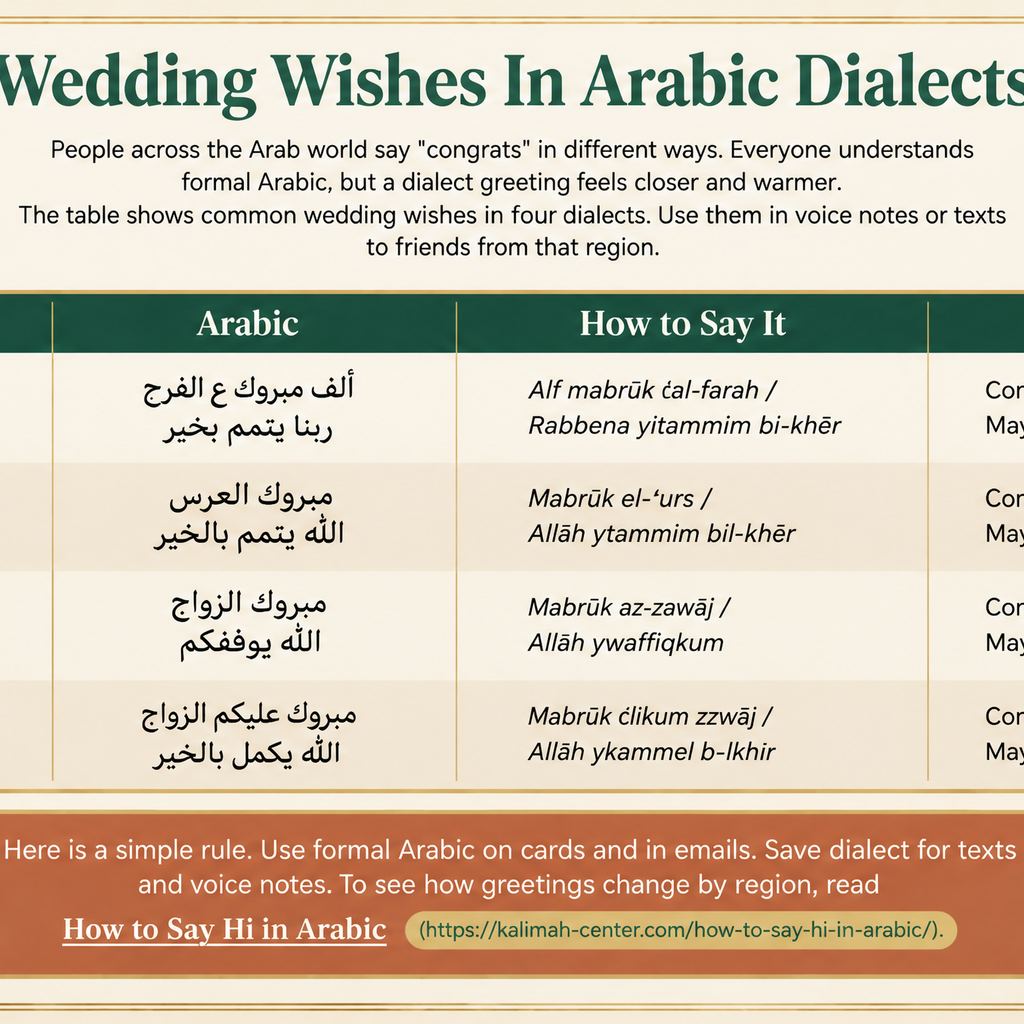
| Dialect | Arabic | How to Say It | Meaning |
| Egyptian | ألف مبروك ع الفرح / ربنا يتمم بخير | Alf mabrūk ʿal-faraḥ / Rabbena yitammim bi-khēr | Congrats on the wedding / May God complete it well |
| Levantine | مبروك العرس / الله يتمم بالخير | Mabrūk el-ʿurs / Allāh ytammim bil-khēr | Congrats on the wedding / May God complete it well |
| Gulf | مبروك الزواج / الله يوفقكم | Mabrūk az-zawāj / Allāh ywaffiqkum | Congrats on the marriage / May God bless your path |
| Moroccan | مبروك عليكم الزواج / الله يكمل بالخير | Mabrūk ʿlikum zzwāj / Allāh ykammel b-lkhīr | Congrats on the marriage / May God complete it well |
Here is a simple rule. Use formal Arabic on cards and in emails. Save dialect for texts and voice notes. To see how greetings change by region, read How to Say Hi in Arabic.
Arabic Wedding Phrases to Avoid (and What to Say Instead)
Some wedding phrases are very common but can feel old or out of place. It helps to know them before you write.
The table lists three of them. Each one comes with a kinder choice you can use instead.
| Old Phrase | Why to Be Careful | Kinder Choice |
| بالرفاء والبنين (Bil-rafāʾ wal-banīn), “with harmony and sons” | It wishes for sons only. A report in Sunan an-Nasa’i 3371 says the Prophet ﷺ taught people to say Bārakallāhu lakum instead. | بارك الله لكما (Bārakallāhu lakumā) |
| دخلتم القفص الذهبي (Dakhaltum al-qafaṣ adh-dhahabī), “you entered the golden cage” | It jokes that marriage is a cage. It is fine with close friends but odd in formal places. | بداية جميلة لحياة جديدة (Bidāyah jamīlah li-ḥayātin jadīdah), “a beautiful start to a new life” |
| أتممتم نصف دينكم (Atmamtum niṣfa dīnikum), “you completed half your faith” | It only fits Muslim couples. | أتمنى لكما حياة سعيدة (Atamannā lakumā ḥayātan saʿīdah), “I wish you a happy life” |
Wishes for children can also be touchy. Some couples wait years to have a baby. If you are not close to them, wish for love and happiness instead.
Is it wrong to use old phrases? Not at all. Egypt’s Dar al-Ifta, fatwa 6666, says Islam does not lock wedding wishes to fixed words. Any phrase with good wishes is fine. The Sunnah dua is simply the best choice.
Read also: Arabic Sayings about Friendship
Arabic Wedding Wishes For Christian And Non-Religious Couples
Not every Arabic-speaking couple is Muslim. Millions of Arab Christians live in Egypt, Lebanon, Syria, Jordan, Iraq, and Palestine.
These wishes fit Christian, mixed-faith, or non-religious weddings. They are kind, clear, and safe for any couple.
| Arabic | How to Say It | Meaning |
| مبروك زواجكما | Mabrūk zawājukumā | Congrats on your marriage |
| أتمنى لكما حياة سعيدة مليئة بالحب | Atamannā lakumā ḥayātan saʿīdatan malīʾatan bil-ḥubb | I wish you a happy life full of love |
| الرب يبارك زواجكما | Ar-Rabb yubārik zawājakumā | May the Lord bless your marriage |
| كل التمنيات الطيبة للعروسين | Kull at-tamanniyāt aṭ-ṭayyibah lil-ʿarūsayn | All good wishes to the bride and groom |
Here is something many people don’t know. Arab Christians also use the word Allāh for God. So many wishes that use God’s name work for Muslim and Christian couples alike.
Replying To Wedding Wishes in Arabic
Getting married yourself? People will send you lots of wishes. You need simple, polite replies. The table shows the most common replies. Pick one based on who sent the wish.
| Arabic | How to Say It | Meaning | When to Use It |
| وفيكم بارك الله | Wa fīkum bāraka Allāh | And may Allah bless you too | Reply to Bārakallāhu lakumā |
| الله يبارك فيك | Allāh yubārik fīk | May Allah bless you | Any wish, formal or casual |
| شكراً جزيلاً | Shukran jazīlan | Thank you very much | Coworkers and mixed groups |
| جزاك الله خيراً | Jazāka Allāhu khayran | May Allah reward you with good | Religious friends and family |
| عقبالك | ʿUʾbālak (to a man) / ʿUʾbālik (to a woman) | Your turn next! | Single friends, in a playful way |
Change fīkum to fīka for one man or fīki for one woman. Be gentle with ʿUʾbālak. It is sweet among friends, but it can hurt someone who has been hoping to marry for a long time.
Inside Kalimah Center: Moments from Our Courses
Get a glimpse into the vibrant learning experience at Kalimah Center. These snapshots capture real moments from our live classes—where students engage deeply, connect with passionate instructors, and grow in a welcoming, supportive environment.
Master Arabic with Kalimah Center
Join our expert-led online classes and start your journey toward Arabic fluency today.
Book Your Free TrialLearn Arabic With Native Tutors: Book Your Free Class at Kalimah Center
You can copy a wedding wish in a minute. But what about saying it out loud at the party, changing it for the bride, or chatting with the family after? That takes real Arabic. Kalimah Center makes it easy to get there.
Here is what you get at Kalimah Center:
- Native Arabic tutors. Every teacher is a trained, qualified native speaker, and some studied at Al-Azhar.
- One-on-one or group classes. Learn alone with your tutor, or join a small group.
- A clear path. The adult course has 16 levels and more than 400 hours of lessons.
- Lessons made in-house. Built from teaching Arabic in Cairo since 2011 and tested with thousands of students.
- Male and female teachers. Choose the teacher you feel most at ease with.
- Your own schedule. Book classes when they suit you, from anywhere in the world.
- Help between classes. Your study material is open day and night, and every lesson has hands-on practice.
- A certificate for each level. See your progress as you move up.
Your first class is free. Try it, meet your tutor, and see how fast you learn.
Book your free trial class now and say your next wedding wish in Arabic you truly understand.

Explore Our Courses:
- Online Arabic Course: Tailored to your level, our comprehensive Arabic program includes 16 teaching levels and 400+ hours of personalized sessions.
- Online Quran With Tajweed Course: Perfect for non-Arabic speakers, our course spans 13 levels and equips you with Tajweed mastery from beginner to advanced.
- Online Arabic Course For Kids: Nurture your child’s love for Arabic with our engaging and structured program, available in 24 levels for primary, intermediate, and secondary stages.
Conclusion:
The best wedding wishes in Arabic are short, kind, and right for the person you are speaking to. For a Muslim couple, Bārakallāhu lakumā wa bāraka ʿalaykumā wa jamaʿa baynakumā fī khayr is the top choice. It comes straight from the Sunnah, and every Muslim knows it.
Small details make a big difference. Say laka to the groom, laki to the bride, lakumā to the couple, and lakum to a group. Keep the same ending all the way through, and your dua will sound natural.
Think about where your words will go, too. Formal Arabic fits cards and emails. Dialect fits texts and voice notes to close friends. For Christian or non-religious couples, Mabrūk zawājukumā is warm and safe. Skip old phrases that may feel out of date.
When your own wedding day comes, you will be ready to reply. A simple Wa fīkum bāraka Allāh shows you understand the blessing and want the same good for others. And if you want to go beyond copying phrases, learning Arabic step by step will let you share these moments in your own words.
FAQs
People often have quick questions before they write or say a wedding wish. Here are clear answers to the ones we hear most.
Is It Sunnah to Congratulate a Couple on Their Marriage?
Yes, Muslim scholars say it is a recommended Sunnah. Imam al-Nawawi wrote that the dua is best said right after the marriage contract, called the nikah.
Can a Woman Say Barakallahu Lakuma to a Man?
Yes, the words of the dua stay the same no matter who says them. Only the ending changes, based on the person you are talking to.
How Do You Say Bride and Groom in Arabic?
The bride is العروس (al-ʿarūs), and the groom is العريس (al-ʿarīs). Together, the bride and groom are called العروسان (al-ʿarūsān).
What Do You Say for an Engagement in Arabic?
Say مبروك الخطوبة (Mabrūk al-khuṭūbah), which means “Congrats on the engagement.” It works for friends, family, and coworkers.
How Do You Say Happy Anniversary in Arabic?
Say عيد زواج سعيد (ʿĪd zawāj saʿīd), which means “Happy wedding anniversary.” You can add كل عام وأنتما بخير (Kull ʿām wa antumā bi-khayr), “May you both be well every year.”
Is It Okay to Send a Wedding Dua by Text?
Yes, a text is a fine way to send a dua, especially if you can’t attend. Write it in Arabic letters so the couple can read it easily.
How Do You Say Happy Wedding Day in Arabic?
Say زفاف سعيد (Zifāf saʿīd), which means “Happy wedding.” Most Arabs pair it with Alf mabrūk to sound warmer.