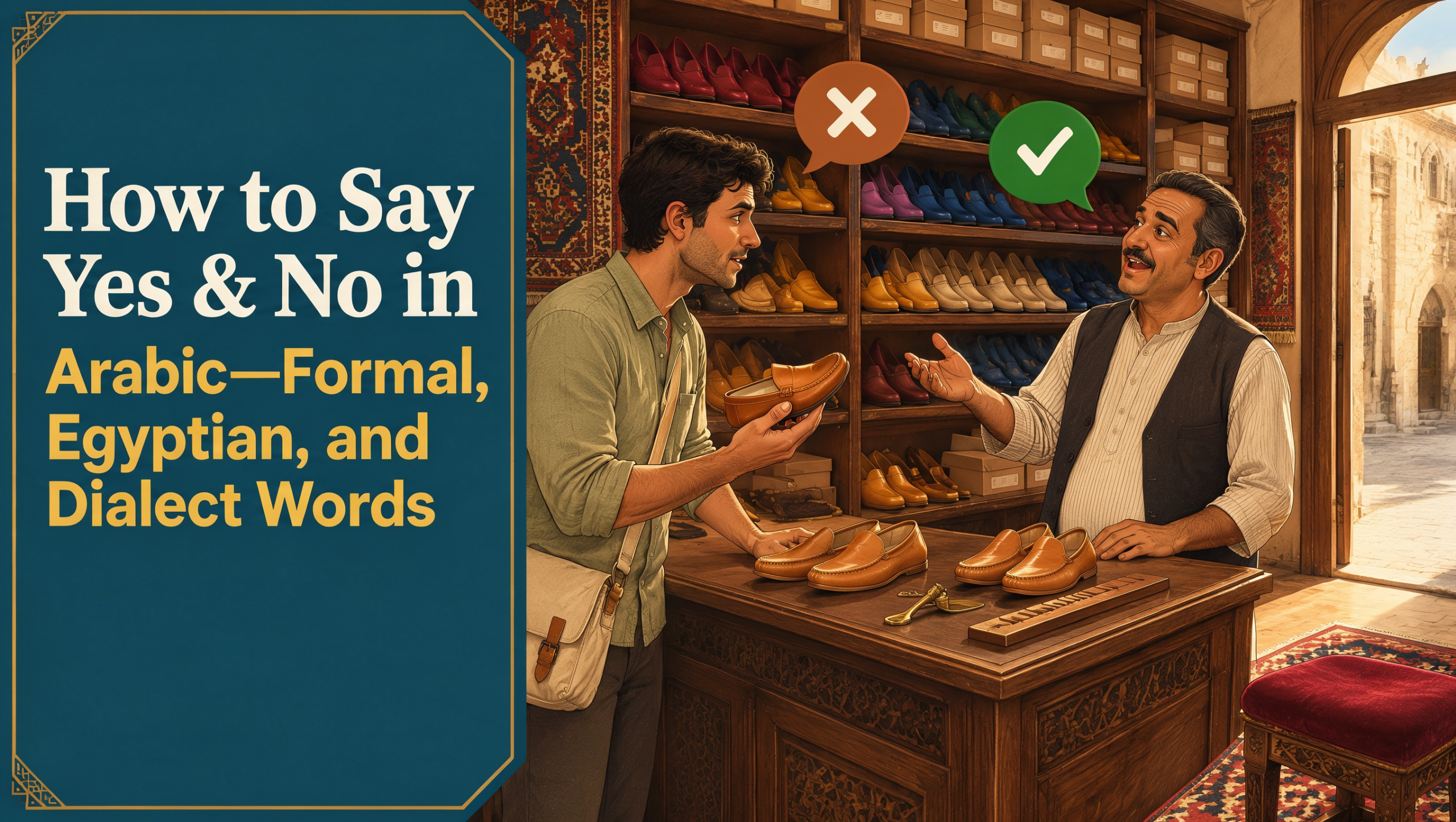
Picture this: you’re in a small shoe shop in Cairo. You ask if they have your size, and the seller just says “aah.” Was that a yes? A sigh? You’re not sure.
That’s the thing about learning how to say yes & no in Arabic. The textbook answer is simple: yes is naʿam (نَعَم), and no is laa (لا). But walk into any shop in Egypt and you’ll hear “aywa” and “la’” far more often. And in some questions, naʿam can even mean the opposite of what you meant.
So let’s start with the two words everyone understands, then move to what people really say on the street, in Cairo, Beirut, Riyadh, and Casablanca. You’ll also learn how to say no without sounding rude. Each phrase comes with an easy way to say it and a short dialogue.
Yes & No in Arabic: The Basic Words
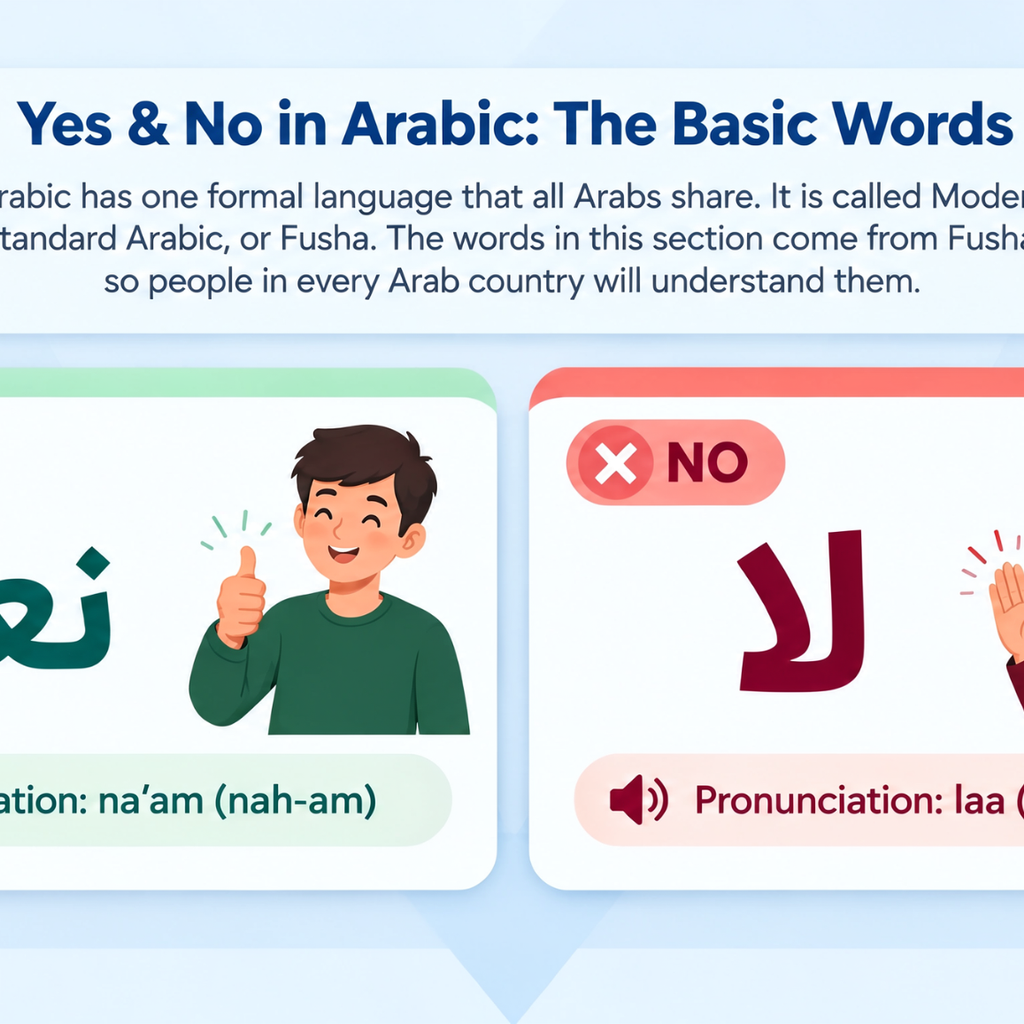
Arabic has one formal language that all Arabs share. It is called Modern Standard Arabic, or Fusha. The words in this section come from Fusha, so people in every Arab country will understand them.
a. Saying Yes in Arabic Language: Naʿam (نَعَم)
The Arabic word for yes is naʿam (نَعَم). You say it like this: NA-ʿam. Put the stress on the first part.
Naʿam is the polite, respectful yes. Use it with older people, teachers, and officials. You will also hear it on the phone. Many Arabs answer a call with “naʿam?” It means “Yes? I’m listening.”
Naʿam has more than one job. It can agree with something someone says. It can answer a question. It can also be a promise. If your friend says, “Please help your brother,” and you answer “naʿam,” you just promised to help.
Here is a simple example:
“Hal anta mustaʿidd?” (Are you ready?)
“Naʿam.” (Yes.)
Naʿam is the standard yes in formal Arabic. It can also mean “Pardon?” If you didn’t hear someone, say “naʿam?” with a rising voice, and they’ll repeat what they said. .
b. Saying No in Arabic Language: Laa (لا)
The Arabic word for no is laa (لا). Say it like the “la” in “la-la,” but hold the sound a little longer: LAA.
Laa works in formal Arabic, and people in Egypt, the Levant, the Gulf, and other regions all understand it. So if you only learn one way to say no, laa is the safest choice.
Laa does one more job. Put it before a verb, and the verb becomes negative. For example, “aʿrif” means “I know.” “Laa aʿrif” (لا أعرف) means “I don’t know.”
To say no kindly, add the word for thank you: laa, shukran (لا، شكرًا). Say it laa, SHUK-ran. It means “No, thank you.” If you want more ways to thank people, read our guide on how to say thank you in Arabic.
Here is a short example:
“Turid qahwa?” (Do you want coffee?)
“Laa, shukran.” (No, thank you.)
c. Other Formal Ways to Say Yes and No
Fusha has a few more words for yes and no. Each one adds a small change in feeling. They are good to know when you read books, watch the news, or hear a speech.
Words for yes:
- Ajal (أجَل), A-jal: means “indeed.” It sounds a bit old and fancy.
- Tabʿan (طبعًا), TAB-ʿan: means “of course.” People use it in formal and casual talk.
- Hasanan (حسنًا), HA-sa-nan: means “okay” or “all right.” Use it to agree with a plan.
Words for no:
- Kallaa (كلّا), KAL-laa: a strong “no, not at all.” You will see it in books more than in talk.
- Abadan (أبدًا), A-ba-dan: means “never.” Use it when the answer will not change.
Kallaa also appears many times in the Quran. It often comes as a sharp warning, as in Surat Al-ʿAlaq, 96:6. When you see it, read it as “No, never!”
Here is how tabʿan sounds in a short chat:
“Hal tatakallam al-ʿarabiyya?” (Do you speak Arabic?)
“Tabʿan, qaleelan.” (Of course, a little.)
You do not need these words on day one. Start with naʿam and laa. Then add tabʿan, since you will hear it often in every country.
How to Pronounce the Hard Sounds in Arabic Yes and No
Two sounds in these words have no letter in English. Getting them right early will make you sound much more natural. Follow these steps:
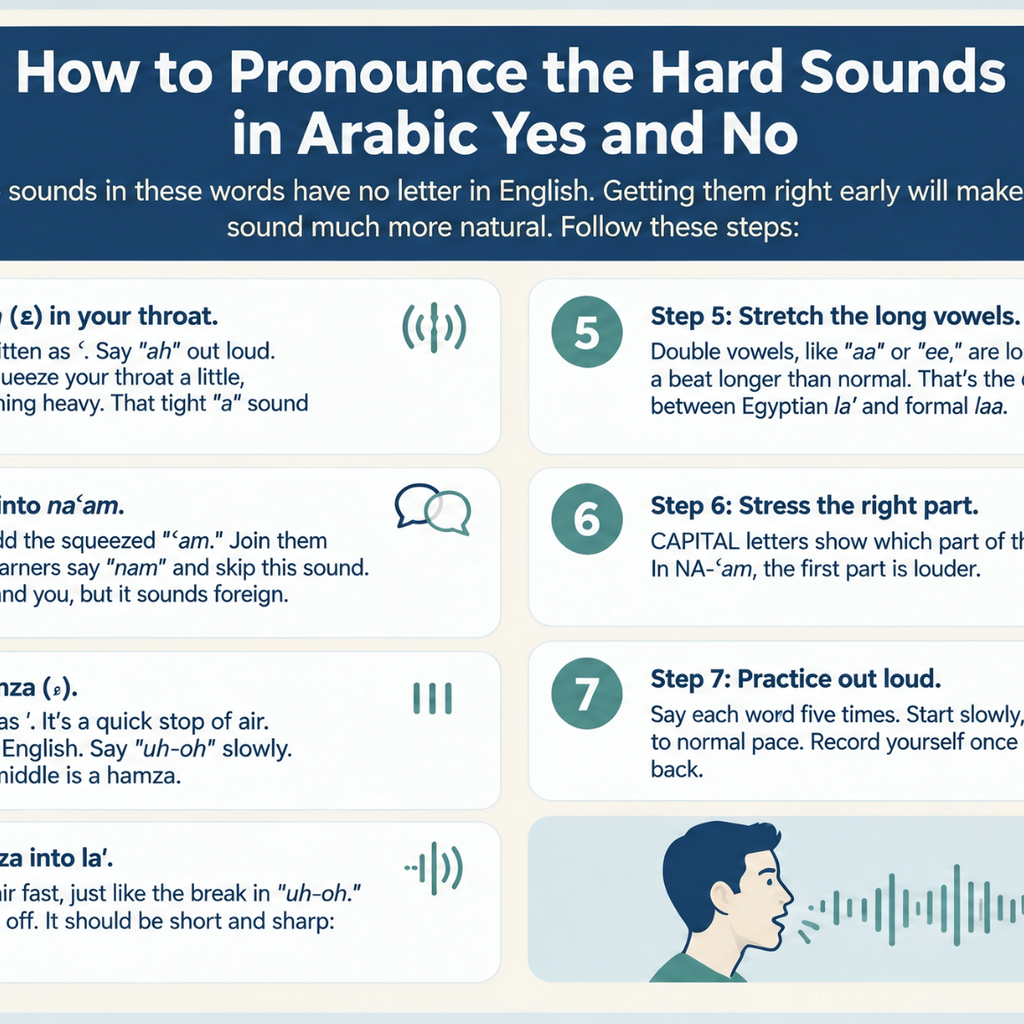
- Find the ʿayn (ع) in your throat: In this guide, ʿayn is written as ʿ. Say “ah” out loud. Now say it again, but squeeze your throat a little, like you’re lifting something heavy. That tight “a” sound is the ʿayn.
- Put the ʿayn into naʿam: Say “na,” pause, then add the squeezed “ʿam.” Join them slowly: NA-ʿam. Most learners say “nam” and skip this sound. People will still understand you, but it sounds foreign.
- Find the hamza (ء): Hamza is written here as ‘. It’s a quick stop of air. You already make it in English. Say “uh-oh” slowly. That tiny break in the middle is a hamza.
- Put the hamza into la’: Say “la,” then stop the air fast, just like the break in “uh-oh.” Don’t let the sound trail off. It should be short and sharp: LA’.
- Stretch the long vowels: Double vowels, like “aa” or “ee,” are long. Hold them a beat longer than normal. That’s the difference between Egyptian la’ and formal laa.
- Stress the right part: CAPITAL letters show which part of the word to push. In NA-ʿam, the first part is louder.
- Practice out loud: Say each word five times. Start slowly, then speed up to normal pace. Record yourself once and listen back.
A quick look at learning with us
See how a live class works, from the teacher’s explanation to the student’s recitation. It’s a simple way to know what to expect before your first lesson.
Read also: What Does Khalas Mean in Arabic?
Saying Yes in Egyptian Arabic
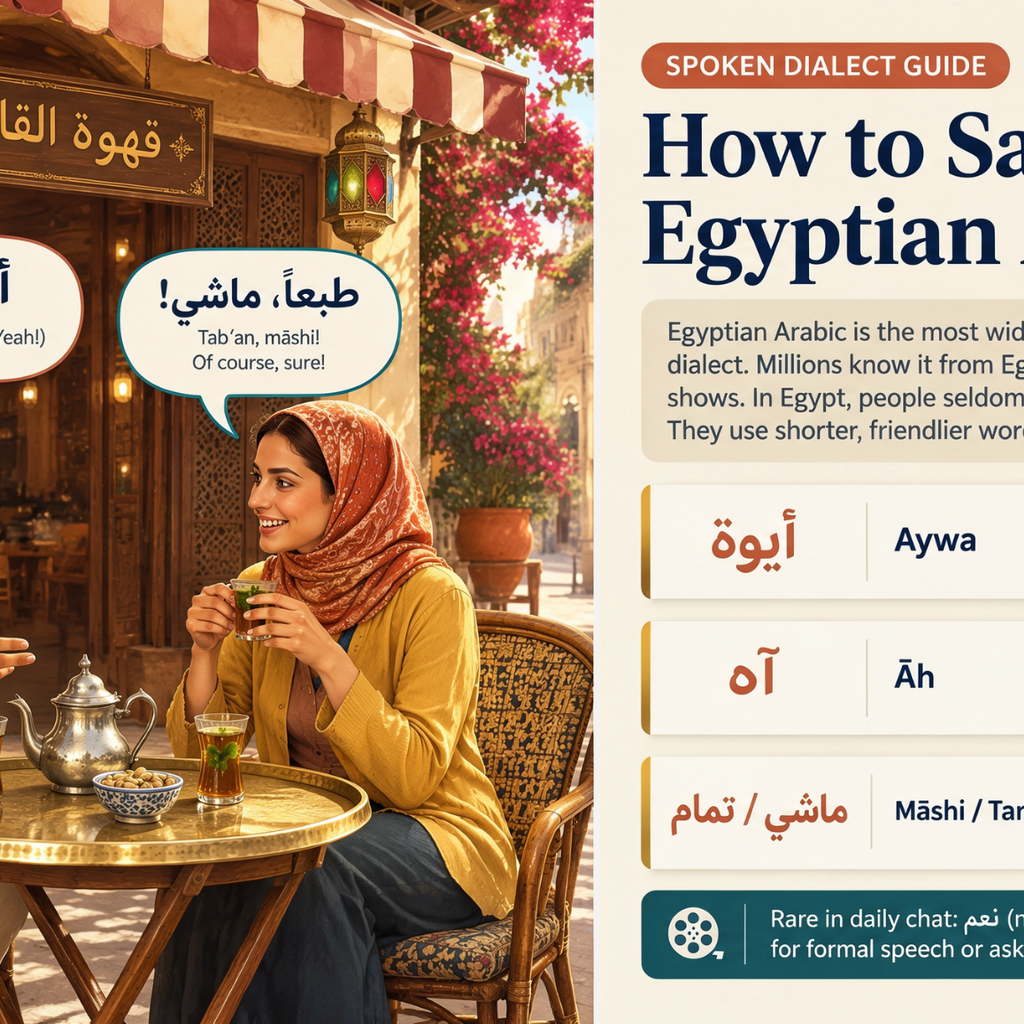
Egyptian Arabic is the most widely understood spoken dialect. Millions know it from Egyptian movies and TV shows. In Egypt, people seldom say naʿam in daily talk. They use shorter, friendlier words.
Aywa and Aah: The Everyday Egyptian Yes
The two most common Egyptian words for yes are aywa (أيوه) and aah (آه).
- Aywa is said AY-wa. It is a clear and sure yes. You can use it with almost anyone, from a taxi driver to a coworker. It is friendly but not rude.
- Aah is said AAH, with a long, flat sound. It is shorter and more relaxed. Egyptians use it with friends, family, and people they see every day.
Your tone of voice matters with aah. Let your voice go down at the end, and it means “yes.” Let your voice go up, like “aah?”, and it means “Really?” or “What?”
Aywa and aah are casual. They are fine for daily life, but they can sound too relaxed in a job interview or with an older person you just met. In those moments, naʿam is the better choice. Many Egyptians also double the word for a stronger yes: “aah, aah” or “aywa, aywa.” It means “yes, exactly” or “yes, I get it.”
Haadir, Tamaam, Maashi, and Akeed: Yes for Special Situations
Egyptians have extra words for yes. Each one fits a certain kind of moment.
- Haadir (حاضر), HAA-dir: This means “Yes, I will do it.” Use it when someone asks you to do something, especially a parent, teacher, or boss. It shows respect. If your mother says “Close the door,” the best answer is “haadir.”
- Tamaam (تمام), ta-MAAM: This means “fine,” “great,” or “all good.” Use it to agree to a plan. “We meet at 5?” “Tamaam.”
- Maashi (ماشي), MAA-shi: This means “okay.” It is relaxed and common among friends. “Let’s take a taxi.” “Maashi.”
- Akeed (أكيد), a-KEED: This means “definitely” or “for sure.” Use it when you are happy to say yes. “Are you coming to the party?” “Akeed!”
Picking the right word shows people you understand Egyptian culture, not just the language. Haadir, in particular, will earn you warm smiles from older Egyptians.
Example Dialogue: Saying Yes in a Cairo Shop
Here is how these words sound in a real chat. A customer is shopping for shoes.
Customer: ʿandak il-maqaas da? (Do you have this size?)
Seller: Aywa, ʿandi. (Yes, I have it.)
Customer: Mumkin ajarrabu? (Can I try it on?)
Seller: Tabʿan, itfaddal. (Of course, go ahead.)
Customer: Tamaam, haakhdu. (Great, I’ll take it.)
Seller: Akeed. (Sure.)
Notice how the seller uses three different words for yes. “Aywa” answers a simple question. “Tabʿan” shows the request is easy. “Akeed” closes the sale in a happy way.
“Itfaddal” (اتفضل) is also worth learning. It means “go ahead” or “please, help yourself.” You will hear it many times a day in Egypt. To learn more greetings and polite words like this, see our guide on how to say hi in Arabic.
Saying No in Egyptian Arabic
The Egyptian word for no is la’ (لأ). It looks like laa, but it sounds different. Egyptians also have many soft ways to say no, so they don’t sound harsh.
La’: The Short Egyptian No
In Egypt, people usually say la’ (لأ), and sometimes la’a, where the “a” runs on a little after the stop. The key is the ending. Say “la,” then stop the air fast, like the break in “uh-oh.” Don’t hold the “a” long as you do in formal laa. It should sound short and sharp: LA’.
You can double it for a stronger answer: la’ la’. This means “No, no, not at all.” Egyptians say it often, and it is not rude. If you say formal “laa” in Egypt, people will understand you. But it may sound like you are reading from a book. In shops, streets, and homes, la’ sounds more natural.
Want to hear more ways Egyptians say no? This page on saying no in Egyptian Arabic has extra examples you can study. One more tip: a quick “la'” with a smile is fine. A long, loud “LAAA'” can sound annoyed. Keep it short and calm.
Polite Ways to Say No in Egyptian Arabic
A plain “la'” can feel cold. Egyptians often add a soft word to make it kind. Some of these phrases change if the speaker is a man or a woman, so pick the one that fits you.
- La’, mitshakkir (لأ، متشكر), la’ mit-SHAK-kir: “No, thank you.” For men.
- La’, mitshakkira (لأ، متشكرة), la’ mit-shak-KI-ra: “No, thank you.” For women.
- La’, mersi (لأ، ميرسي), la’ MER-si: A casual “No, thanks” used in Egypt. Men and women both use it. Hear it in this short lesson.
- Aasif, la’ (آسف، لأ), AA-sif: “Sorry, no.” For men. Women say asfa (آسفة), AAS-fa.
- Mish ʿaayiz (مش عايز), mish ʿAA-yiz: “I don’t want it.” For men. Women say mish ʿayza (مش عايزة), mish ʿAY-za.
- Mish mumkin (مش ممكن), mish MUM-kin: “It’s not possible.”
- Mustaheel (مستحيل), mus-ta-HEEL: “Impossible.” This is the strongest no.
The small word mish (مش) means “not.” Egyptians put it before many words. Unlike in formal Arabic, it stays the same no matter who you are talking about. This guide to Arabic negation explains it in more detail.
Example Dialogue: Turning Down Tea Politely
In Egyptian homes, hosts love to offer food and drinks. They may offer two or three times, just to be kind. Here is how to say no without hurting anyone’s feelings.
Host: Tishrab shaay? (Would you like some tea?)
Guest: La’, mitshakkir. Lissa shaarib. (No, thank you. I just had some.)
Host: Tayyib, ʿaseer? (Okay, some juice?)
Guest: Mitshakkir awi, mish ʿaayiz haaga. (Thanks a lot, I don’t need anything.)
Host: Wallahi lazim tishrab haaga! (You really must drink something!)
Guest: Khalaas, shaay sughayyar. (Okay then, a small tea.)
See what happened? The guest gave a reason the first time. He thanked the host warmly the second time. On the third offer, he said yes to something small. This is a very common and polite pattern in Egypt.
Want to practice real talks like this one? Kalimah Center’s Online Arabic Course is built around daily speaking. Kalimah Center teaches both Modern Standard Arabic and Egyptian Arabic, so you learn the formal words and the street words in one place.
Master Arabic with Kalimah Center
Join our expert-led online classes and start your journey toward Arabic fluency today.
Book Your Free TrialRead also: Common Arabic Names For Boys and Girls
Saying Yes and No in Other Arabic Dialects
Each Arab region has its own spoken dialect. The word for no changes very little from place to place. The word for yes changes much more.
The table below gives you a quick view of each region. Find the country you plan to visit, then read the notes under it for more detail.
| Region | Yes | No |
| Formal Arabic (Fusha) | naʿam (NA-ʿam) | laa (LAA) |
| Egypt | aywa (AY-wa), aah (AAH) | la’ (LA’) |
| Levant (Syria, Lebanon, Jordan, Palestine) | eh (EH), ee (EE) | la’ (LA’) |
| Gulf (Saudi Arabia, UAE, Kuwait, Qatar) | ee (EE), naʿam (NA-ʿam) | laa (LAA) |
| Iraq | ee (EE), bali (BA-li) | laa (LAA) |
| Morocco | iyyeh (IY-yeh), waah (WAAH) | laa (LAA) |
Levantine Arabic: Eh and La’
The Levant includes Syria, Lebanon, Jordan, and Palestine. Here, the most common yes is eh (إيه), said EH. In Lebanon you will also hear ee (إي), said EE.
Aywa (أيوا) is used too, just like in Egypt. For a strong yes, people say akeed (أكيد), meaning “for sure.” To agree with a plan, they say tayyib (طيب), TAY-yib, meaning “okay.”
The Levantine no is la’ (لأ), the same short sound as in Egypt. To say no politely, people say la’, shukran. In Lebanon, many also say la’, merci, since French words are common there.
For “it’s not possible,” people say mish mumkin in Palestine and Jordan. In Syria and Lebanon, you may hear ma byisir (ما بيصير), ma BYI-sir, meaning “it can’t happen” or “that’s not okay.”
Here is a quick example from Beirut:
“Baddak tiji maʿna?” (Do you want to come with us?)
“Ee, akeed!” (Yes, for sure!)
Gulf and Iraqi Arabic: Ee, Naʿam, and Bali
In the Gulf, people use ee (إي), said EE, as a casual yes. But naʿam is still very common in daily life. Gulf speakers use it to answer calls, to reply to older people, and in shops and offices. So naʿam does not sound stiff there.
A special Gulf word is abshir (أبشر), AB-shir. It means “Consider it done.” People say it when you ask them for help. It is warm and kind. Another word is zain (زين), ZAIN, meaning “good” or “okay.”
The Gulf no is laa, with the long sound, close to formal Arabic. A firm no can be laa wallah (لا والله), meaning “No, really.”
In Iraq, the casual yes is also ee. Iraqis have one more word: bali (بلي), BA-li. It comes from the formal word “bala” and simply means “yes.” For “okay” or “good,” Iraqis say khosh (خوش), KHOSH.
The Iraqi no is laa. To make a sentence negative, Iraqis and Gulf speakers often use mu (مو), meaning “not.” For example, “mu zain” means “not good.”
Moroccan Arabic: Iyyeh, Waah, and Safi
Moroccan Arabic is called Darija. It sounds quite different from Egyptian or Gulf Arabic, and it uses some French and Berber words.
The Moroccan yes is iyyeh (إيه), IY-yeh, or waah (واه), WAAH. Both are common in daily talk.
To say “okay,” Moroccans use wakha (واخا), WA-kha. You will hear it many times a day. It means “fine, I agree.” Another key word is safi (صافي), SAA-fi. It means “that’s enough” or “it’s settled.”
The Moroccan no is laa, sometimes said quickly as lla. To make words negative, Moroccans use maashi (ماشي), which means “not.”
Be careful with maashi. In Egypt, it means “okay.” In Morocco, it means “not.” So “maashi mezyan” in Morocco means “not good.” Another useful word is walu (والو), WA-lu, meaning “nothing.” If someone asks, “Do you need anything?” you can say “walu, shukran.”
Head Gestures That Mean Yes or No
In many Arab countries, people say yes and no with their heads, not just with words. Some gestures can confuse visitors. In Egypt and the Levant, a quick tilt of the head upward means no. People often raise their eyebrows at the same time. Some also make a “tsk” sound with their tongue. Many visitors think this is a nod and believe the answer was yes. It was not.
A nod downward means yes, just like in English. Placing your right hand on your chest while you turn something down shows thanks and respect. It softens the “no.” It is common when someone offers you food, a gift, or a favor.
Waving your hand side to side with the palm facing out also means “no, thanks.” Taxi drivers and street sellers see it all the time. Watch people’s faces as well as their words. The head tilt alone can be the whole answer.
Saying No Problem in Arabic
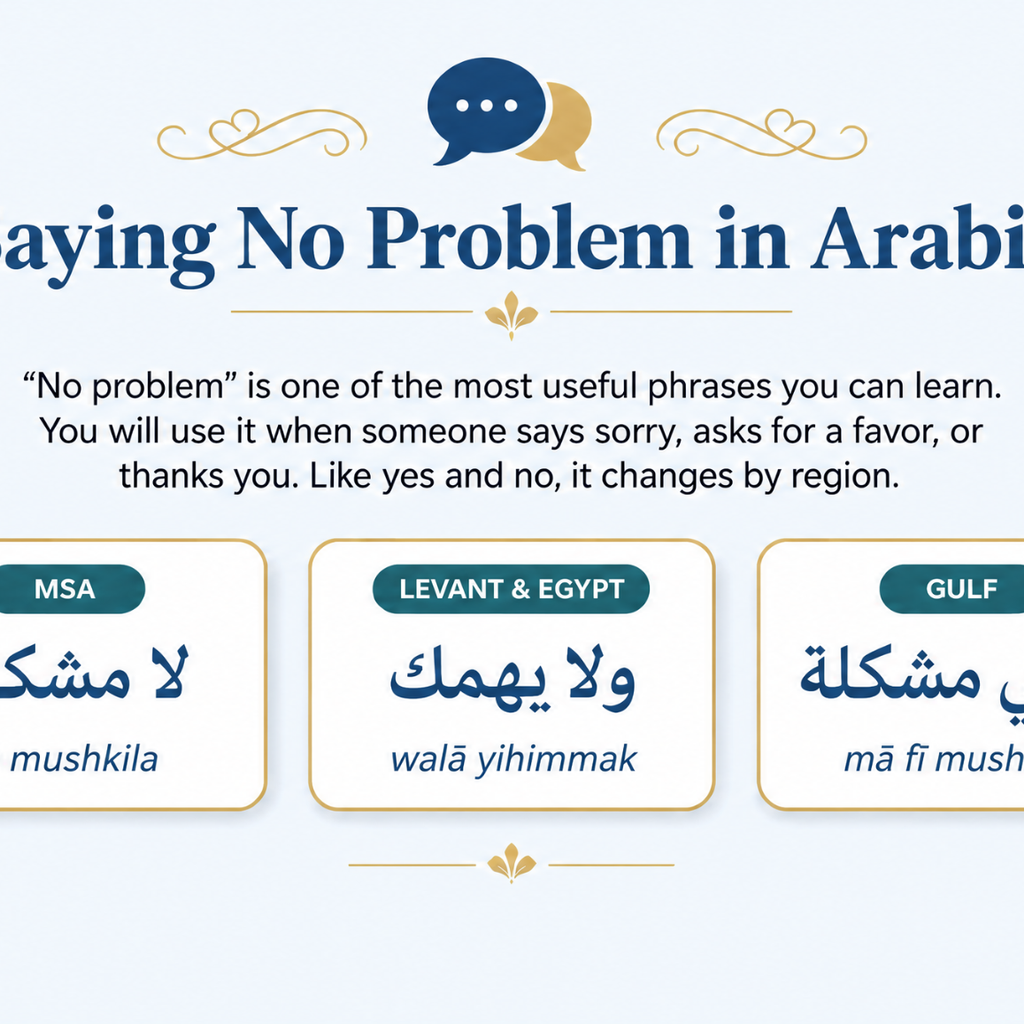
“No problem” is one of the most useful phrases you can learn. You will use it when someone says sorry, asks for a favor, or thanks you. Like yes and no, it changes by region.
Formal Ways to Say No Problem: Laa Mushkila and Laa Ba’s
The formal way to say no problem is laa mushkila (لا مشكلة). Say it laa MUSH-ki-la. “Mushkila” means “problem,” so the phrase is easy to remember. People in every Arab country understand it.
To make it stronger, add abadan: laa mushkila abadan (لا مشكلة أبدًا). It means “No problem at all.” Another formal phrase is laa ba’s (لا بأس). Say it laa BA’s, with a short stop at the end. It means “It’s okay” or “No harm done.” It is a little softer and more formal than laa mushkila. You might hear it from a teacher when a student makes a small mistake.
Laa ba’s has a special place in Muslim life. When the Prophet ﷺ visited a sick man, he told him “laa ba’s, tahoor in shaa Allah” (Sahih al-Bukhari, 5656). It means “No harm, it is a cleansing, God willing.” Many Muslims still say these words when they visit someone who is ill.
Use laa mushkila when someone asks for a favor:
“Mumkin tusaʿiduni?” (Can you help me?)
“Laa mushkila.” (No problem.)
Use laa ba’s when someone worries about a small thing:
“Ana mutaʾakhkhir qaleelan.” (I’m a little late.)
“Laa ba’s.” (It’s okay.)
Dialect Ways to Say No Problem
Each dialect has its own way to say no problem. Using the local phrase makes you sound friendly and relaxed.
- Mafeesh mushkila (مفيش مشكلة), ma-FEESH MUSH-ki-la: Egyptian. It means “There’s no problem.”
- Ma fee mushkle (ما في مشكلة), ma FEE MUSH-kle: Levantine. It is common in the Gulf too.
- Maashi mushkil (ماشي مشكل), MAA-shi MUSH-kil: Moroccan.
Egyptians also have two warm phrases you will hear all the time:
- Wala yhimmak (ولا يهمك), wa-la y-HIM-mak: “Don’t worry about it.” Say it when someone thanks you or says sorry.
- Maʿlesh (معلش), MAʿ-lesh: “Never mind” or “It’s okay.” Say it when someone makes a small mistake, like bumping into you.
Maʿlesh is also used to ask for patience. A shop owner might say “maʿlesh” if you have to wait a minute. It means “Sorry, please bear with me.”
Example Dialogue: Saying No Problem After Being Late
Here is how these phrases work together in Egyptian Arabic. One friend shows up late to a meeting.
Friend 1: Aasif, itʾakhkhart ʿaleek. (Sorry, I’m late.)
Friend 2: Maʿlesh, mafeesh mushkila. (Never mind, no problem.)
Friend 1: Il-tariq kaan zahma awi. (The traffic was really bad.)
Friend 2: ʿaarif, kull yoom kida. (I know, it’s like that every day.)
Friend 1: Shukran ʿala sabrak. (Thanks for your patience.)
Friend 2: Wala yhimmak. (Don’t worry about it.)
Friend 2 uses three phrases. “Maʿlesh” calms things down first. “Mafeesh mushkila” makes it clear there is no anger. “Wala yhimmak” answers the “thank you” in a warm way.
Notice that Friend 2 does not say “laa mushkila.” That phrase is correct, but between Egyptian friends it would sound too formal.
Answering Negative Questions: Naʿam or Bala?
Some questions have “not” in them, like “Aren’t you coming?” In English, people answer these loosely. In Arabic, the right word depends on the meaning you want. Linguists have found that yes and no behave in tricky ways in many languages, and Arabic has a special word to help.
The Strict Rule: Bala Turns a “Not” Question Into Yes
The special word is bala (بَلى). Say it BA-la. You use it to answer “yes” to a question that has “not” in it.
Here is the strict rule. Naʿam agrees with the question exactly as it was asked. Bala says the opposite of the “not.”
So imagine someone asks: “Aren’t you coming?”
- If you say naʿam, you mean: “Right, I’m not coming.”
- If you say bala, you mean: “Yes, I am coming.”
Old Arabic scholars explained this with a famous verse in the Quran. God asks, “Am I not your Lord?” and the answer is “bala” (Surat Al-Aʿraf, 7:172). The scholars said that “naʿam” here would have agreed with the “not.” That is why “bala” is the correct answer.
To make sure people understand you, repeat the action after your answer. Say “Bala, I’m coming.” This clears up any doubt in formal Arabic or any dialect.
When Naʿam After a “Not” Question Still Means Yes
Some questions only look like questions. They are really strong statements. Old Arabic grammar books, like those collected in al-Maktaba al-Shamela, say naʿam works differently here.
Take this verse: “Did We not open your chest for you?” (Surat Al-Sharh, 94:1). It is not really asking. It means “We opened your chest.”
The scholars point to the next verse as proof: “And We lifted your burden from you” (Surat Al-Sharh, 94:2). It is joined to the first verse as a plain fact. So the first verse must be a fact, too.
In cases like this, naʿam agrees with the real meaning, which is positive.
The scholars gave a money example as well. Suppose someone asks, “Don’t you owe a dinar?” If you answer “naʿam,” people will take it to mean you owe the dinar. In daily life, naʿam usually sounds like “Yes, that’s true.”
Naʿam After a “Don’t” Request
There is one more case. Sometimes people ask you not to do something. Here, naʿam is a promise not to do it.
For example, someone says: “Don’t hit me.”
You answer: “Naʿam.”
You have just promised not to hit them. Naʿam agrees with the request as it was said. Since the request was “don’t,” your yes means “I won’t.”
This can feel strange to English speakers. In English, people often say “no” here: “Don’t be late.” “No, I won’t.” In Arabic, naʿam does the same job as that English “no.”
Here is another example:
“Laa tansa il-miftaah.” (Don’t forget the key.)
“Naʿam, lan ansaah.” (Yes, I won’t forget it.)
Small points like these are hard to catch on your own. That’s why a live teacher helps. At Kalimah Center, you can pick from a team of Arabic conversation tutors. All of them are native Arabic speakers with university degrees from schools like Al-Azhar University and Cairo University.

Kalimah Center has both male and female tutors, so you can choose the teacher you feel most comfortable with.
Choosing the Right Yes or No
Now you know many words. The next step is choosing the best one for each moment. The right word depends on who you are talking to and where you are.
The table below shows who each common word suits best. Use it as a quick check before you answer someone.
| Word | Best used with |
| نعم (naʿam) | Officials, elders, phone calls, any country |
| أيوه (aywa) | Friends, shopkeepers, coworkers |
| آه (aah) | Close friends and family |
| حاضر (haadir) | Parents, teachers, bosses |
| لا (laa) | Anyone, anywhere |
| لأ (la’) | Daily talk in Egypt and the Levant |
The 3-Check Rule for Every Answer
Choosing between so many words can feel hard. This simple rule makes it easy. Before you answer, ask yourself three quick questions.
Check 1: Who am I talking to?
Is the person older, a stranger, or an official? Pick a respectful word. Is the person a friend, a seller, or someone your age? Pick a casual one.
Check 2: Where is this person from?
If you know the region, use its word. Say aywa in Cairo, eh in Beirut, ee in Riyadh, and waah in Casablanca. If you are not sure, go back to the formal words.
Check 3: Did the question have “not” or “don’t” in it?
If yes, slow down and use bala when you mean “yes, I do.”
These three checks take only a second once you get used to them. After a few weeks, you will do them without thinking. Your answers will sound natural, polite, and clear.
Simple Ways to Practice Yes and No Every Day
Knowing the words is only half the job. You also need to say them often, so they come out fast in a real chat. Here are easy ways to practice.
Watch with a goal. Pick an Egyptian movie or TV show. Each time someone says yes or no, pause and repeat it out loud. Copy the tone, not just the word.
Record yourself. Say naʿam, aywa, laa, and la’ into your phone. Play it back. Does your naʿam have the throat sound? Is your la’ short and sharp?
Use one new word a day. Choose a word in the morning, like “tamaam” or “maʿlesh.” Use it at least once that day, even with a friend who doesn’t speak Arabic.
Practice “not” questions. Ask a study partner questions like “Aren’t you hungry?” Answer with bala or naʿam and check that the meaning is right.
Talk to real people. Use a few words with Arab shop owners, coworkers, or online language partners. Most people are happy to hear you try.
Inside Kalimah Center: Moments from Our Courses
Get a glimpse into the vibrant learning experience at Kalimah Center. These snapshots capture real moments from our live classes—where students engage deeply, connect with passionate instructors, and grow in a welcoming, supportive environment.
Master Arabic with Kalimah Center
Join our expert-led online classes and start your journey toward Arabic fluency today.
Book Your Free TrialBook Your Free Arabic Class at Kalimah Center Today
You now know how to say yes and no. The next step is speaking full sentences with confidence. Kalimah Center can take you there, step by step.
Here is what you get when you learn with Kalimah Center:
- Your first class is free. You can try a class at no cost before you decide.
- A free placement test. You start with a free test, so your course fits your exact level.
- Live private lessons. Every session is live, with one student and one tutor, and no recorded lectures.
- Years of experience. Kalimah has taught Arabic from Cairo, Egypt, since 2011.
- Its own study plan. Kalimah Center built its own Arabic study program over 13 years of teaching.
- A schedule that fits you. Lessons come with personal feedback and flexible times that match your pace.
- A certificate. You earn a certificate when you finish the course, which you can add to your profile.
Stop guessing between aywa and naʿam. Book your free class now and say your first confident Arabic yes this week.

Explore Our Courses:
- Online Arabic Course: Tailored to your level, our comprehensive Arabic program includes 16 teaching levels and 400+ hours of personalized sessions.
- Online Quran With Tajweed Course: Perfect for non-Arabic speakers, our course spans 13 levels and equips you with Tajweed mastery from beginner to advanced.
- Online Arabic Course For Kids: Nurture your child’s love for Arabic with our engaging and structured program, available in 24 levels for primary, intermediate, and secondary stages.
Conclusion
Learning how to say yes & no in Arabic starts with two words: naʿam and laa. They are polite, correct, and understood in every Arab country. If you remember nothing else, remember these two.
Real conversations, though, use more than the basics. In Egypt, aywa and aah are the everyday yes, and la’ is the everyday no.
Haadir shows respect when someone asks you to do something. Tamaam, maashi, and akeed each add their own feeling. Every region has its own flavor, from “eh” in Beirut to “abshir” in the Gulf and “wakha” in Morocco.
Saying no politely is just as important as saying it clearly. Add “mitshakkir” or “mitshakkira,” give a short reason, and place your hand on your chest. When someone says sorry, reply with “mafeesh mushkila” or “maʿlesh,” and you will sound warm and kind.
Finally, watch out for questions with “not” in them. Bala is your tool for a clear yes. Keep the 3-check rule in mind: who, where, and “not.” With a little daily practice, choosing the right word will feel automatic. When you’re ready for your next step, explore our list of useful Arabic phrases and sentences and keep building your daily Arabic.
FAQs
These questions cover extra points that learners often ask about. Each answer is short, so you can find what you need fast.
How Do You Write Yes and No in Arabic Letters?
You write yes as نعم, using three letters: noon (ن), ʿayn (ع), and meem (م). You write no as لا, which is a single joined shape made of laam (ل) and alif (ا).
How Do You Say Yes Sir in Arabic?
In formal Arabic, say “naʿam, ya sayyidi” (نعم يا سيدي). In Egypt, people say “haadir, ya fandim” (حاضر يا فندم), which is a very polite way to answer someone you respect.
How Do You Say Yes Please in Arabic?
In formal Arabic, say “naʿam, min fadlak” (نعم، من فضلك) to a man or “min fadlik” to a woman. In Egypt, people say “aywa, law samaht” (أيوه، لو سمحت).
How Do You Say Maybe in Arabic?
The formal word for maybe is “rubbama” (ربما), said RUB-ba-ma. In Egyptian Arabic, people say “mumkin” (ممكن), and in the Levant you will often hear “yimkin” (يمكن).
What Does Inshallah Mean When Used as an Answer?
Inshallah (إن شاء الله) means “if God wills.” As an answer, it can be a real yes or a soft, polite maybe, so ask for a day or time if you need a clear reply.
How Do You Say No Way in Egyptian Arabic?
Egyptians say “mish maʿool” (مش معقول), meaning “no way” or “I can’t believe it.” For a funny “never going to happen,” they say “fil-mishmish” (في المشمش), which literally means “in apricot season.”
Are Yes and No Used in the Quran?
Yes, both words appear in the Quran. For example, the people of Paradise answer “naʿam” when asked if they found God’s promise true (Surat Al-Aʿraf, 7:44), and “laa” appears in many verses to mean “no” or “not.”