If you have ever tried to build a sentence in Arabic and wondered why certain words appear where they do — or why some words change form depending on their position — the answer usually comes back to one foundational concept: the predicate in Arabic.
The predicate is one of the two pillars every Arabic sentence stands on. Without it, no sentence is complete. Understanding it is not just an academic exercise; it is the key to reading the Quran with comprehension, writing accurate Modern Standard Arabic, and speaking with grammatical precision.
This guide explains what the predicate is, how it works in nominal and verbal sentences, what forms it takes, and how classical Arabic rhetoric treats it as a tool of meaning — not just a grammatical label.
What You’ll Learn in This Article
- The exact definition of the predicate in Arabic and its Arabic term.
- How the predicate functions in nominal versus verbal sentences.
- The seven forms the predicate can take in Arabic grammar.
- The rhetorical purposes of mentioning, omitting, defining, or fronting the predicate.
- Common mistakes learners make when identifying predicates in Arabic text.
What Is the Predicate in Arabic?
The predicate in Arabic is called المسند (al-musnad) — literally “that which is leaned upon” — and it is the element of a sentence that carries the judgment or ruling about the subject.
Every Arabic sentence is built from exactly two obligatory parts: المسند إليه (al-musnad ilayhi), the subject or topic being spoken about, and المسند (al-musnad), the predicate that states what is said about it.
The classical Arab grammarian Sibawayhi called this relationship the foundation of all Arabic speech: the subject is “that which is judged,” and the predicate is “that which judges.”
In English, “The weather is beautiful” — weather is what we are talking about, and beautiful is the predicate. Arabic works the same way, but with far more precision in how the predicate changes form, position, and definiteness depending on what meaning the speaker intends.
The Predicate in Arabic Words and Terminology
| Arabic Term | Transliteration | Meaning |
| المسند | al-musnad | The predicate (what is stated) |
| المسند إليه | al-musnad ilayhi | The subject (what is spoken about) |
| الإسناد | al-isnād | The act of attribution / predication |
| الخبر | al-khabar | The predicate of a nominal sentence |
| الفعل | al-fi’l | The verb (predicate in a verbal sentence) |
The relationship between these two elements — المسند and المسند إليه — is called الإسناد (al-isnād): the joining of one to the other in a way that produces a complete, communicable meaning.

The Predicate in Arabic Grammar: Nominal vs. Verbal Sentences
Arabic has two sentence types, and the predicate functions differently in each.
1. The Predicate in a Nominal Sentence (الجملة الاسمية)
A nominal sentence (جملة اسمية) begins with a noun or pronoun. Its two parts are:
- المبتدأ (al-mubtada’) — the subject/topic, which is the المسند إليه
- الخبر (al-khabar) — the predicate, which is the المسند
Both carry the nominative case (الرفع), marked by the Dammah vowel (ـُ).
Example:
الجوُّ جميلٌ Al-jawwu jamilun — “The weather is beautiful.”
- Al-jawwu = subject (المسند إليه)
- Jamilun = predicate (المسند / الخبر)
Notice that Arabic drops the verb “is” entirely. The predicate states the judgment directly.
Mubtada & Khabar | Basic Nominal Sentence Structure in Arabic
2. The Predicate in a Verbal Sentence (الجملة الفعلية)
A verbal sentence begins with a verb. Its two parts are:
- الفعل (al-fi’l) — the verb, which is the المسند
- الفاعل (al-fa’il) — the subject/doer, which is the المسند إليه
Example:
قرأَ الطالبُ الدرسَ Qara’a al-talibu al-darsa — “The student read the lesson.”
- Qara’a (read) = predicate / المسند
- Al-talibu (the student) = subject / المسند إليه
- Al-darsa (the lesson) = object, not part of the core predication
One critical distinction: a verbal predicate signals occurrence and renewal (التجدد والحدوث) — something that happened or happens at a specific time. A nominal predicate signals permanence (الثبوت) — a stable, ongoing state.
This is why Arabic rhetoricians say يُخادعون الله وهو خادعُهم uses two forms deliberately: the verb يُخادعون (they repeatedly deceive) versus the noun خادعُهم (He is permanently their deceiver) — the same root, two completely different implications.
The Seven Forms the Predicate Takes in Arabic
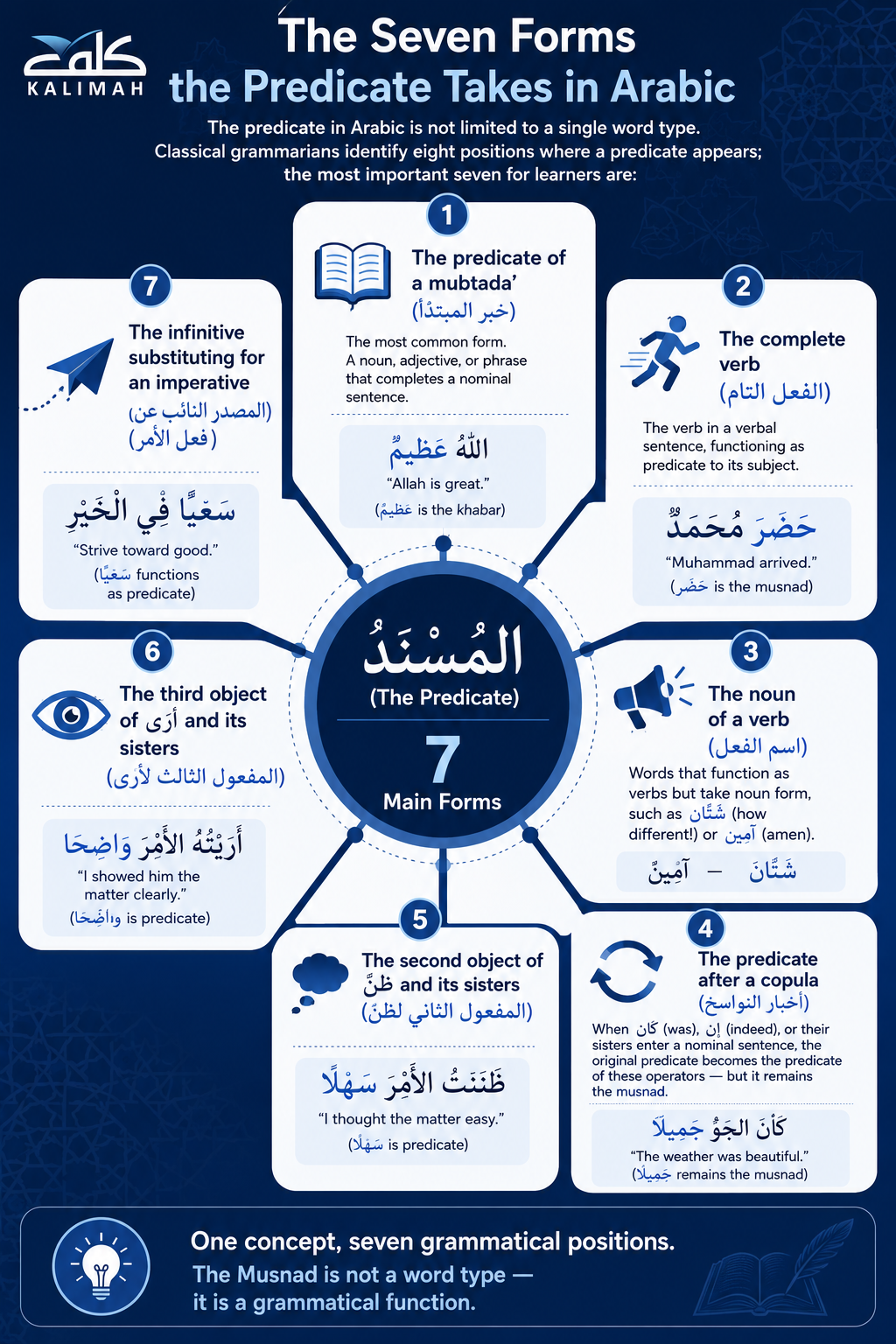
The predicate in Arabic is not limited to a single word type. Classical grammarians identify eight positions where a predicate appears; the most important seven for learners are:
1. The predicate of a mubtada’ (خبر المبتدأ) The most common form. A noun, adjective, or phrase that completes a nominal sentence.
الله عظيمٌ — “Allah is great.” (عظيمٌ is the khabar)
2. The complete verb (الفعل التام) The verb in a verbal sentence, functioning as predicate to its subject.
حضرَ محمدٌ — “Muhammad arrived.” (حضر is the musnad)
3. The noun of a verb (اسم الفعل) Words that function as verbs but take noun form, such as شتان (how different!) or آمين (amen).
4. The predicate after a copula (أخبار النواسخ) When كان (was), إن (indeed), or their sisters enter a nominal sentence, the original predicate becomes the predicate of these operators — but it remains the musnad.
كان الجوُّ جميلاً — “The weather was beautiful.” (جميلاً remains the musnad)
5. The second object of ظن and its sisters
ظننتُ الأمرَ سهلاً — “I thought the matter easy.” (سهلاً is predicate)
6. The third object of أرى and its sisters
أريتُه الأمرَ واضحاً — “I showed him the matter clearly.”
7. The infinitive substituting for an imperative (المصدر النائب عن فعل الأمر)
سعياً في الخير — “Strive toward good.” (سعياً functions as predicate)
Mentioning and Omitting the Predicate in Arabic
One of the most sophisticated aspects of Arabic grammar — and a place where learners frequently make errors — is that the predicate can be omitted entirely when context makes it recoverable.
When Is the Predicate Mentioned?
The predicate is stated explicitly when:
- Mentioning it is the default and there is no reason to drop it: العلم خير من المال (Knowledge is better than wealth).
- The contextual clue is too weak to carry the meaning alone.
- The listener needs the information confirmed clearly, such as in a direct response: قل يُحييها الذي أنشأها أول مرة (in answer to “Who revives dead bones?”).
- The speaker wants to emphasize occurrence by using a verbal predicate, or permanence by using a nominal one.
Read also: Parts of Speech in Arabic: The Complete Guide with Examples
When Is the Predicate Omitted?
The predicate is dropped when:
- Context makes it obvious, and there is a rhetorical purpose in the omission — such as economy of speech (ضيق المقام): the poet’s line “نحن بما عندنا وأنت بما عندك راضٍ” omits راضون for compression.
- Avoiding redundancy: إن الله بريء من المشركين ورسوله — repeating “بريء” would be meaningless repetition, so it is dropped.
- Following established Arabic usage: لولا أنتم (You alone are the cause) drops the predicate موجودون because Arabic convention allows it.
A practical rule for learners: never omit a predicate unless a clear contextual signal restores it. Dropping predicates without that signal produces grammatical error, not elegant compression.
Experience Kalimah Center Classes
Watch real excerpts from our live sessions at Kalimah Center and see how we bring learning to life. These clips highlight our interactive, student-centered teaching approach across all our courses—designed to keep learners engaged, motivated, and actively involved every step of the way.
Master Arabic with Kalimah Center
Join our expert-led online classes and start your journey toward Arabic fluency today.
Book Your Free TrialFronting and Delaying the Predicate in Arabic
Classical Arabic rhetoric dedicates an entire chapter to the rhetorical effects of moving the predicate before the subject — a device called تقديم المسند (taqdim al-musnad).
The default position of the predicate is after the subject. Departing from this default always carries a meaning:
When Is the Predicate Fronted?
1. To restrict the subject to the predicate (إفادة القصر):
لله ملك السماوات والأرض — “To Allah belongs the kingdom of the heavens and earth.” Fronting “لله” restricts ownership exclusively to Allah.
2. To signal from the start that it is a predicate, not a description:
When the subject is indefinite (نكرة), a fronted predicate prevents the reader from mistaking the following element for an adjective: له همم — “He possesses ambitions.” If reversed to “همم له,” the reader might read “له” as an adjective.
3. To build anticipation (التشويق):
ثلاثة تشرق الدنيا ببهجتها — “Three things illuminate the world with their splendor.” Fronting the number creates curiosity about what the three are.
4. For good omen (التفاؤل):
في عافية أنت — “You are in good health.” Placing the positive state first conveys it immediately.
5. To express restriction negatively or with emphasis:
fronting after a negative particle confirms that the action belongs to someone else — ما أنا قلت means “I did not say it; someone else did,” which is semantically different from ما قلت أنا (I did not say it at all).
Definite vs. Indefinite Predicates in Arabic
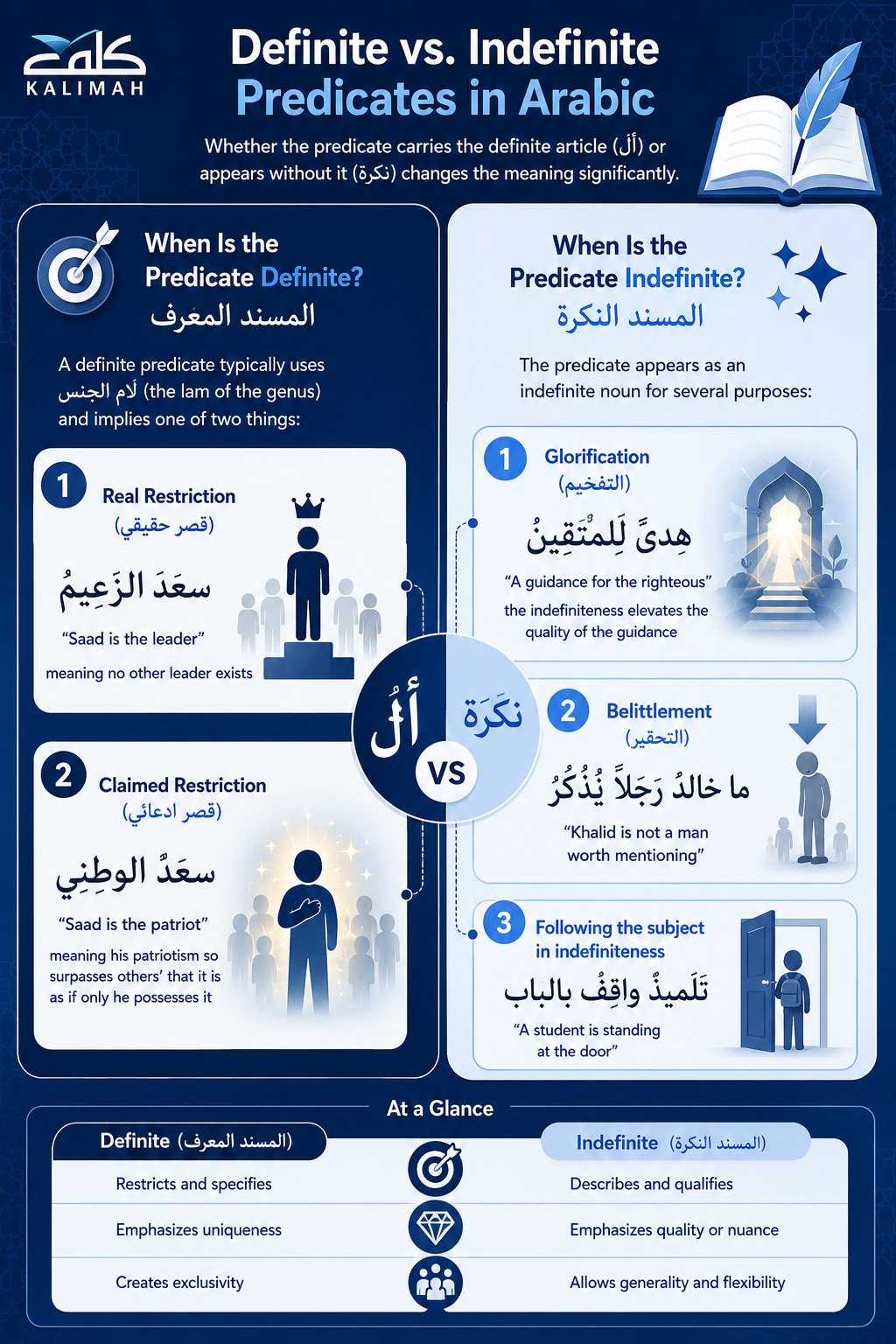
Whether the predicate carries the definite article (أل) or appears without it (نكرة) changes the meaning significantly.
When Is the Predicate Definite?
A definite predicate typically uses لام الجنس (the lam of the genus) and implies one of two things:
- Real restriction (قصر حقيقي): سعد الزعيم — “Saad is the leader” — meaning no other leader exists.
- Claimed restriction (قصر ادعائي), an exaggeration for effect: سعد الوطني — “Saad is the patriot” — meaning his patriotism so surpasses others’ that it is as if only he possesses it.
When Is the Predicate Indefinite?
The predicate appears as an indefinite noun for several purposes:
- Glorification (التفخيم): هدىً للمتقين — “A guidance for the righteous” — the indefiniteness elevates the quality of the guidance.
- Belittlement (التحقير): ما خالد رجلاً يُذكر — “Khalid is not a man worth mentioning”.
- Following the subject in indefiniteness: تلميذ واقف بالباب — “A student is standing at the door”.
Inside Kalimah Center: Moments from Our Courses
Get a glimpse into the vibrant learning experience at Kalimah Center. These snapshots capture real moments from our live classes—where students engage deeply, connect with passionate instructors, and grow in a welcoming, supportive environment.
Here Are The Reviews On Our Courses:
Our students frequently commend the excellence of our courses and the commitment shown by our instructors. You can read their complete reviews on Trustpilot.
Read more reviews on Trustpilot

Read also: Singular in Arabic – What It Means, How It Works, and Why It Matters
Start Learning Arabic Grammar the Right Way
If your goal is to understand Arabic texts, communicate more comfortably, and build strong language skills, our Arabic courses provide practical training that develops reading, speaking, listening, and comprehension together rather than treating each skill separately.
- Quran Reading and Tajweed Development
For students who want a stronger connection with the Quran, our Quran and Tajweed programs focus on accurate recitation, proper pronunciation, and gradual improvement in fluency.
As your Arabic understanding grows, Quranic verses become clearer and more meaningful.
- Engaging Arabic Learning for Children
Young learners need a different approach. Our children’s programs combine structured learning with interactive activities that help students absorb Arabic naturally while staying motivated and engaged throughout the learning process.
- A Learning Experience Built Around You
Every student begins from a different point. Some want to improve their Arabic for daily use, others want to understand Quranic Arabic, and many aim to achieve both. Our teachers adapt lessons to individual goals, helping learners make steady progress through personalized instruction and continuous support.
Wherever you are in your Arabic journey, the next step becomes easier when you learn with a clear plan, experienced teachers, and a supportive environment that keeps you moving forward.

📚 Explore Our Courses:
Online Arabic Course: Tailored to your level, our comprehensive Arabic program includes 16 teaching levels and 400+ hours of personalized sessions.
Online Quran With Tajweed Course: Perfect for non-Arabic speakers, our course spans 13 levels and equips you with Tajweed mastery from beginner to advanced.
Online Arabic Course For Kids: Nurture your child’s love for Arabic with our engaging and structured program, available in 24 levels for primary, intermediate, and secondary stages.
🚀 Start Your Free Trial Today! 🚀
Don’t miss out on this life-changing opportunity to deepen your faith and knowledge. Sign up now for your free trial and take the first step towards becoming a better practicing Muslim with Kalimah Center!
Master Arabic with Kalimah Center
Join our expert-led online classes and start your journey toward Arabic fluency today.
Book Your Free TrialConclusion
The predicate in Arabic — المسند — is one half of every sentence in the language. It is the element that carries the ruling, the judgment, the description, the action. Without it, Arabic speech is incomplete.
Understanding it at the grammatical level (what form it takes, what case it carries, what types exist) is necessary. But understanding it at the rhetorical level — why it is fronted in one verse and delayed in another, why it is made definite in one context and indefinite in the next, why it is sometimes dropped entirely — is what takes a learner from grammar student to genuine reader of Arabic text.
The predicate in Arabic is not just a label. It is a precision instrument.
Frequently Asked Questions About the Predicate in Arabic
What is the predicate in Arabic called?
The predicate in Arabic is called المسند (al-musnad). In a nominal sentence specifically, it is called الخبر (al-khabar). In a verbal sentence, the verb itself (الفعل) serves as the predicate.
Both terms refer to the element that states what is being said about the subject.
What is the difference between the predicate in Arabic and English?
In English, the predicate follows the subject and usually includes a verb (even “is” or “are”). In Arabic, the predicate in a nominal sentence is a noun or adjective with no verb needed — الجو جميل (“The weather beautiful”) is grammatically complete without any verb.
Arabic also allows the predicate to be fronted before the subject for rhetorical effect, which English does not permit in the same way.
What are predicate examples in Arabic?
In a nominal sentence: الله واحدٌ — “Allah is one” (واحد = predicate).
In a verbal sentence: ذهب الولدُ — “The boy went” (ذهب = predicate).
After a copula: كان الطقسُ باردًا — “The weather was cold” (باردًا = predicate).
All three show the same concept — the element that completes the sentence’s meaning.
Can the predicate in Arabic be omitted?
Yes. The predicate can be omitted when a clear contextual signal (قرينة) makes the omitted element recoverable, and when there is a rhetorical purpose in the omission — such as:
Compression (ضيق المقام).
Avoiding pointless repetition.
Following established Arabic usage.
Without a recoverable context, omitting the predicate produces a grammatical error, not a rhetorical effect.
Why does the predicate in Arabic sometimes come before the subject?
Fronting the predicate (تقديم المسند) serves specific rhetorical purposes:
1. Restricting the subject to the predicate (قصر).
2. Preventing the reader from misreading the element as an adjective.
3. Building anticipation, expressing good omen.
4. Emphasizing a contrast.
It is never random — every fronted predicate in classical and Quranic Arabic carries a detectable reason.
What is the difference between the predicate in a nominal and verbal Arabic sentence?
In a nominal sentence, the predicate is typically a noun or adjective (الخبر) and implies a permanent or stable state (الثبوت).
In a verbal sentence, the predicate is the verb (الفعل) and implies occurrence at a specific time with renewal (التجدد والحدوث).
This distinction is central to understanding why Arabic chooses one sentence type over the other — it is not arbitrary word order but a deliberate signal about the nature of the predication