Arabic organizes its entire vocabulary into just three core word types — a structure simpler than the eight parts of speech most English speakers learned in school.
Understanding parts of speech in Arabic with examples is the fastest way to stop guessing at sentences and start reading them correctly, word by word.
If you’ve searched for “8 parts of speech in Arabic” and then found other sources listing only 3, the confusion is real and worth resolving upfront. Classical Arabic grammar (Nahw) defines exactly three native categories.
The 8-part version is a modern teaching adaptation borrowed from English grammar — useful as a first bridge, but not what classical texts or grammar references use.
What You’ll Learn in This Article
- The three classical parts of speech in Arabic (الاسم، الفعل، الحرف) with examples for each.
- The grammatical signs (علامات) that let you identify each word type on sight.
- How the 8-part English-style framework maps onto the 3-part Arabic system.
- The four sub-types of harf (particle) and how each one functions.
- Practical sentence examples showing all three word types working together.
The Three Parts of Speech in Arabic
Classical Arabic grammar divides every word in the language into one of three categories:
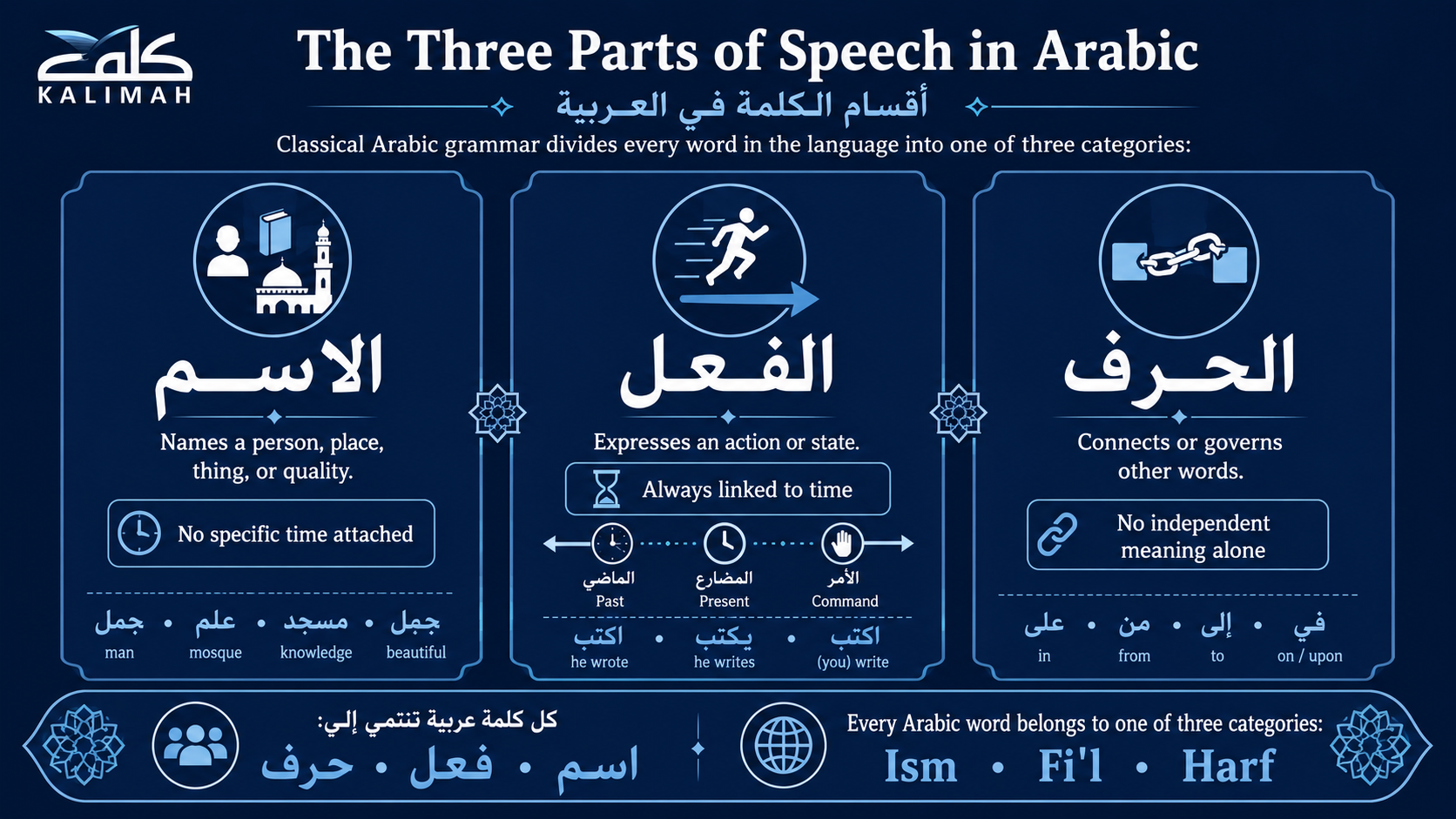
- الاسم (Ism) — names a person, place, thing, or quality; never tied to a specific time.
- الفعل (Fi’l) — expresses an action or state; always tied to past, present, or command.
- الحرف (Harf) — connects or governs other words; carries no independent meaning alone.
This three-way division has stayed unchanged since the earliest grammarians systematized Arabic, and it remains the foundation every grammar reference, Tafsir work, and classical text assumes.
A key difference from English shows up immediately here: Arabic does not give adjectives, pronouns, or numerals their own separate categories.
All of them fall under ism. A descriptive word like كبير (big) is grammatically a noun. A pronoun like هو (he) is also a noun. This single rule explains a large share of how Arabic sentence structure actually works.
What Is Ism (Noun) in Arabic?
Ism (الاسم) is any word that points to something concrete or abstract — a person, place, object, or idea — without being tied to a particular time.
| Arabic | Transliteration | English gloss | Part of speech | Notes (no tense marking) |
| وردة | wardah | a rose | noun (concrete) | Names an object; form does not indicate tense. |
| مسجد | masjid | a mosque | noun (place) | Place noun; no past/present/future marking. |
| مسلم | muslim | a Muslim | noun (agent/person) | Agent noun; invariant for tense. |
| صدق | sidq | honesty/truthfulness | abstract noun | Abstract quality; not time‑marked. |
| ذكاء | dhakāʼ | intelligence | abstract noun | Abstract trait; no tense. |
| كتاب | kitāb | a book | noun (object) | Added example: concrete object, time‑neutral. |
| مدرسة | madrasa | a school | noun (place) | Added example: place noun, invariant for tense. |
What Is Fi’l (Verb) in Arabic?
Fi’l (الفعل) is a word that expresses an action or occurrence and is always tied to one of three time frames: past, present, or command.
Arabic verbs come in exactly three forms based on tense:
- الماضي (past) — كَتَبَ (he wrote), ذَهَبَ (he went), صلى (he prayed)
- المضارع (present) — يكتب (he writes/is writing), يذهب (he goes/is going)
- الأمر (command) — اكتب (write!), اذهب (go!)
These three forms aren’t optional categories — every Arabic verb fits into exactly one of them, and the form itself is part of what marks the word as fi’l rather than ism.
What Is Harf (Particle) in Arabic?
Harf (الحرف) is a short word whose meaning only becomes clear when it’s connected to another word — it carries no independent meaning by itself.
| Arabic | Transliteration | English gloss | Part of speech | Function (example) |
| من | min | from / of | preposition/particle | Shows origin or source: من الكتاب (from the book). |
| هل | hal | question marker | interrogative particle | Introduces yes/no questions: هل حضرَ؟ (Did he attend?). |
| أو | aw | or | conjunction/particle | Connects alternatives: هذا أم ذاك؟ / أَخذته أو لم آخذه؟ |
| لم | lam | (negation for past) | negation particle | Negates past verbs and causes subjunctive: لم يذهبْ (he did not go). |
How to Identify Each Part of Speech: The Grammatical Signs (العلامات)
Arabic grammar gives each part of speech a set of distinct signs (علامات) — and recognizing these signs is far more reliable than guessing from a word’s length or how it “feels.”
Signs of the Noun (علامات الاسم)
A word is identifiable as ism if it accepts any of the following:
- الجر (Jarr / genitive marking) — taking a preposition or being placed in an إضافة (possessive) construction, as in صليت في المسجد (I prayed in the mosque).
- التنوين (Tanween) — a final unwritten “n” sound added for indefiniteness, as in هذا كتابٌ (this is a book), pronounced kitābun.
- النداء (Direct address) — being called out to with يا, as in يا أرض (O earth!).
- دخول أل (Taking the definite article “al-“) — turning a word definite, as in الحق (the truth).
- الإسناد (Predication) — being the subject or predicate of a sentence, as in الحق محبوب (truth is loved).
Only ism accepts all five of these. A fi’l or harf will never take تنوين, never take أل, and is never called out to directly.
Signs of the Verb (علامات الفعل)
Each of the three verb forms carries its own distinct markers:
- الماضي (past tense) accepts تاء التأنيث الساكنة (a silent feminine “ta” suffix, as in قامتْ — “she stood”) and تاء الفاعل (a subject “ta” suffix, as in قرأتُ — “I read”).
- المضارع (present tense) accepts the four prefixes grouped in the mnemonic أنيت — أ، ن، ي، ت — as in أكتب، نكتب، يكتب، تكتب, and it also accepts نصب particles (أن، لن، كي) and جزم particles (لم، لما).
- الأمر (command) accepts ياء المخاطبة (the feminine “you” suffix, as in قرّي — “be at ease,” feminine command) and نون التوكيد (an emphatic ending, as in استسهلنّ — “consider it easy!”).
A common mistake here is assuming any word beginning with a present-tense prefix is automatically fi’l — but the full test is whether the word also accepts نصب or جزم particles, since a handful of nouns can superficially resemble verb prefixes without behaving like verbs grammatically.
Signs of the Particle (علامات الحرف)
Harf is identified mainly by absence — it takes none of the signs that mark ism or fi’l. It never accepts تنوين, never takes أل, is never the subject of النداء, and never takes verb tense markers. \
Short words like هل، لم، أو qualify as harf precisely because none of the noun or verb tests apply to them.
Experience Kalimah Center Classes
Watch real excerpts from our live sessions at Kalimah Center and see how we bring learning to life. These clips highlight our interactive, student-centered teaching approach across all our courses—designed to keep learners engaged, motivated, and actively involved every step of the way.
Master Arabic with Kalimah Center
Join our expert-led online classes and start your journey toward Arabic fluency today.
Book Your Free TrialParts of Speech in Arabic and English: A Side-by-Side Comparison
English grammar traditionally lists eight parts of speech: noun, verb, adjective, adverb, pronoun, preposition, conjunction, and interjection.
Arabic grammar collapses several of these into a single category — most notably folding adjectives, pronouns, and numerals into ism.
The table below shows where each English category lands inside the Arabic system:
| English Part of Speech | Arabic Equivalent | Arabic Category |
| Noun | اسم | Ism |
| Verb | فعل | Fi’l |
| Adjective | اسم (صفة) | Ism (subtype) |
| Pronoun | اسم (ضمير) | Ism (subtype) |
| Preposition | حرف جر | Harf |
| Conjunction | حرف عطف | Harf |
| Negation word | حرف نفي | Harf |
| Interjection | اسم فعل / حرف نداء | Ism or Harf (varies) |
The practical takeaway from this comparison is that harf in Arabic functions as an umbrella term covering what English splits into prepositions, conjunctions, negation particles, and several other small categories — all unified by one shared trait: none of them carry independent meaning without another word attached.
Read also: The Predicate in Arabic: Definition, Types, and Grammar Rules Explained
Why Do Some Sources List 8 Parts of Speech in Arabic Instead of 3?
The eight‑part classification (noun, verb, pronoun, adjective, preposition, conjunction, interjection, adverb) is an instructional adaptation influenced by English grammar.
It’s useful as a soft introduction because it mirrors categories English‑speaking learners already know.
Why this adaptation can mislead learners
- The eight‑part frame does not reflect how Arabic grammar is traditionally organised in classical nahw.
- Many items grouped separately in the English model (for example, pronouns and adjectives) still behave like ism in Arabic: they obey the same case and agreement rules regardless of their label.
- Therefore, the English‑style list can obscure the underlying grammatical behaviour learners actually need to master.
What to learn for real Arabic reading and study
- If your aim is reading authentic Arabic texts, consulting grammar references, or studying classical works, learn the three‑category system: ism (noun), fi‘l (verb), and harf (particle).
- The three‑category model is the framework assumed by every intermediate and advanced Arabic grammar resource; it captures how grammar functions internally in the language.
Use the eight‑part list for an easy start, but prioritise the classical three‑way division (ism, fi‘l, harf) for real progress in Arabic.
Subtypes of Harf: The Four Functions of Particles
Arabic particles split into four functional groups depending on which word type they attach to and what grammatical effect they produce:
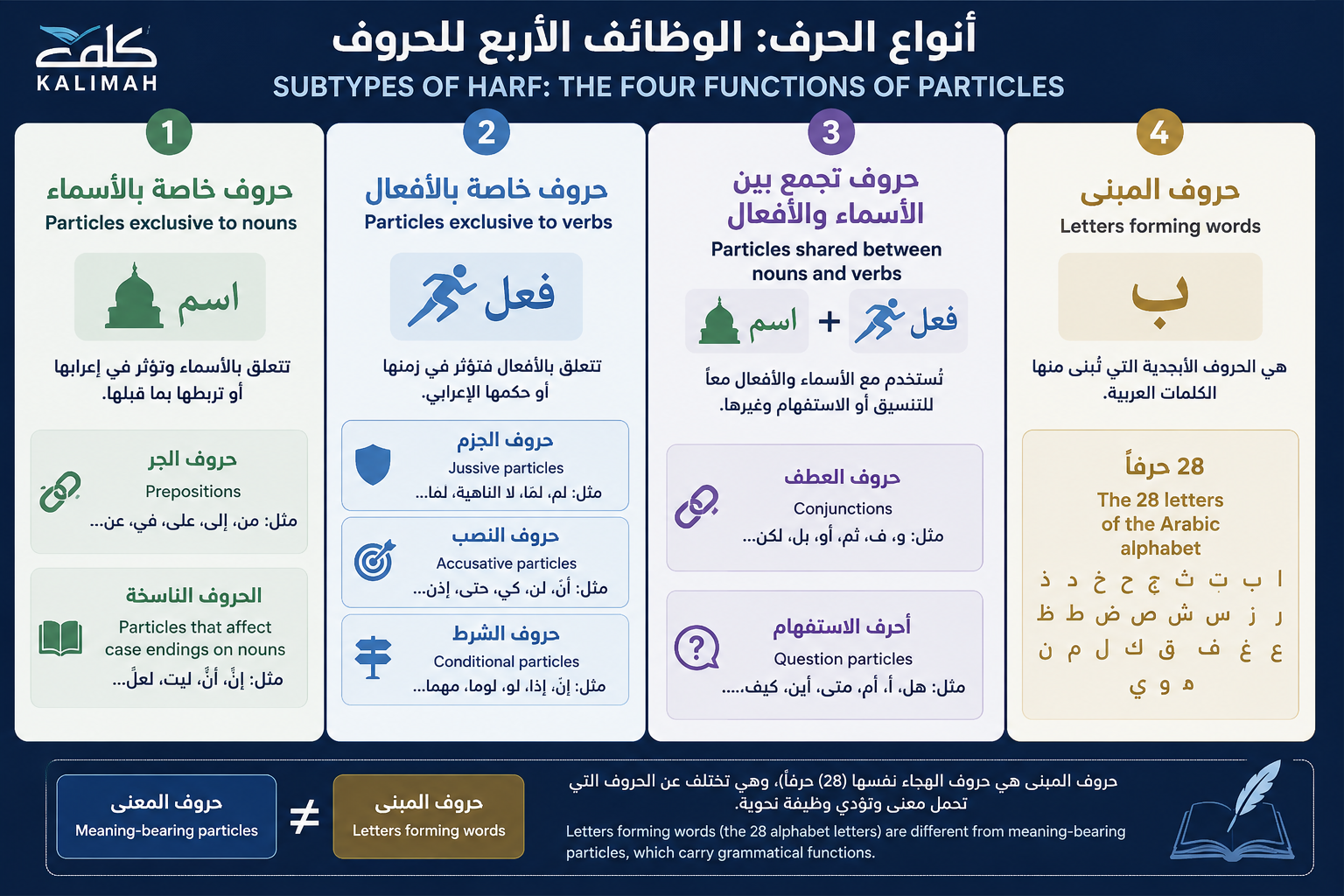
- حروف خاصة بالأسماء (Particles exclusive to nouns) — including حروف الجر (prepositions like من، إلى، على) and الحروف الناسخة (particles like إنّ that affect case endings on nouns).
- حروف خاصة بالأفعال (Particles exclusive to verbs) — including حروف الجزم، حروف النصب، and حروف الشرط (conditional particles).
- حروف تجمع بين الأسماء والأفعال (Particles shared between nouns and verbs) — including حروف العطف (conjunctions like و، فـ) and أحرف الاستفهام (question particles like هل، أ).
- حروف المبنى (Letters forming words) — the 28 individual Arabic alphabet letters themselves, distinct from حروف المعنى (meaning-bearing particles).
Recognizing which subtype a particle belongs to tells you immediately what kind of word it’s allowed to attach to — a preposition will never govern a verb, and a verb-exclusive particle like لم will never attach to a noun.
Parts of Speech in a Real Sentence: A Worked Example
Take the sentence أحب اللغة العربية (I love the Arabic language) and break down each word by category:
| Word | Part of Speech | Why |
| أحب | فعل (present, مضارع) | Begins with أ from the أنيت prefix group; accepts نصب/جزم particles |
| اللغة | اسم | Takes the definite article ال and would accept تنوين without it |
| العربية | اسم (صفة) | Adjective functioning as ism; agrees with اللغة in gender and definiteness |
Start by checking the first word: is it an ism (noun) or a fi‘l (verb)? That single decision tells you whether the sentence is a الجملة الاسمية (nominal sentence) or a الجملة الفعلية (verbal sentence).
What each sentence type requires
- Nominal sentence (الجملة الاسمية): begins with a subject (المبتدأ) followed by a predicate (الخبر). Both elements are typically marked with الرفع (nominative).
- Verbal sentence (الجملة الفعلية): begins with the verb, then the subject, and then the object if present.
Identifying the sentence type from the first word sets expectations for the sentence’s structure, so you rarely need to re‑read to find the subject or predicate.
This quick habit is one of the fastest ways to improve Arabic reading comprehension and reduce confusion when parsing new sentences.
Common Mistakes When Classifying Arabic Words
There are Three common mistakes come up repeatedly among learners working through this system for the first time:
- Assuming word length predicts category — short words are often mistaken for harf automatically, but هو (he, three letters) is ism and قال (he said, three letters) is fi’l; length tells you nothing, only the grammatical signs do
- Treating adjectives and pronouns as separate categories — carrying over the English 8-part habit leads learners to expect adjective-specific or pronoun-specific rules, when both simply follow ism rules for case, gender, and number agreement
- Classifying a word outside of context — a handful of Arabic words behave differently depending on their role in a specific sentence, so checking the grammatical signs in context is more reliable than memorizing a word’s category in isolation
Catching these three patterns early prevents a layer of confusion that tends to compound later, especially once sentences get longer and the case-ending system starts interacting with word order.
From Understanding Parts of Speech to Understanding Real Arabic
After learning how Arabic nouns, verbs, and particles work, many students realize that memorizing grammar rules alone is not enough.
Real progress happens when you start seeing these patterns inside authentic Arabic texts, conversations, and Quranic verses.
At Kalimah Center, students do not study grammar as isolated rules. Instead, they learn how to recognize grammatical patterns naturally through:
- Guided practice
- Reading exercises
- Personalized instruction that turns theory into practical language skills.
A Valuable Grammar Resource for Serious Learners
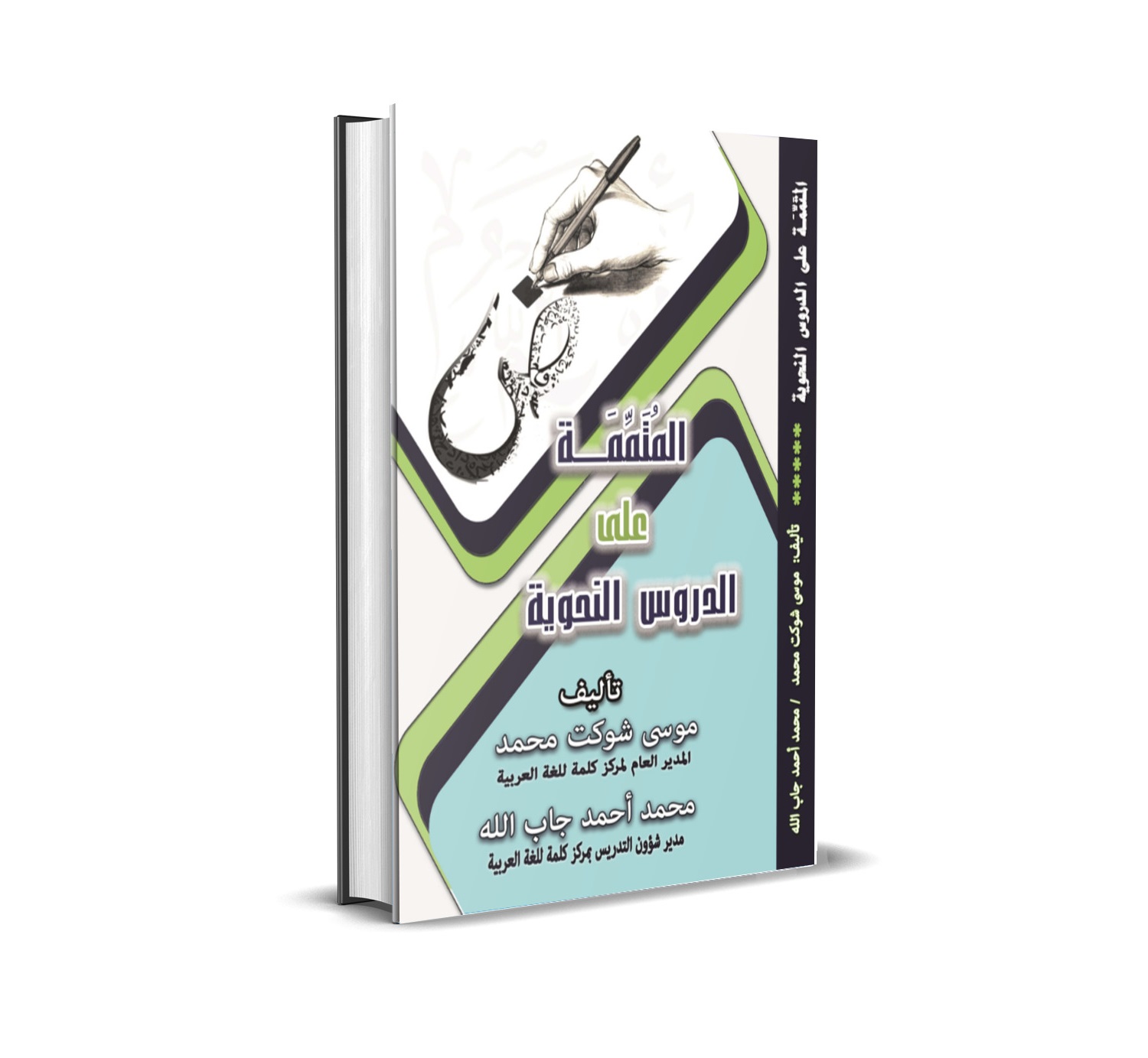
To make grammar study easier, many students use Al Mutammimah Grammar (PDF) – المتممة على الدروس النحوية as a companion resource alongside their lessons.
This book helps learners:
- Review core grammar concepts systematically.
- Strengthen sentence analysis skills.
- Understand relationships between different parts of speech.
- Build confidence when reading Arabic texts.
- Reinforce classroom learning through additional practice.
Why Students Choose Kalimah
Learning Arabic becomes much easier when you follow a structured path instead of collecting random lessons from different sources.
Students at Kalimah benefit from:
- One-to-one live instruction.
- Qualified and experienced teachers.
- Flexible scheduling.
- Interactive learning tools.
- Courses designed for adults, children, and Quran learners.
- Clear progression from beginner to advanced levels.
Whether your goal is learning Arabic, improving Quran recitation, or understanding Quranic texts more deeply, the learning journey is built around your level and pace.
How to Join Kalimah Group Program | Step by Step Guide #ArabicForBeginners #learnarabicfast
Find the Learning Path That Fits Your Goal
| Your Goal | Recommended Program |
| Build strong Arabic grammar and communication skills | Online Arabic Course |
| Improve Quran reading and Tajweed | Online Quran With Tajweed Course |
| Help a child learn Arabic confidently | Online Arabic Course For Kids |
Inside Kalimah Center: Moments from Our Courses
Get a glimpse into the vibrant learning experience at Kalimah Center. These snapshots capture real moments from our live classes—where students engage deeply, connect with passionate instructors, and grow in a welcoming, supportive environment.
Here Are The Reviews On Our Courses:
Our students frequently commend the excellence of our courses and the commitment shown by our instructors. You can read their complete reviews on Trustpilot.
Read more reviews on Trustpilot

Read also: Singular in Arabic – What It Means, How It Works, and Why It Matters
Start Building Real Arabic Confidence
Understanding Parts of Speech in Arabic is an important milestone, but fluency comes from consistent guidance and practical application.
Book your free trial lesson today, explore our courses, and discover how much faster Arabic becomes when you learn with a clear roadmap and expert support.

📚 Explore Our Courses:
Online Arabic Course: Tailored to your level, our comprehensive Arabic program includes 16 teaching levels and 400+ hours of personalized sessions.
Online Quran With Tajweed Course: Perfect for non-Arabic speakers, our course spans 13 levels and equips you with Tajweed mastery from beginner to advanced.
Online Arabic Course For Kids: Nurture your child’s love for Arabic with our engaging and structured program, available in 24 levels for primary, intermediate, and secondary stages.
🚀 Start Your Free Trial Today! 🚀
Don’t miss out on this life-changing opportunity to deepen your faith and knowledge. Sign up now for your free trial and take the first step towards becoming a better practicing Muslim with Kalimah Center!
Master Arabic with Kalimah Center
Join our expert-led online classes and start your journey toward Arabic fluency today.
Book Your Free TrialConclusion
Arabic organizes its entire vocabulary into three core categories — الاسم، الفعل، والحرف — a system that has remained the backbone of Nahw since the earliest grammarians and the only one that matches grammar references, Tafsir, and classical texts.
The 8-part framework some beginner resources use is a useful first bridge for English speakers, but it’s a simplification, not the traditional classification.
Once you can recognize ism, fi’l, and harf on sight using their grammatical signs, you gain something more valuable than a vocabulary list: the ability to predict sentence structure before you finish reading it.
Frequently Asked Questions
How many parts of speech are there in Arabic?
Classical Arabic grammar recognizes exactly three parts of speech: الاسم (noun), الفعل (verb), and الحرف (particle).
Some modern teaching materials present an adapted 8-part version based on English grammar, but this is a pedagogical simplification rather than the traditional classification.
What is the difference between ism and fi’l in Arabic?
Ism names a person, place, thing, or quality without reference to time, while fi’l expresses an action or state and is always tied to one of three tenses — past (الماضي), present (المضارع), or command (الأمر).
Are adjectives and pronouns their own part of speech in Arabic?
No — adjectives and pronouns are both classified as ism in Arabic grammar. They follow the same case-ending and agreement rules as nouns, even though English treats them as separate categories.
How do you know if a word is harf in Arabic?
A word is harf if it fails every test that identifies ism or fi’l — it never accepts تنوين, never takes the definite article أل, is never directly addressed with النداء, and never takes verb tense markers like تاء الفاعل or حروف المضارعة.
What are the four types of harf in Arabic?
The four functional types of harf are:
particles exclusive to nouns (like حروف الجر)
particles exclusive to verbs (like حروف الجزم)
particles shared between nouns and verbs (like حروف العطف), and the 28 alphabet letters themselves (حروف المبنى).
Why do some Arabic grammar resources teach 8 parts of speech instead of 3?
These resources adapt English grammar’s eight-category model as a beginner-friendly entry point.
It isn’t inaccurate as an introduction, but it doesn’t match the three-category system (ism, fi’l, harf) used in classical Nahw, grammar references, and Tafsir works